Q&A with Panpan Yang, author of "Animation Thinks"

Panpan Yang is Assistant Professor in the arts and visual cultures of modern China at the School of Oriental and African Studies (SOAS), University of London. An interdisciplinary scholar by training, Panpan works at the intersections of art history, media studies, East Asian studies, and digital humanities.
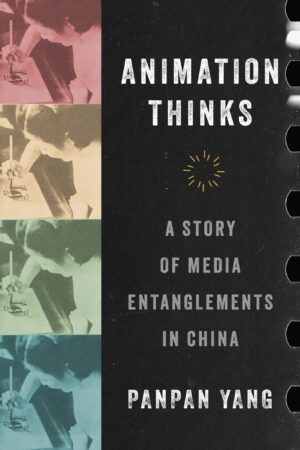
Her book, Animation Thinks, charts a fragmentary history of Chinese animation from the 1920s to the present. Focusing on animation's encounters with other art forms, including photography, painting, calligraphy, and porcelain, this book examines contemporary Chinese animation trans-spatially, tracing how the meaning of Chinese animated works subtly shifts when moving between spaces such as the film industry and the contemporary art world.
UC Press: Rather than offering a chronological history of Chinese animation, Animation Thinks: A Story of Media Entanglements in China unfolds through a series of case studies. What led you to structure the book in this way?
Panpan Yang: Animation Thinks asks what happens when animation falls in love with other art forms, including photography, painting, calligraphy, and porcelain. Each chapter focuses on one of these encounters. What led me to structure the book in this way was a desire to make sense of the relationships between different media. How can we study one medium through another? This is a method that I exercise in writing this book.
UC Press: What was something that surprised you as you were researching or writing this book?
Panpan Yang: One of the most delightful surprises that I harvested while writing this book was that the animation stand used in cel animation production lends itself to being a visual model of my historiography. I see the history of Chinese art and visual culture as a layered one—an animation stand of time and materiality. Here, layers of history from pre-modern, modern, and contemporary times can be sandwiched together. Unlikely connections between different art forms might be discovered anew. The spatial unfolding of historical and theoretical dynamics constantly surprises us.
This vision of history as layered is informed by the theories and methods of media archaeology, most pertinently by the work of Thomas Elsaesser and the work of Jussi Parikka. In writing Animation Thinks, I put different parts of the history of Chinese art and visual culture in space, as if they were movable, translucent celluloid sheets stacked together. This enables me to analyze their interconnections, to unveil history’s patterns and disruptions, and to read one layer of history through another. In doing so, I hope the history of Chinese animation can be reanimated.
UC Press: What was the process of book production like in your own experience?
Panpan Yang: Animation Thinks was offered a book contract by the University of California Press in June 2025 when, by coincidence, I was on a trip to present at a conference on book culture at the Chinese University of Hong Kong. The conference was co-organized by Yihui Sheng and Xiaoyu Xia. It brought together scholars from different continents to consider how a book might be studied beyond the textual information it provides, with particular attention to its typography, layout, and materiality.
The book production process of Animation Thinks took about one year. Over the course of the year, I have gained an embodied understanding of what it means for a book to take on its material form. I have learned that dealing with image and epigraph permissions can be a full-time job. I have also learned that a mysterious peer reviewer who decides to lift the veil of anonymity might become the writer of a blurb on the book’s back cover. And I have learned that, in the process of designing a book, the thickness of its spine is the very last piece of data to be determined.
I literally looked into the components of a book and found that, in English and Chinese alike, figurative, endearing, and at times anthropomorphic or zoomorphic vocabulary is used to describe a book’s material components. For instance, shuyi (書衣) literally means “the clothing of a book”; shuyao (書腰), “the belt of a book.” Most evocative is probably hudie ye (蝴蝶頁), literally “butterfly pages”: the two symmetrical, folded leaves, or wings, located between a book’s cover and its main body. It is a butterfly buried in the book.
UC Press: Having gone through the process of book writing and publication yourself, what advice do you have for other first-generation scholars who may still be starting out?
Panpan Yang: I am not sure whether I am in a good position to answer this question. In the post-pandemic world, amid the deepening crisis of the humanities, an academic monograph published by one of the world’s leading presses no longer guarantees tenure, promotion, or any other form of security. As the author of an academic book, you cannot count on royalties to do much of anything. For first-generation scholars, yes, it is a luxury to publish an academic tome, as the time that a 22.7 × 15.2 × 1.6 cm cuboid demands could be spent on many other things that help make ends meet.
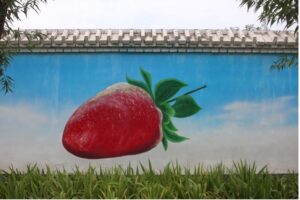
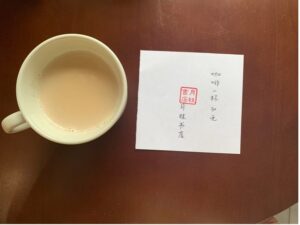
And yet, I have also realized, somewhat belatedly, that the journey of academic publishing is one toward a better self. I was a very introverted person; breaking the ice to talk to artists whose works I admire was not an easy thing for me. The ice melted in the process of researching and writing this book. For instance, I went to visit contemporary artist Geng Xue—whose Mr. Sea (2014) and other moving-image works I write about in the book—at her studio in Shangyuan Artist Village in the suburbs of Beijing. In this little village, I had many unexpected encounters: a massage clinic that has turned half of its space into a gallery; enormous strawberries painted across the walls of villagers’ homes; and a bookstore owner who wrote me a receipt for a cup of coffee by hand and stamped it with a small square seal. The process of researching and writing the book incubated friendships and shimmering moments of life. In completing the book, I transformed myself. Perhaps the subject of a book isn’t important, because the process of making a book is a door onto paths leading in every direction.
UC Press: There seems to be a creative project emerging from the academic book. Tell us about this.
Panpan Yang: Sure! In Animation Thinks, I cite and discuss Scott Bukatman’s brilliant essay “Some Observations Pertaining to Cartoon Physics; or, The Cartoon Cat in the Machine.” I have always been fascinated by those moments in cartoons when a character runs off a cliff and remains suspended in mid-air for a few seconds before falling. As Bukatman memorably puts it, in the cartoon world, “gravity is a sometimes thing.”
I have been collecting and assembling these delightful instances into a work of found-footage animation, and the work I am currently editing has been selected for the ongoing Xu Bing Space Art Residency Program. Once completed, the work is expected to be sent into outer space, where there is, in fact, no gravity at all. In that setting, the cartoon characters’ refusal to fall suddenly becomes perfectly reasonable.