How Mexican Women Artists are Imagining a Different Mexico
By Alberto McKelligan Hernández, author of I Want to Dance with You: Resistance, Community, and Solidarity in the Work of Contemporary Mexican Women Artists
In the summer of 2026 during the FIFA World Cup, a general mood of celebration seemed to take over the Mexican nation. Several international media outlets lavishly praised the country’s citizens, noting their warm, welcoming character as hosts, and these reports frequently noted the numerous cultural and artistic events the Mexican government had organized as part of the tournament. The mood was even more elated when Mexico’s national team, affectionately nicknamed El Tri, appeared to be doing exceptionally well in the tournament.
Even amid this positive news coverage, however, people could not entirely forget the difficult social crises that Mexico has faced over the last few years, especially the myriad forms of violence associated with the Mexican drug war. Since 2006, the Mexican government escalated its attempts to eradicate illegal drug trafficking by deploying the Mexican army throughout the country. Although state officials noted that this approach led to the arrest of individual cartel leaders, these “victories” often resulted in a power struggle and increased violence among crime syndicates. The state’s policies have thus led to a marked increase in deaths and disappearances in the country that remain unsolved through the country’s judicial system. In particular, the 2014 disappearances of 43 male students from the Ayotzinapa’s Rural Teacher’s College in Iguala has come to symbolize the extreme violence associated with the drug war. Not surprisingly, activists seized upon the increased attention from international observers during the world cup to organize numerous protests that highlighted the pressing need for justice in the country.
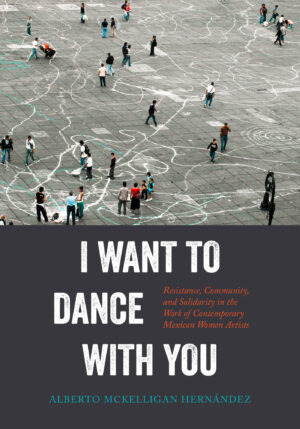
In my new book, I Want to Dance with You: Resistance, Community, and Solidarity in the Work of Contemporary Mexican Women Artists, I explore the ways in which visual artists have contributed to these activist efforts of resistance over the last few years. More specifically, I analyze how contemporary Mexican women artists have confronted immense social problems – the violence of the drug war, environmental devastation, growing class inequality – through projects that center perspectives often sidelined in Mexican society.
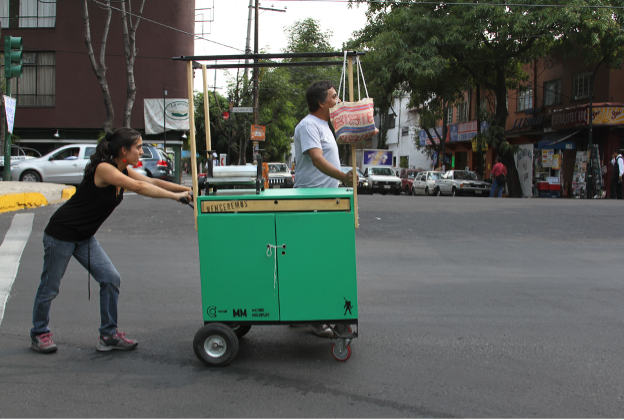
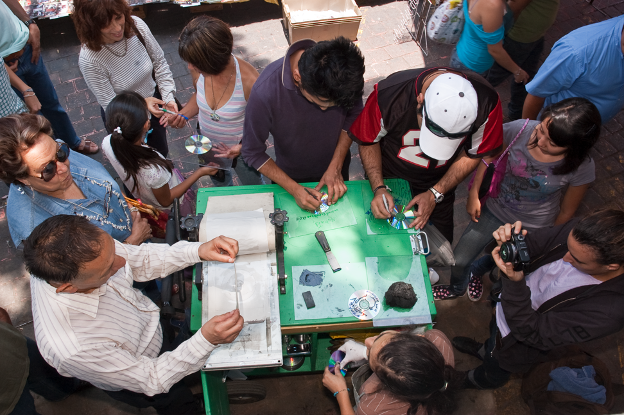
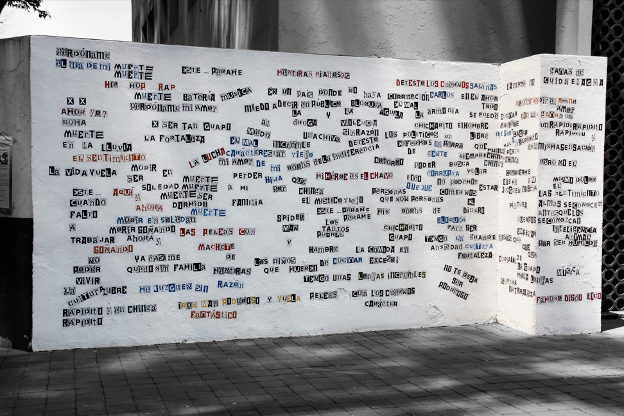
For example, I focus on projects such as Nuria Montiel’s Mobile Press (2010-2015). As part of this public art intervention, the artist pushed a small printing cart through the streets of Mexico City and other locales (fig. 1), inviting random passersby to create a print of their own design (fig. 2). The artist had originally intended for the project to capture the wide range of emotions and behaviors that characterize daily life in the city: “I wanted to make a map of the communities that live in Mexico City, who are in the street, playing in the street, falling in love in the street, selling and working in the street,” Montiel explained in conversation. “I wanted to create that cartography.” Most of the participants described the effects of the drug war and the extreme emotions it provoked through prints that included phrases such as “fights with machetes,” “the children who die,” and “afraid to speak in public” (fig. 3). While several of these phrases denounced the actions of the drug cartels, the participants also condemned the violence deployed by the state and its agents, including police officers and members of the military. Through her artwork, Montiel provided a space for individuals to express viewpoints that largely remain absent in prevailing discussions of the drug war.
In addition to Montiel, I conducted interviews with Gina Arizpe, Melissa García, Brenda Anayatzin Ortiz, and Laura Valencia. Together, these five artists exemplify the wide variety of artistic practices developed by contemporary Mexican women artists. While conducting these interviews, I was also drawn to the inspiring forms of resistance fostered by Mexican feminist activists and scholars. In particular, the ideas developed by members of the Red de Feminismos Descoloniales (Network of Descolonial Feminisms, RFD) helped me understand the larger significance of the projects developed by these artists. Members of the RFD aimed to develop a form of feminist thought that challenged the pervasive violence of gender inequality in Mexican everyday life, even as they also highlighted how this violence was related to other forms of oppression, including those rooted in colonialism. Using the RFD’s theoretical framework, I position the work of the five selected artists as important examples of active resistance, highlighting how they confronted the violent hierarchies of Mexican society. Echoing the RFD’s efforts, these artists created projects that foregrounded the experiences and knowledges of Mexico’s marginalized populations, including rural, indigenous, and working-class communities.
Throughout the book, I explore how the projects developed by Mexican women artists resist the simplistic rhetoric employed by the Mexican state to suggest that the violence of the drug war and other social problems can only be solved through punitive measures. In my analysis, I emphasize how these artists encouraged audiences to consider the effects of Mexico’s social inequalities, even as they visualized experiences that rarely receive attention in the Mexican national context. In short, my book explores how visual artists have contributed to ongoing forms of resistance and community formation. The artists included in this book point towards the possibility of creating a more egalitarian nation by building bonds throughout Mexico’s diverse communities.
About the Author

is Associate Professor of Art History at the Schnitzer School of Art + Art History + Design at Portland State University