Faith, Politics, and the Power of Images in Mexico
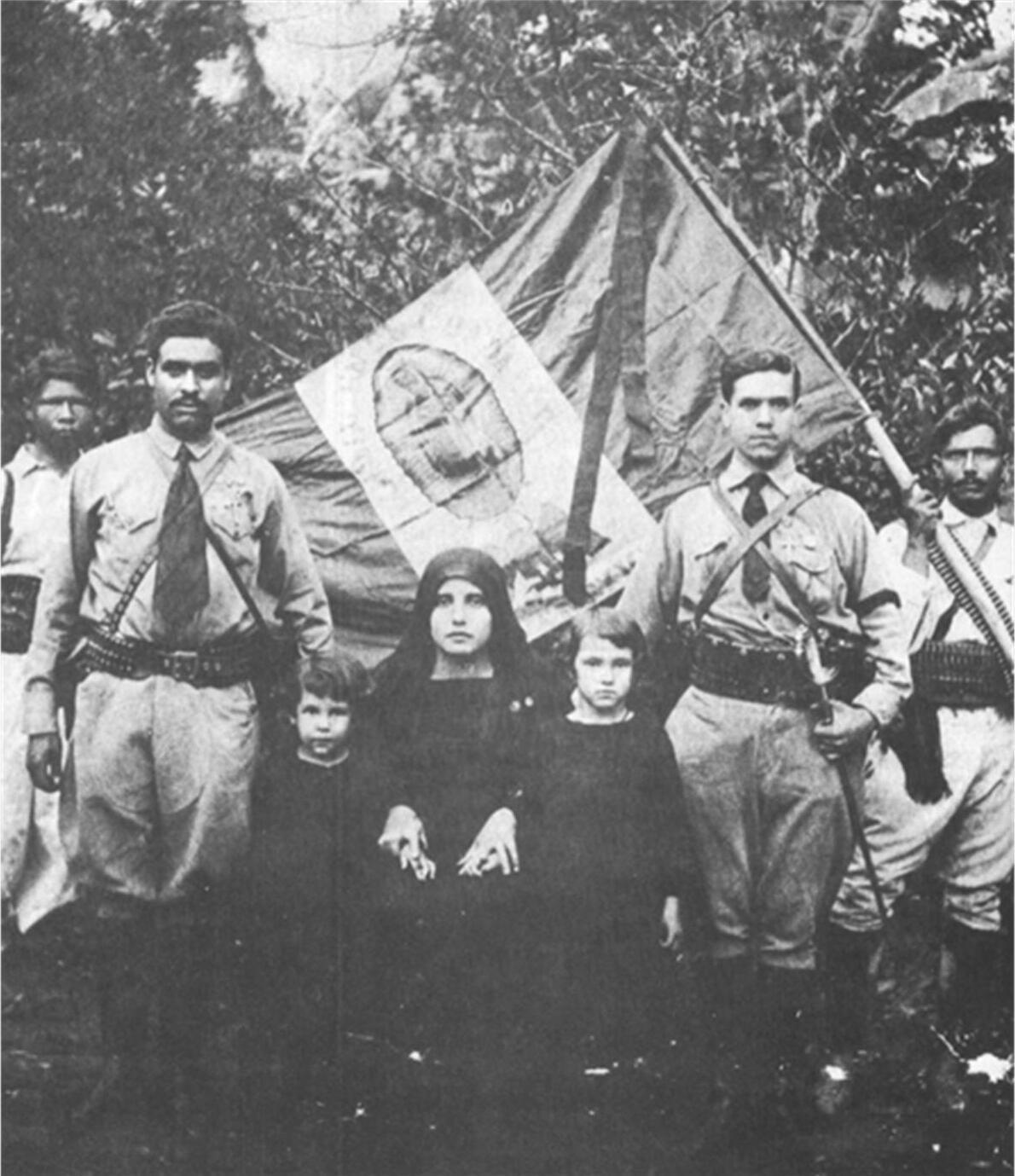
The Cristero War (1926–1929), an armed conflict between Mexico’s anticlerical government and Catholics resisting restrictions on the Church’s public role, continues to shape the country’s religious and political culture. In a new special issue “Catholic Visual Culture” of Mexican Studies/Estudios Mexicanos, Lucy O’Sullivan, Julia G. Young, and Gema Kloppe-Santamaría examine how the war and its legacies have been represented, remembered, and mobilized over the past century through photographs, prints, devotional objects, memorial images, and digital media. From the experimental photography of Manuel Ramos and the carefully curated images of Sinarquista women to Cristero imagery circulating through Mexico’s contemporary Christian right, these visual materials reveal the complex intersections of Catholic politics, gender, memory, technology, and religious identity. In the following Q&A, the guest editors discuss the making and significance of this special issue.
What drew you to making a study of the visual culture, specifically, of Catholic Mexico and the Cristero War?
Lucy O’Sullivan (LOS): I think in the process of conducting archival research over the years we have all encountered a wealth of visual materials pertaining to the Cristero war and subsequent Catholic movements, some of which has been reproduced in previous studies for illustrative purposes but never analyzed in depth. A central aim of the issue has been to bring together and examine some of these understudied sources in order to construct a more complete picture of Catholic political activism over the last hundred years. The centenary has undoubtedly stimulated the increased circulation of Cristero images in online spaces, so it feels like the ideal moment to delve into and critically examine this visual archive.
Julia G. Young (JY): I have long been fascinated by Mexican Catholic visual art, ever since my first visit to the country as a teenager in 1998. Then, I was stunned by how different Mexico’s Catholic Churches looked in comparison to the ones I had seen growing up in the mid-Atlantic United States—and curious about how Mexican Catholic visual culture had developed. It was also on that trip when I first encountered retablos—devotional folk paintings that depict images of everyday miracles, typically with a textual explanation underneath the image. I also saw altars with milagros, or charms, meant to represent body parts or people healed through prayer. Ever since then, I’ve paid attention to the many ways that religious devotion has manifested itself through visual culture in Mexico. As I began researching Mexico’s Cristero War and religious conflict in Mexico more broadly, I continuously encountered photographs, paintings, and even illustrated objects (such as a scapular that fell out of an archival folder I was investigating) that reminded me how important it is to incorporate visual culture in discussions of Catholicism in Mexico.
Gema Kloppe-Santamaría (GKS): While researching and writing my book, In the Vortex of Violence, I came across multiple visual representations—in film, lithographs, and murals—of Catholics and Cristeros as so-called religious fanatics that were prone to riots, lynchings, and violence more broadly and that were uncapable (or unwilling) to engage in civil forms of doing politics. Many of these visual cultural artifacts implicitly appropriated religious imagery, including references to socialist teachers as martyrs that had sacrificed their lives and needed to be collectively mourned and remembered. As I started working more actively on religious violence and contentious politics in modern and contemporary Mexico, I realized I had not really examined the visual culture produced by Catholics themselves and that most of the historiography I was in dialogue with paid greater attention to the visual representations (or misrepresentations) produced by revolutionary and secular actors than to Catholic visual art. Cristero imagery, in particular, has proven particularly fruitful for generations of Catholics that believed and that continue to believe the Cristero War constitutes an unresolved conflict between state and church and that Catholics’ religious freedom ought to be defended against what they perceive as a series of secular, socialist, and tyrannical governments during and after the post-revolutionary period.
Revolutionaries in Mexico used to pillory Catholics as “reactionaries.” Did it surprise you that some Catholic visual pieces, for instance the photography of Manuel Ramos that Lucy O’Sullivan writes about, were pretty avant garde for their time?
LOS: Yes, we might assume that Catholic visual culture in this period was conservative or backward-looking, and Ramos's experimentalism complicates that assumption. But in reality, the opposition between “revolutionary” and “reactionary” positions is not so clearly reflected in artistic practices of this period. For example, the early works of the muralists drew heavily from religious iconography and continued to rely on such themes, even as they individually forged more coherent artistic and ideological visions over the subsequent decades and produced explicitly anti-Catholic artworks. In my first book I wrote about how Diego Rivera and other government-commissioned artists presented the rural teacher as a Christ-like figure redeeming the rural masses from the late 1920s onwards. So, many artists affiliated to a greater or lesser degree with the post-revolutionary government drew from religious metaphors and visual repertoires to articulate what we would describe as revolutionary themes in their work.
On the other hand, in Ramos, we have a highly innovative counter-revolutionary image-maker who was a master in particular of photomontage, a practice long associated with left-wing activism both in and beyond Mexico at this time. Ramos’s multi-media techniques and cinematic compositions visualize the Virgin in ever more spectacular ways to produce responses of awe and wonder in the viewer. For me, these efforts to stretch the photographic medium to its expressive limits reflect Ramos’s deep devotion to the Guadalupana, but also his desire to affirm the durability and vibrance of her visual cult at a time of anticlerical hostility and attacks against her image.
JY: My article discusses illustrations as well as photographs, most produced in the 1940s. What surprised me about these drawings and prints were how similar they are stylistically to left-wing art of the time, both in Mexico and globally. What that tells me is that Mexican Catholic activists who hold opposing political positions to the Mexican Left were still deploying the same visual style—using the same visual vocabulary—as the people they regarded as their opponents. In particular, prints and drawings of men emphasize their physical strength by depicting them shirtless, with rippling muscles, in a way that reminds me a lot of the art of the New Deal or even Soviet Realism. In looking at this art, one can see that these Catholic activists—who in many ways were committed to resisting the ideology of the global Left—were carving out a space for themselves within the parameters of the visual culture of the moment, rather than attempting to create or work within a more traditional style.
GKS: The propensity to understand Catholic visual culture and even cultural politics more broadly as reactionary and conservative was indeed common among Mexican revolutionaries and persists amongst certain sectors in Mexico and beyond up until today. And yet, as my colleagues have mentioned and as I have explored in my work on visual representations of lynching, revolutionary artists were clearly using religious imagery to denounce the violence perpetrated by Catholics as well as to visually produce the notion that the violence committed by the revolutionary state was always civilizing, rational, and conducive to peacebuilding. Moreover, as Lucy’s article shows, Catholics were creating cutting-edge and experimental art to denounce the iconoclastic violence generated by the state’s secularizing and anti-clerical policies. In the case of the Cristero imagery used, reimagined, and AI-generated by the new Christian right in Mexico I think we can see yet another example of how Catholics—in this case linked to far-right and conservative ideas—do not shy away from experimenting with the newest technologies and forms of communication. Moreover, like the Sinarquistas that Julia analyzes, these new Christian right leaders and their followers reproduce images of muscular warriors and courageous crusaders that circulate in global networks and that reproduce an ideal of hegemonic masculinity linked to virility, heroism, and the willingness to use violence.
Julia Young’s piece shows how Sinarquista women were in fact photographed often—but then curated out of the visual record of their movement by Sinarquista leaders. What was the most poignant or revealing photo you found that had been left out? How would you have liked to photograph Sinarquista women differently?
JY: I’ve found myself thinking a lot about photos of female Sinarquista speakers, in particular one (Figure 3 in my article) of an unidentified young woman standing on a platform or stage, who is smiling while speaking. Standing below her are a number of men, who all look up at her admiringly. Who was she, and what was she talking about? She looks so confident and calm on stage—comfortable in a position of leadership, even. But that is my interpretation of what I am seeing; I cannot know what she was talking about! So, I suppose what I really wish I could do is go back in time and record audio and video of the Sinarquista women whose photos fascinate me so much.
I was also fascinated by numerous images of women in traditional indigenous dress, such as those shown in Figure 6 of my article. Typically, the captions don’t reveal much about the indigenous group to which they belong (or even if they considered themselves to be part of one). Did they speak another language other than Spanish? Did they have particular religious practices or traditions? As Ricardo Álvarez-Pimentel shows in his article, indigenous people were often portrayed through the lens of hispanism or anti-indigeneity in Catholic publications; in Sinarquista photographs, they appear more as neutral subjects, but not much is said about the specific groups of people being portrayed. I would be so interested to know more about why these women joined the Sinarquista movement—and what in particular about the Sinarquista message resonated with them.
Gema Kloppe-Santamaría’s piece shows us that today’s Cristeros are keyboard warriors of the New Right. Why is the Cristero War so suggestive to those pursuing twenty-first century culture wars? Does the Church now have to do battle with the Christian Right in order to assert control over the narrative of the Cristero War?
GKS: The Cristero War is without a doubt the most potent source of inspiration and mobilization for the new Christian right in Mexico. The reasons for this are manifold. This conflict was the most important challenge to the legitimacy and stability of Mexico’s post-revolutionary state. Its reverberations continued to be felt not only during the 1930s with the Second Cristiada (c 1934-1938) but also in the following decades amongst generations of Catholics that felt that the state was either uncapable or unwilling to guarantee their religious freedom and to uphold the set of values and practices they believed defined Mexico as a nation. Moreover, the history of the Cristiada involves the actions of thousands of Catholic militants that fought not only against the Mexican secular state but also against what the Cristeros perceived as the indifference, cowardice or complicity of other Catholics, including ecclesiastical authorities. In this sense, the Cristiada is a story that resonates with the sort of counter-hegemonic or fringe politics these groups try to promote. According to their narrative, they, like the Cristeros, are not only fighting against socialist and secular forces but also against other Catholic and right-wing groups that are too weak, too complicit, or too corrupt to fight for religious freedom. Lastly, the Cristeros embodied a form of doing politics that involved the willingness not only to die but also to kill in the name of Christ. Although leaders of the new Christian right in Mexico discursively oppose the use of violence, I argue that the use of Cristero and Christian imagery more broadly, including images of martyrs, warriors, and crusaders, allows these groups to articulate a belligerent message that does call for the use of violent means if necessary.
This year is the centenary of the Cristero War, so it’s fitting that your special issue takes snapshots over a whole century of Catholic visual culture. How much did the centenary inform the thinking behind this special issue?
LOS, JY, GKS: The centenary provided a valuable chronological framework for the issue, encouraging us to look beyond the years of the Cristero war itself and consider how Catholic visual culture has been utilized and for what purposes over a hundred year period. This more ambitious temporal scope has enriched the collaborative research, enabling us to identify contrasts and continuities between bodies of imagery produced in distinct historical contexts, from the Sinarquista movement in the late 1930s and the Cold War era “Cristianismo Sí” campaign through to the online imagery of the new Christian right. Looking at the whole century also allowed us to see how certain aspects of Catholic visual culture—such as the images of Miguel Pro and other Cristero martyrs—changed and were redeployed over the course of decades and into the modern period. Finally, the centenary of the war also gave us a firm writing deadline!
How do you think visual representations of Mexican Catholicism might develop in future?
LOS: The issue as a whole highlights the plasticity of Mexican Catholic visual culture which has been utilized by political actors for different purposes across a range of historical contexts. A great example of this which we discuss in the introduction is the Virgen de Guadalupe which has served as an emblem for various political movements in Mexico from the 1800s to the present and was even embraced as an emblem of Chicana feminist empowerment from the 1970s onwards.
Another important factor in shaping visual representations of Mexican Catholicism is our rapidly evolving online environment. Gema’s piece specifically highlights how Cristero memory has been appropriated and manipulated in Mexico’s New Christian right in social media content that includes AI-generated imagery. Given its increasing use in the production and dissemination of religious imagery online, it seems inevitable that AI and ever more sophisticated forms of artificial image production will continue to shape Catholic visual culture in Mexico in the coming years.
If you could each find a dream image of twentieth-century Mexican Catholicism in the archives, what would it show?
LOS: For me, it wouldn't be an image itself so much as any source—visual or textual—providing further insight into the identities and/or intentions of any of the image makers whose work is analyzed in the special issue. In the majority of these articles, the maker behind the photograph, illustration, cartoon or mural is anonymous, as is often the case with less studied or previously overlooked archival images. An exception to this is Manuel Ramos, about whom we have a good deal of contextual information as a prominent photojournalist. Yet despite his archive containing hundreds of photographs, I have yet to encounter any personal reflections on his artistic vision or process. That kind of material that would really deepen our understanding of his work.
JY: As I said earlier, I’d want documentary-style video! Or better yet, I’d want to be a time-traveler and go back and actually see and interview the people that appear in the photographs I studied. Barring that possibility, however, I’m really happy to combine textual archival research with analysis of images. I think it allows scholars to add a new layer of insight to historical analysis—especially when the images are not just used as illustrations, but are considered as objects of study in their own right. I think the articles in this Special Issue are a fantastic demonstration of that.
GKS: As a scholar of violence, I am always interested in tracing the ways in which violent acts are construed as legitimate, acceptable, or inevitable in the eyes of perpetrators and society at large. What forms of violence we see and what forms of violence we do not see is a product of political ideologies, power dynamics and social inequalities, but it is also a result of the circulation of cultural artifacts, including visual materials, that make some forms of violence more tolerable than others. Postrevolutionary artists construed the violence perpetrated by Catholics as religious, fanatic, and irrational. Catholic artists, on their part, were able to denounce the violence of the post-revolutionary state and portray it as tyrannical, abusive, and contrary to religious freedom. Perhaps more than a dream image, what I would like to find or rather to develop is a greater attentiveness to the contradictions and silences that we find in the archives regarding violence. I think we do not know enough yet about Mexican Catholics’ visual culture and its relation to violence and contentious politics. I do think, however, that this Special Issue can offer a fresh starting point to embark into newer and more ambitious explorations.

We invite you to read the special issue, "Catholic Visual Culture" for free online for a limited time.
Print copies of the special issue (issue 42.2), as well as other individual issues of MS/EM, can be purchased on the journal’s site.
For ongoing access to Mexican Studies/Estudios Mexicanos, please ask your librarian to subscribe and/or purchase an individual subscription.
About the Authors

Lucy O’Sullivan is Associate Professor in Modern Languages at the University of Birmingham where she specialises in Mexican visual and literary culture. Her first book Diego Rivera and Juan Rulfo: Post-revolutionary Body Politics (1922-1965) traced evolving intellectual and artistic interpretations of post-revolutionary nationhood by comparatively analyzing representations of the body in the literary and visual works of two of the most significant figures in Mexico’s twentieth-century cultural landscape: the muralist Diego Rivera (1886-1957) and the writer Juan Rulfo (1917-1986). Her current book project explores the role of images and image-makers in Mexico’s religious struggles of the early post-revolutionary period. She holds a PhD in Medieval and Modern Languages from the University of Oxford, a Masters from University College London and a BA from Trinity College Dublin.

Gema Kloppe-Santamaría is a sociologist and historian specializing in questions of violence, gender, religion, and politics in Latin America, with a particular focus on Mexico, Central America, and US-Latin American relations. Kloppe-Santamaría is the author of the book In the Vortex of Violence: Lynching, Extralegal Justice, and the State in Post-Revolutionary Mexico (published by University of California Press in 2020; translated to Spanish and published in Mexico in 2023). She is also the main editor of the books Violence and Crime in Latin America: Representations and Politics (University of Oklahoma Press, 2017) and Human Security and Chronic Violence in Mexico: New Perspectives and Proposals from Below (Editorial Porrúa, 2019). Dr. Kloppe-Santamaría holds a PhD in Sociology and Historical Studies from the New School for Social Research and a Masters in Gender and Social Policy from the London School of Economics. She completed her BA in International Relations at the Instituto Tecnológico Autónomo de México (ITAM). Her work has received several accolades, including a British Academy Visiting Fellowship (2025), a Marie Curie Fellowship of the European Union (2021-2022), a Mellon Emerging Faculty Leaders Award (2020-2021), and a Harry Frank Guggenheim Foundation Distinguished Scholar Award (2020). She has published in top academic journals in her field, including The Americas, the Latin American Research Review, Journal of Latin American Studies, and the Journal of Social History. She is a Lecturer of Sociology at the University College Cork, an Associate Research Professor at the George Washington University and a Member of the Center for the Study of Security, Intelligence and Governance (CESIG) at ITAM. She is currently working on a project on the contentious relation between religion and violence in Mexico (c. 1930-2020) and she is writing a book on the history of violence in Mexico and Central America from a comparative, transnational and historical perspective.

Julia Young is a historian of migration, Mexico and Latin America, and Catholicism at The Catholic University of America in Washington, D.C, and the founding Chair of the University’s Department of Global Studies. She is the author of Mexican Exodus: Emigrants, Exiles, and Refugees of the Cristero War (2015), and co-editor of Local Church, Global Church: Catholic Activism in Latin America from Rerum Novarum to Vatican II (The Catholic University of America Press, 2015). She has published scholarly articles in The Americas, The Catholic Historical Review, Mexican Studies/Estudios Mexicanos, and The Journal on Migration and Human Security. In 2020-2021, Dr. Young was a fellow with the Luce/ACLS Program in Religion, Journalism & International Affairs. She is currently writing a new book about Mexico’s Unión Nacional Sinarquista, and frequently writes for the media about immigration, border issues, and Catholic immigration history. She received her PhD from the University of Chicago in 2009.