How Queer Resistance is Connected to Economic Reform and Social Change in China
By Susanne YP Choi, author of Queer Resistance: Contesting State, Family and Inequality in Post-Socialist China
China provides few of the legal protections for LGBTQ+ people that have been established in many Western societies. It has not legislated against discrimination based on sexual orientation and gender identity, and equal marital and parental rights have not been granted to non-heterosexual people. Less widely recognized, however, is that despite the lack of legal protection and equal rights, and in spite of intensified state crackdowns on LGBTQ+ civic organizations and online activism since 2016, LGBTQ+ communities and queer lives in China have undergone major changes. Compared with the 1980s and earlier decades, LGBTQ+ people have gained visibility and considerable autonomy, at least in their private lives. Instead of passing as heterosexual and entering heterosexual marriages, many younger LGBTQ+ people in China today assert their sexual orientation and pursue same-sex intimacy. How have these changes come about amid a constraining political environment? And have these changes been experienced equally by LGBTQ+ people across gender, cohort, social class, and region?
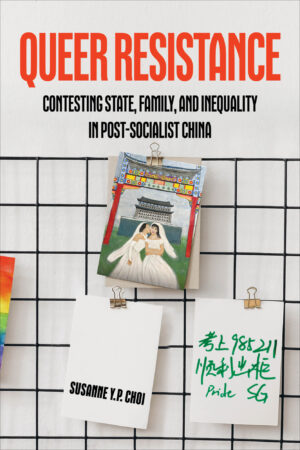
My book, Queer Resistance: Contesting State, Family, and Inequality in Post-Socialist China, addresses these two key questions. The concept of resistance emerges from my analysis of the life stories of nearly 200 LGBTQ+ people of different genders and educational backgrounds, born from the 1970s to the 2000s and coming from both rural and urban regions. Their life stories show how changes in queer lives are partly the result of economic reforms since the late 1970s, China’s insertion into global and regional capitalism, and the subsequent transformation of private lives and weakening of the institutions of heterosexuality. At the same time, these changes are also the result of queer collective efforts and resistance, including community building and rights advocacy, as well as everyday resistance. LGBTQ+ people resist marriage pressure from their families of origin, assert their sexual autonomy and pursue same-sex intimacy, and construct alternative familial arrangements outside conventional heterosexual marriage. Resistance, in this sense, is not confined to organized activism or explicit confrontation with the state. It is also embedded in the everyday negotiation of intimate and family life.
Resistance also serves as a lens through which to understand changes in political, societal, and familial power, as well as the changing relationships among the three. What emerges is a changing configuration of power governing intimate lives. The Chinese state selectively cracks down on LGBTQ+ organizations and collective rights claims while largely turning a blind eye to depoliticized and commodified online LGBTQ+ spaces. Despite intensified crackdowns and online censorship of LGBTQ+ organizations and activism, the Chinese government has also introduced measures that enhance certain individual rights, such as lowering the threshold for transgender people to change their gender on legal documents.
Chinese society has also changed in contradictory ways. Despite continuing moral condemnation of homosexuality, attitudes toward homosexuality have gradually become differentiated from attitudes toward citizenship rights, contributing to growing support for granting LGBTQ+ people equal political and employment rights and access to welfare. The Chinese family, too, is far from simply controlling. Although families continue to exert strong pressure on LGBTQ+ people to marry and fulfill familial obligations, changes in parental attitudes toward their adult children’s homosexuality can also be observed. Some parents “come in” to accept their children’s nonnormative sexuality, while others “come out” to defend their children’s right not to be discriminated against. Parental resources can be instrumental in facilitating queer transnational migration in search of greater sexual autonomy and a future outside heterosexual marriage. Parents are also often collaborators in what I call “nominal marriage,” the practice in which gay men and lesbians marry each other to give society the impression of heterosexuality. Queer Resistance thus occurs at a historical juncture when the state-society-family alliance that once jointly enforced heterosexuality has weakened, with the state, society, and family increasingly moving in different and sometimes contradictory directions.
At the same time, queer collective and everyday resistance has encountered new challenges. In addition to intensified state crackdowns on LGBTQ+ organizations and increased online censorship, LGBTQ+ communities are increasingly divided by growing income and wealth inequalities. New hierarchies of desirability valorize those who have the means to consume, lead an urban middle-class lifestyle, and conform to mainstream gender expectations. Societal and parental acceptance can also be transactional and conditional upon adult children being youxiu (outstanding), as manifested in educational attainment, career success, and the capacity to bring honor to the family. While LGBTQ+ people have increasingly asserted the legitimacy of pursuing same-sex intimacy, their capacity to forge and sustain such relationships remains closely related to social class, leaving some of those without financial resources and social status feeling excluded and marginalized. And while some LGBTQ+ people challenge heteronormative scripts in their everyday practices of intimacy, others continue to reproduce heterosexual norms, including gendered patterns of class and age hypergamy in their intimate relationships. Queer everyday resistance is therefore uneven and partial.
Queer Resistance is a book about how social change occurs under conditions of political constraint. The experiences of LGBTQ+ people in China show that intensified state repression can coexist with expanding autonomy in private life. Families can simultaneously constrain queer lives and provide the resources that make nonnormative lives possible. Greater societal acceptance can coexist with persistent stigma and generate new forms of inequality. Seen through the lens of queer resistance, social change is neither linear nor uniform. It emerges through changing relationships among state power, social norms, family obligations, market forces, and individual and collective action. The experiences of LGBTQ+ people in post-socialist China therefore offer a window onto something larger: the contradictory and uneven transformations of contemporary Chinese society, and the multiple ways in which people negotiate, accommodate, and resist power in their everyday lives.
About the Author
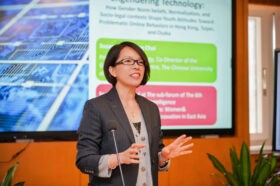
Susanne Y.P. Choi is Professor of Sociology at the Chinese University of Hong Kong. She is also lead author of Masculine Compromise: Migration, Family, and Gender in China.