Q&A with Jallicia Jolly, author of "Ill Erotics"

Jallicia Jolly is Assistant Professor of Black Studies and American Studies at Amherst College and founder and director of the Black Feminist Reproductive Justice, Equity and HIV/AIDS Activism Collective.
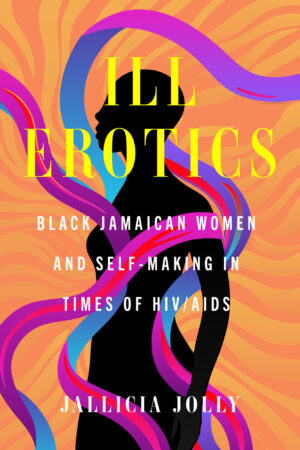
Her new book, Ill Erotics: Black Jamaican Women and Self-Making in Times of HIV/AIDS, is the first book-length ethnographic study of Black girls and women living with HIV in the Anglophone Caribbean. Jolly traces how they navigate stigma and institutional barriers while building networks of care, exercising sexual agency, and organizing for reproductive justice.
Here, Jolly discusses the women whose stories shaped the book, the everyday practices of care that sustain life, and what their experiences reveal about HIV/AIDS, reproductive justice, and Black feminist activism.
What motivated this project? How did this book come to be?
Ill Erotics began long before I had language for it as a book. I grew up in Brooklyn at a time when HIV/AIDS was part of the landscape of Black life, but the stories circulating about the epidemic rarely reflected the complexity of the people and communities I knew. I first became interested in HIV/AIDS organizing as a teenager working as a peer educator at Project Reach Youth, an HIV education and arts-activist organization in Park Slope. In the media, I encountered narratives that portrayed Black communities as sites of disease and young Black women, in particular, as sexually irresponsible, dangerous, or “carriers” of infection. At the same time, I witnessed communities and community-based organizations building their own ways of educating, caring for, and protecting one another. Those contradictions stayed with me.
Years later, those contradictions brought me to Jamaica, where I began ethnographic research during my 2015 Fulbright fellowship in Kingston. Over nearly a decade of research, I came to understand that the women at the center of Ill Erotics were not simply living through HIV/AIDS. They were interpreting it, organizing around it, caring for one another through it, and creating forms of knowledge and infrastructure that institutions often failed to provide. I wanted to understand HIV not simply as a biomedical condition but as something that pulsated in the vibrant and complex lives of everyday people. I became interested in what dominant narratives left out in their emphasis on isolable risk groups and compartmentalized identities. They often left out women’s families, desires, politics, creativity, relationships, motherhood, pleasure, structural inequality, and the everyday practices through which people make lives and love under difficult conditions.
Jamaica also allowed me to think transnationally and to challenge a history of HIV/AIDS that too often centers the United States while treating the Caribbean as peripheral. The Black Caribbean is a critical intellectual site that expands the geographic and thematic scope of theories of Black agency, politics, humanity, and freedom. The island is not separate from the histories of the United States, global health institutions, international funding structures, migration, or Caribbean diasporas. Its intellectual significance certainly is not as “America’s backyard” despite constant iconography of a tropical paradise tourist attraction. Ideas, policies, people, and resources move across these borders. Studying Jamaica therefore became a way of expanding American Studies and Black feminist scholarship across the Americas while asking what becomes visible when we take Caribbean knowledge and experience seriously as central to the history of HIV/AIDS.
The book continued to become more personal over nearly a decade of research. The women I met were not simply research participants. They were interlocutors, peer educators, mothers, lovers, organizers, mentors, friends, and architects of communities of survival. Some of the women whose lives and organizing helped me understand this story are no longer here. Some died before their thirty-third birthday, an age that I have now reached myself. That knowledge changed what it meant for me to write this book.
Ill Erotics is scholarship, but it is also an act of remembrance. It asks us to remember Black women living with HIV not as the “poster children” of an epidemic, but as thinkers and political actors who created ways of living, loving, organizing, and caring for one another in conditions never designed for their flourishing.
You coined the concept of “ill erotics.” What does this term mean, and how does it help us understand the ways Black Jamaican women living with HIV reclaim experiences associated with shame, contagion, and isolation?
I coined the term “ill erotics” because we need new language to describe what it means for Black women to live, love, and organize in the fourth decade of the global HIV/AIDS pandemic.
The term emerged from my conversations with women themselves. I initially did not have a framework that brought “illness” and “erotics” together. But the more I listened to women talk about HIV alongside intimacy, sexuality, motherhood, friendship, leadership, and organizing, the more I realized that these dimensions of life could not be separated.
“Ill erotics” is a framework that captures how Black Jamaican women negotiate erotic autonomy and pathologizing discourses of HIV containment, seemingly contradictory impulses. This concept describes how women navigate their embodied realities of marginalization and their personal and political investments in bodily autonomy through grassroots politics, such as maternal mentorship networks, peer support groups, and political organizing. Two contradictions remain salient:
First, Black women living with HIV are often told that illness reduces their humanity, diminishes their sexuality, and that an HIV diagnosis should produce shame, isolation, restraint, or the end of erotic life. Yet the women I came to know refused that script. They desired pleasure. They pursued relationships. They had sex. They became mothers. They cared for children and partners. They created friendships and networks of mutual support. They disclosed and withheld their status strategically. They organized politically. They enacted life-affirming care.
Second, when Black women are simultaneously framed as sources of transmission and innovative community leaders who will end the pandemic as we know it, I get curious. I set out to ask: Who profits from the dichotomous and dehumanizing portrayals of Black women as an infectious source or savior? What do Black women create when the institutions charged with caring for them fail to do so? Too often, public health narratives position Black women living with HIV as either victims or vectors—as people defined by risk, pathology, or responsibility to protect others. I use ill erotics to describe how Black Jamaican women living with HIV repurpose conditions of illness, stigma, surveillance, and structural abandonment into possibilities for care, pleasure, political mobilization, and self-making. Through their strategic embodied and grassroots practices, ill erotics asks what becomes visible when we recognize these women as desiring, thinking, political actors who are actively making lives and relationships.
Ill erotics names intersecting forces, managed to repurpose discourses of shame and disease into calls for interdependence, community building, and agency.
You challenge narratives that biomedical progress has brought about an “end of AIDS.” What do the everyday experiences of the women in your book reveal about the limits of that story?
It is a known fact that biomedical progress has transformed HIV. Scientific advances such as antiretroviral treatment, PrEP, PEP, testing, and prevention of vertical transmission of HIV to newborns have saved millions of lives. But a scientific breakthrough is not the same thing as equitable access to that breakthrough. It does not guarantee quality access to dignified care. The biomedical story can tell us what a medication does; it cannot, by itself, tell us what it means to live and thrive with HIV in a particular social and cultural world.
That distinction is fundamental to Ill Erotics. The women in the book show us that HIV is never simply about whether medicine exists. An HIV diagnosis is about whether someone can reach a clinic, afford transportation, find childcare, eat enough to take medication, navigate medical institutions without humiliation, and disclose her status without losing housing, or a relationship, or her own life. Ill Erotics is about whether a person living with HIV can imagine a future for herself after diagnosis.
That is why I resist narratives of an “end of AIDS.” Women’s experiences complicate the idea that AIDS is simply “over.” For many Black women, the epidemic did not simply end; it became less visible and with more persistent inequalities in who becomes sick, who receives care, whose knowledge counts, and whose suffering attracts sustained political attention. We celebrate decades of biomedical progress while many of the community organizations that make that progress accessible are fighting for basic resources to exist.
It’s for these reasons that it is particularly dangerous when top governmental health officials promote discredited ideas that HIV does not cause AIDS, eliminate life-saving HIV programs, and inaccurately declare the “end of AIDS.” Few realize we are living in the historical consequences of U.S. HIV/AIDS policy. In 1982, the Center for Disease Control and Prevention (CDC) notoriously classified Haitians as a “risk group” in policy that reinforced racist and xenophobic narratives of Black pathology. This later gave fuel for the passage of immigration bans into U.S. territories based on HIV-status in Congress in 1987. This illuminates a throughline of public health stigma to legalized immigration and health discrimination that has shaped the continued terrorizing of Haitian migrants and Haitian Americans we see today.
And this is personal for me. Some of the women whose organizing appears in the archival and ethnographic research surrounding this project helped build supportive communities and HIV infrastructures that sustained other women and they themselves did not survive. That reality makes it impossible for me to tell a triumphant story about the epidemic being over.
The 45th anniversary of the first widely documented AIDS cases should not simply prompt us to remember the epidemic. It should also prompt us to ask whose experiences remain marginalized, whose labor made survival possible, and what forms of care and infrastructure are still needed.
The book presents grassroots care as a form of Black feminist infrastructure. What does this look like? What do these networks of interdependence provide that state agencies, humanitarian organizations, and medical institutions often cannot?
Community care does something institutions often struggle to do: it encounters people as whole human beings rather than as discrete “risk” groups. A clinic can provide medication. But medication alone cannot babysit your child while you attend an appointment. It cannot necessarily help you decide whether it is safe to disclose your HIV status to an intimate partner. It cannot automatically replace the feeling of belonging lost after rejection from close relatives. And it cannot temper the psychic and emotional toll of isolation of stigma and exclusion from a community you once loved. This is why one of the central arguments of the book is that medicine alone cannot sustain health. Communities and grassroots networks do.
Grassroots care is often built through seemingly ordinary acts that are, in fact, life-saving and life-sustaining. The women I worked with built systems that helped other women survive the everyday realities of HIV and intersecting inequalities. They help newly diagnosed women understand what an HIV diagnosis means. They accompany one another to appointments. They share treatment information. They demystify medical knowledge. They organize transportation and childcare and address food insecurity. They make referrals, mentor younger women, process grief, and create spaces where women could talk about sex, relationships, disclosure, motherhood, violence, and fear without being reduced to their diagnosis.
I call these practices a Black and Caribbean feminist infrastructure of care because they are built through interdependence. They were not formally recognized as infrastructure, but people depended on them to live. Infrastructure usually makes us think about hospitals, clinics, roads, buildings, or government programs. Ill Erotics asks us to recognize how everyday grassroots leaders provide this infrastructure of support. It asks us to recognize these interdependent communities themselves as infrastructure.
I also want to be careful here: even as Black women living with HIV have built community-rooted systems, those systems require sustained full-cost investments by the state and institutions. It must not become an excuse for state neglect and institutional abandonment. We are witnessing anew what Ill Erotics traces historically: federal HIV infrastructure faces retrenchment as public health and community care support structures are being dismantled, deregulated, and defunded such as the Ryan White HIV/AIDS Program and Medicaid. Communities should not have to compensate indefinitely for governments withdrawing support and extracting life-saving resources. Care is not charity or an inexhaustible resource extracted from Black women. It is infrastructure—and infrastructure requires these sustained investments.
What can these practices of erotic autonomy, mutual aid, mothering, and political organizing teach us about reproductive justice and public health beyond Jamaica and beyond the HIV/AIDS pandemic?
These lessons travel far beyond HIV/AIDS or/and Jamaica. They matter wherever public health intersects with racial inequality, reproductive injustice, gendered violence, migration, poverty, or other forms of structural vulnerability.
The women in Ill Erotics wanted to remain healthy, but health was never their only aspiration. They wanted to mother, have sex, experience pleasure, build relationships, care for friends, earn money, organize politically, and determine the conditions of their own lives. Their experiences show why health cannot be separated from bodily autonomy, sexual and reproductive freedom, gender justice, racial justice, and economic security.
Therfore, Ill Erotics teaches us, first, that the people most affected by a crisis are not simply populations to be served. They are theorists, political actors, leaders, experts and architects of life-sustaining care and possible futures. They teach us to begin with a different question. Instead of only asking, What intervention can we deliver to this population?, we might ask, What knowledge and infrastructure has this community already created? What would it mean to resource it?
Second, these practices teach us central reproductive justice lesson. Health cannot be separated from the structural and social conditions that make life possible. Reproductive justice asks us to move beyond individual choice and consider how access to economic means and social protections make meaningful choices possible. RJ asks us to think not only about the right to avoid pregnancy or have children, but about the enabling conditions necessary to raise children, access quality care across the life span, to exercise bodily autonomy without coercion and constraints, and to live with dignity. The women in Ill Erotics make the Reproductive Justice show us how we can make reproductive justice futures possible. Their lives show that bodily autonomy depends upon relationships, resources, institutions, and communities.
Third, they teach us that communities have lived expertise and knowledge. People living closest to a crisis develop expertise about how institutions actually function, where systems fail, and what people need to survive. Public health and social policies become stronger when that knowledge shapes research, interventions, and policies rather than appearing as an afterthought. The community infrastructures described in the book demonstrate the importance of designing research, funding, and policy priorities with communities most impacted by these issues, building trust, making healthcare accessible, translating medical knowledge, challenging stigma, and sustaining investments long after a crisis disappears from the headlines.
And finally, the practices in Ill Erotics ask us to think of care as infrastructure rather than charity. Community organizations and organizers cannot be expected to fill institutional gaps indefinitely without sustained resources, meaningful recognition, and decision-making power.
That may be one of the most important lessons of Ill Erotics.
As a FirstGen author, do you have any advice for other FirstGen scholars who are hoping to write and publish a book?
Build your village. Nourish your imagination. Develop a writing practice and recommit to it. Protect writing time. Invest in your craft, which will inevitably hone your voice. Move your body. Forge forward and release the rest!
Being FirstGen often means entering institutions whose rules other people seem to have inherited. Privilege is protected. As a FirstGen student and faculty, this means learning and demystifying as you go. It can feel like building from scratch. There are so many things you simply do not know that you are supposed to know including how to approach an editor, what a proposal should look like, when to ask for feedback and who to ask trusted feedback from, how book publishing production works, what is negotiable, or even what questions you should or are “allowed” to ask.
You don’t know what you don’t know, and you should not have to figure everything out alone. Find people who can help you understand the unwritten rules of academia and publishing, and do not be afraid to ask questions.
For me, this included mentors, peers, editors, librarians, writing partners, invested colleagues and senior scholars, and other people who will openly tell what they know. Let trusted people read your work when you are ready. Ask questions. Share information: when you gain access to knowledge that once felt mysterious to you, pass it on.
I was a new parent during the pandemic as I began writing my book. It really helped me to unlearn the isolation that is often the convention of academic writing and remember that writing is social. Book writing can feel intensely solitary, but intellectual work is not actually produced in isolation. Academia can teach us to imagine scholarship as sanitized and detached, something produced by a solitary thinker in a regal armchair behind a closed door. My experience has been the opposite. Intellectual work happens through meaningful conversations, disagreement, invested mentorship, quality friendships, caring community, and sustained revisions. I have been sustained by mentors, friends, colleagues, community organizers, students, family members, and fellow scholars who helped me think, revise, imagine, and keep going.
I encourage FirstGen scholars to protect the intellectual and political commitments that brought them to the work in the first place. Publishing the book is not the only accomplishment. Your work does not have to lose the people, relationships, communities, and questions that made it meaningful. Building the relationships, archives, collaborations, and communities that make the work possible is part of the scholarly and intellectual labor. Make sure to share your work and findings with the communities you invest in and who have invested in you. Throughout the research and writing process, create opportunities to listen, hear what resonates or doesn’t, and allow conversations to sharpen how you understand and represent the work. This is crucial to the knowledge production process itself. That makes the life of Ill Erotics feel more meaningful to me.