How Economics Discovered Women — And Why It Matters Right Now
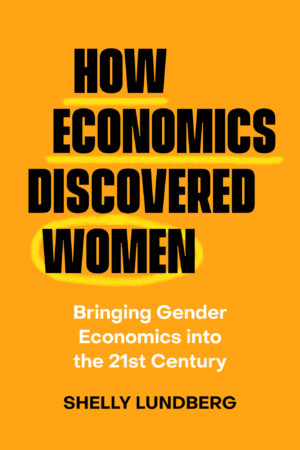
By Shelly Lundberg, author of How Economics Discovered Women.
When I titled my new book How Economics Discovered Women, I expected raised eyebrows. Women, after all, have always been economic actors: they are workers, consumers, and caregivers, and economists are well aware of this. The "discovery" I document is not women's entry into economic life. It's the economics profession’s slow and still-incomplete recognition that women must be studied as independent agents with their own interests and constraints, and that the cultural forces that shape these are too economically important to ignore.
That journey to discovery happened in two steps. And two issues prominent in the news right now — the global plunge in birth rates and the ubiquity of domestic violence — illustrate exactly why those steps matter, and how far we still have to go.
Step One: Not Just Homo Economicus, but also Femina Economica
For most of economics' history, the family was treated as a single decision-making unit — an economic entity with one will, usually assumed to be the husband's. When economists studied fertility, for instance, they asked how many children "the household" wanted, as if a couple's reproductive decisions emerged from a single mind. This was always a fiction, but it was a convenient one.
That fiction has become impossible to sustain in the face of realities such as the substantial declines in fertility almost everywhere in the world. Birth rates have fallen below replacement levels across Europe, East Asia, and recently Latin America and South Asia, sparking alarm among policymakers about aging populations, shrinking workforces, and applying fiscal pressure on pension and healthcare systems. The old economic models offer surprisingly little help here. If households are unified agents, then pronatalist policies such as cash bonuses for babies or subsidized childcare should work straightforwardly by lowering the cost of children. But the evidence is that these policies have modest effects at best, and researchers are increasingly recognizing why: women and men don't necessarily want the same number of children.
Children are more costly to women than to men in time, health risks, and career penalties, and many women are now able to advance their own interests within the household. When a woman can support herself financially, when divorce is legally accessible, and when her career prospects depend on continuous employment, a mother’s calculation can look very different from a unitary model's prediction about births. Recognizing women as independent agents with their own fertility preferences, which may diverge sharply from their partners', turns out to be essential for understanding one of the most consequential demographic trends of our time.
Step Two: No Man, and No Woman, is an Island
The second step in economics' discovery of women is the recognition that the preferences and attitudes that drive economic behavior, including gender differences in competitiveness and risk-taking, are not fixed traits that people are born with. They are shaped, powerfully and continuously, by social forces and cultural expectations.
Nowhere is this clearer, or more disturbing, than in the economics of domestic violence. According to the World Health Organization, intimate partner violence affects roughly one in three women worldwide, and it has received growing public attention. For a long time, economics had little useful to say about this, since violence within a harmonious and efficient household is difficult to explain. The field's response, for decades, was to treat the issue as a pathology outside the scope of economic analysis.
More recently, economists have started producing important empirical findings on domestic violence, but explanations demand that we take seriously ideas that the traditional framework excludes — that power imbalances within relationships and gender norms about male authority and female submission enable violence. Much more work remains to be done. In wealthy countries in which divorce provides a reasonable escape hatch from domestic conflict, women's economic independence is a robust predictor of reduced violence. Research in many more traditional societies with limited divorce, however, finds that increases in women’s access to employment can lead to increases in intimate partner violence, indicating a male backlash against threats to their dominance. In general, research on domestic violence shows that we need to consider households as sites of conflict as well as cooperation, with gender norms playing important roles.
Why This Matters — And What Comes Next
These two examples — fertility and domestic violence — are not just illustrations of academic progress, though they are that. They are reminders that the conceptual models that economists use and the assumptions they bring to bear on a problem have real consequences for the policies governments adopt and the interventions that get funded. A fertility policy that does not consider women's independent interests and labor market constraints, or a domestic violence policy designed without reference to gender norms and power, are unlikely to be effective.
Economics has made genuine progress in its study of gender. But the discovery of women is not complete. The realization that preferences themselves are shaped by social forces — by the gender norms children absorb and the expectations communities enforce — is still working its way through the field, slowly and against resistance. My book tells the story of the journey so far: where economics started, what it got wrong, and what a new economics of gender might look like. I hope it's a useful map for the road still ahead.
About the Author

is Distinguished Professor of Economics and Leonard Broom Professor of Demography at the University of California, Santa Barbara. She is also a Distinguished Fellow of the American Economic Association.