Q&A with Tracy Thomas and Jennifer L. Brinkley
Tracy Thomas is Seiberling Chair of Constitutional Law and Director of the Center for Constitutional Law at the University of Akron School of Law.
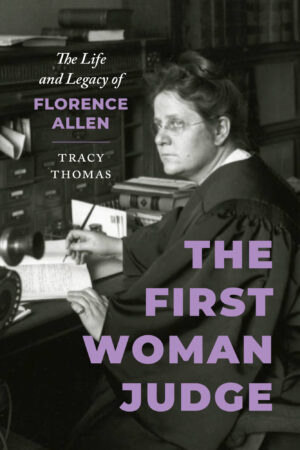
Her new book, The First Woman Judge, tells the story of Florence Allen, the first woman judge in the United States, and the larger history of how women infiltrated the legal system as judges, lawyers, jurors, and legislators to demand a more representative system of justice for the welfare of all.
Jennifer L. Brinkley is Assistant Professor at the University of Dayton School of Law and an attorney in the Commonwealth of Kentucky.
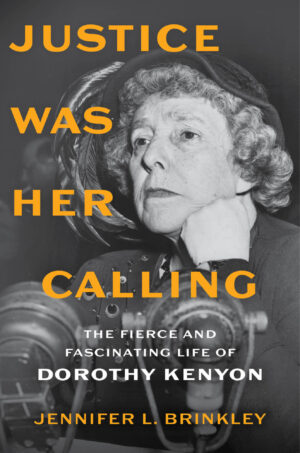
Her upcoming book, Justice Was Her Calling, is the first full-length biography of Dorothy Kenyon, the New York judge, lawyer, and civil liberties champion whose litigation strategies helped transform the Equal Protection Clause into a powerful tool for women’s rights.
Here, Tracy and Jenn discuss what drew them to these pioneering women, the surprising stories they discovered in the archives, and what Allen's and Kenyon's stories reveal about women's long struggle for equality in American law.
What inspired you to write these books on Florence Allen and Dorothy Kenyon?
Tracy: I wrote this book because Judge Allen’s picture was literally staring me in the face. Her portrait hung in the hallways of the law school where I teach, as she was a local heroine from Northeast Ohio. One day while chatting with my dean, he pointed to the framed photo on the wall, and said, “You know Judge Florence Allen, right?” I did not. But I soon discovered there was much to learn.
Allen was known as the first woman judge in the nation. She was the first woman appointed to any federal appellate court, nominated by FDR in 1934 to the Sixth Circuit. Before that she was the first woman elected to any general jurisdiction common pleas court in 1920 and the first elected to any state supreme court, Ohio in 1922 and again in 1928. Significantly, she was the first woman nominated to the U.S. Supreme Court, shortlisted twelve times by three presidents from both parties. Allen spent forty years on the federal and states courts from 1920 to 1960. She authored over 800 opinions during a pivotal time in constitutional law with the advent of a progressive state constitution and federal New Deal legislation. Allen led the suffrage movement, ran for Congress twice, and led an international legal movement for peace, building a national reputation for her broad commitment to legal justice. Identifying as both a nonpartisan and Democrat, Allen offered a progressive view of constitutionalism that insisted on ethical, careful judging for the benefit of all people.
Jenn: I was working from home during the COVID-19 lockdown and decided to redesign my undergraduate Women and the Law course. The focus of that course was Ruth Bader Ginsburg’s work as co-director of the ACLU’s Women’s Rights Project in the 1970s and the cases she brought before the Supreme Court that focused on sex-based differentials in the law. I was reading about Dorothy Kenyon being added as an author to the brief RBG wrote in Reed v. Reed, the case where the Supreme Court, for the first time, applied the Equal Protection Clause of the Fourteenth Amendment to a sex discrimination case. Kenyon had not written any of the brief but had been promoting that litigation strategy since the 1930s.
I thought about how Kenyon essentially laid the groundwork for RBG’s successes, so I wanted to assign a book on Kenyon for my students. To my astonishment, none existed. So, I thought I would start with writing an article about Kenyon’s and Pauli Murray’s efforts to obtain sex equality in jury service in Alabama. They worked on a 1965 federal case called White v. Crook, and they were successful in obtaining compulsory jury service for women in the state. Kenyon had been a member of the ACLU’s national board of directors since 1931 and she had sponsored Murray’s membership to the board that year.
After the article was written, I decided I couldn’t stop there. The book took six years to research and write and it draws on twenty-four manuscript collections from across the country. I really believed, once I dug into the archives at Smith College where Kenyon’s papers are housed, that Kenyon was a major figure in advancing the cause of women in the twentieth century. I am so happy that her story will be told. This book will be the first biography on her life but I hope it’s not the last.
What surprised you most during the writing process?
Jenn: This was my first biography so I feel like I learned a lot about crafting a book, specifically using archival material. Because of that, there were a lot of surprises just about the process. I was surprised at how alive Kenyon became through her writings. Her archival collection is voluminous. Kenyon’s sister-in-law, Mildred Adams Kenyon, deserves a lot of credit for recognizing the importance of Kenyon’s papers and compiling them for Smith College. I was surprised at what I found in the collection at Smith. Letters regarding the mundane—like one to the storage company regarding the proper storage of her winter clothes or to the laundress for overcharging her a few pennies—to passionate love letters, to letters about politics, law, and loss. Kenyon was an independent, strong, sometimes abrasive spirit, and a lot of that came through in her own writings and speeches. She seemed to be the same on paper as she was in life, as confirmed through letters from, and interviews of, people who knew her. One person said it best: Insincerity could not live in the same room as Dorothy Kenyon.
Tracy: One thing that surprised me in the research, but probably should not have, was the dirty politics of U.S. Supreme Court nominations. Allen was shortlisted for the Court many times between 1934 and 1950, with presidents hoping to pander to new women voters by appointing the first woman Justice. The national media often featured Allen as a frontrunner, and she had built a solid record as a careful and experienced judge. Yet supporters of other nominees, like William Douglas, resorted to trickery and fed false information to the press that was syndicated across the country. They claimed that Allen’s decisions were overturned many times, suggesting she, and women generally, were incompetent judges, when in fact just a few cases of Allen’s had ever been reversed on technical matters. Former colleagues in Cleveland secretly told the FBI during its investigation that she was unqualified, that appointing a woman was a ridiculous joke, and that Allen might be a socialist. White House advisors made these important judicial decisions over poker games and weekly drinks at the presidents’ home, and Presidents Roosevelt and Truman favored their personal friends for continued inside access once on the Court. When Truman was persuaded by the women’s coalition to appoint Allen, he first checked with his buddy, Chief Justice Vinson. Vinson said the Justices would not have a woman because then they could not take off their shoes, roll up their shirt sleeves, and debate comfortably in conference. Truman proposed a compromise: to appoint Allen for just one year so he could gain points with women voters, but she would have little influence on the Court. The Justices refused.
What do you hope readers take away from the stories of these two fascinating women in law?
Jenn: I hope readers see that Dorothy Kenyon belongs as an important figure in the twentieth century history of the United States. There is a lot to learn in the book about the history of women entering the legal profession, and the obstacles that were placed in the way of people like Kenyon on their path to becoming a lawyer. Women lawyers in particular stand on the shoulders of women who kept advancing the cause of women by demanding entry into law schools, voting booths, bar associations, judicial chambers, and jury boxes. I hope the reader understands how vulnerable civil rights and liberties can be and that it takes the action of individuals to protect those rights.
What I want is for the reader to close the book and be inspired to create their own kind of change in the world. To be a little bit like Kenyon—fierce, fascinating, and passionate.
Tracy: The complexity of how gender did—and did not—impact the work of the first woman judge. Allen was more Elena Kagan than Ruth Bader Ginsburg. Not a gender champion on the bench, despite her work for women’s rights in the national leadership of the women’s suffrage movement and litigation of employment and constitutional equality cases. Few cases of women’s rights came before her as a judge, and in those that did, she often deferred to her male colleagues to write the decisions, perhaps to insulate the decisions from challenge. Yet Allen’s gender was used against her by male judicial colleagues, resisting women’s equal role on the courts. The men on the bench tried to put her on a separate, women’s domestic relations court, refused to speak to her in deliberations, ate lunch in men’s only clubs that denied her admission, canceled court and played golf without her, refused to attend ceremonial events in her honor, paid her less than the men judges, used case assignments to keep important constitutional cases away from her influence, and declined to assign her patent cases assuming they were too hard for a woman.
Allen used grit and hard work to work twice as hard as her colleagues to prove her own and women’s worthiness for the court. And she understood the power of women’s collectives, having been catapulted into office by bipartisan support of women, and supported by national organizations of women lawyers. Allen did not want to be defined by her gender. But she appreciated her role as an important first and recognized the need to pave the road for the women who would come after.
About the Authors

is Seiberling Chair of Constitutional Law and Director of the Center for Constitutional Law at the University of Akron School of Law.

is Assistant Professor at the University of Dayton School of Law and an attorney in the Commonwealth of Kentucky.