Q&A with Samantha Barbas, author of "Hate Speech"

Samantha Barbas is Professor of Law and Aliber Family Chair at the University of Iowa College of Law and the author of seven previous books on mass media and free speech history, including Actual Malice: Civil Rights and Freedom of the Press in New York Times v. Sullivan.
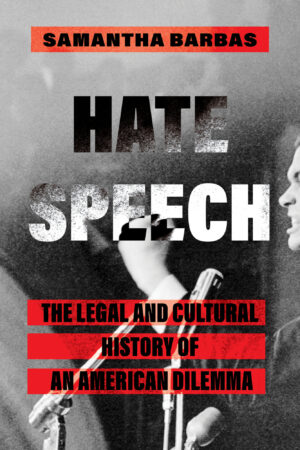
Her latest book, Hate Speech: The Legal and Cultural History of an American Dilemma, looks at the long history of the battles over regulation of hate speech in the United States.
Over your seasoned career, you've written multiple books that look at the legal aspects and battles of the First Amendment. How did you come to the idea to write a book about the US history of hate speech?
It’s one of the major unanswered questions of American free speech law. Most other countries have laws banning hate speech—the United States does not. Why did America take a different path? What social, cultural, legal, and political forces led us down that road? This was a challenging question to tackle, since the issue is complex and doesn’t lend itself to easy answers. But I felt it was especially important to understand America’s stance on hate speech today, given how much it proliferates and how many people are now calling for regulation of it.
I wanted not only to understand why America took a different road, but how Americans have debated the issue along the way. I was surprised to discover that we’ve been arguing about hate speech regulation for over a hundred years, and that there were periods in our history when hate speech laws actually existed. The archives revealed a fascinating story about a national dilemma that is far older than most people realize.
Objectively speaking, hate speech feels more prevalent now than it has in decades. Is that true or is it because of our access to media now?
With the internet, it’s certainly easier to disseminate hate speech to massive audiences than in the past, so there may well be more of it in circulation today. On the other hand, there was more hate speech embedded in everyday life fifty or a hundred years ago than there is now. One thing I describe in my book is how hate groups have always found ways to circulate their messages. In the 1940s and 50s, they sent out thousands of pamphlets and newsletters that arrived in people’s mailboxes unsolicited – an early version of spam. That proliferation of “hate mail,” and its intrusion into daily life, was one reason why legislators of that era sought to make hate speech illegal.
Your book looks back at over 100 years of the US history of hate speech. What seminal events or figures do you feel shaped the way we engage with it now?
The book traces many key figures and moments in the national debate over hate speech and its regulation. It begins with the controversy over the notorious racist film The Birth of a Nation in 1915— one of the first national controversies over hate speech – and shows how that episode led both to the passage of early hate speech laws and to some of the first arguments against them. It then describes the 1930s and 40s, when America grappled with the rise of domestic Nazi groups and passed hate speech laws, dubbed “anti-Nazi” laws, which were challenged by an unlikely set of opponents – Black and Jewish civil rights groups, whose opposition to hate speech laws would continue for much of the twentieth century. It examines the World War II period, when states and cities across the country passed hate speech laws to prevent race riots and other breaches of the peace that would undermine the war effort.
The book turns to the immediate post-World War II period, when a surge of hate speech placed America’s escalating national commitments to civil rights and to freedom of speech on a collision course. It explores how, in the 1960s, the civil rights movement helped establish the legal foundations that made hate speech laws all but impossible under the First Amendment. It looks at the 1970s, when the free speech enthusiasm of the 1960s began to fade and when the Skokie affair, in which uniformed Nazis sought to march through a Chicago suburb home to many Holocaust survivors, revived national interest in hate speech laws. In the 1980s and 90s, the critical race theory movement picked up and advanced many of the arguments about the harms of hate speech that had first surfaced in the Skokie case, even as the Supreme Court continued to move First Amendment law in a more civil libertarian direction.
Together, these events and episodes left a complex legacy: Americans believe deeply in the virtues of free speech, yet many, at the same time, support laws against hate speech.
Your argument is that hate speech laws undermine civil rights and democracy. Have you always felt this way? Or as you researched this book did you formulate that conclusion?
I’ve always supported broad free speech rights. As a historian, I’ve seen many examples of the damage that censorship can inflict on democracy, art and culture, and the flourishing of ideas. Freedom of speech is essential to checking abuses of power and holding government accountable. It’s essential to education, creativity, and social change. This study of hate speech underscored another reason why freedom of speech matters: it creates the foundations for equality and civil rights. The civil rights movement would never have accomplished what it did without the right to speak, assemble, and protest. Without freedom of speech, advocates of equality would never have had the opportunity to speak out against injustice and change people’s minds. My research deepened my belief that freedom of speech and civil rights are mutually supportive and intertwined.
What is the ultimate lesson you would like the audience to get out of a book about such a timely, yet uncomfortable, subject?
The lesson is that hate speech laws seem like an easy solution to a disturbing problem, but they may create more problems than they solve. For one, such laws can backfire by drawing more attention to the speech they’re meant to suppress. In 1915, attempts to ban the Birth of A Nation only made people curious about it, driving them to see the film.
Laws banning racial “hatred” or “insult” are also inevitably broad and vague, which means they can be easily turned against the oppressed groups they’re meant to protect. In the segregationist South, criticism of white supremacist ideas was sometimes characterized as a form of “racial hatred” and prosecuted. As civil rights groups recognized at the time, hate speech laws can undermine the freedom of speech that minority groups need to make their claims for equality before the public. Broad protections for free speech give us our best shot of creating the kind of social change – through education, protest, and counterspeech – that’s actually needed to cut off hate speech at its roots.