"Predicted" Author Mona Sloane on AI’s Vision for Society
By Mona Sloane, author of Predicted: How AI is Restructuring Social Life.
The rapid build out of massive data centers across the US has, at long last, changed our AI vocabulary: rather than talking about the allegedly inevitable, but always-in-the-future, general artificial intelligence (AGI), we are now talking about AI as infrastructure. Our worry has shifted from the threat of robot overlords to concrete impacts of AI’s infrastructural dimension, from spiking utility bills to noise pollution and the potential of plummeting property values. That is a good thing.
As communities are wrapping their head around, and not seldomly resisting, these huge construction projects, we are all beginning to adopt a more sober view on AI and look under the hood of how these systems are designed and deployed. From chips to servers to models and back—it is increasingly clear to all of us that AI is not computer magic, but a macro design project that is powered by a particular vision for society that tugs along an unprecedented mobilization of capital and resources.
The dazzle of this mobilization—accompanied by equally unparalleled accumulation of wealth among few individuals—is worthy of investigation and critique, from concerns around a potential AI bubble threatening the global economy to wider spreading surveillance and fundamental questions of (in)equality. But it also distracts us from taking a look at the unspoken societal vision that is behind it all: that prediction ought to be an organizing principle of society.
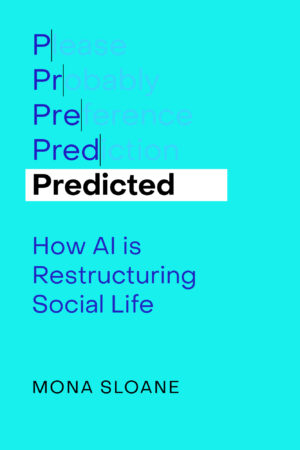
In my book Predicted, I suggest that we need a pivot in our way of thinking about AI. I argue that AI is not just a new kind of infrastructure, but a social infrastructure—one that mediates the formation and organization of social relations through the lens of prediction. I discuss how prediction is the design principle of all AI systems, from rule-based AI to generative and agentic AI. And I show how the integration of AI into our individual and collective lives and core social institutions (such as education, health, and the labor market) subtly but forcefully centers the calculation of probabilities over other forms of judgement. I call this the 'prediction paradigm'.
All infrastructures direct the flow of ideas, people, and resources—meaning they also foreclose alternative paths. What the infrastructuralization of AI, its social embedding, forecloses by way of the prediction paradigm is the idea that the future is unknown and unknowable. Conversely, it embeds the assumption that a knowable future is not up for debate, it is linear and it is singular. In Predicted, I argue that this is the biggest risk of AI: that we silently agree that our world maps onto a one-dimensional line, that we do not need or desire debate and pluralism, and that our future (with AI) is already set in stone.
The good news is that AI, like any other infrastructure, is an assemblage of social arrangements. And we can make these arrangements visible by asking, "What is social about AI?" That way, we can put them back up for discussion and reveal where questions about our shared futures are settled in the infrastructural layers of AI—from chips production to data centers, model makers and the institutions that use them. Predicted is an argument for recouping collective deliberation in the age of AI—about which futures with AI we want, and what technology, science, and innovation are actually for. Debating data centers is a great start that will hopefully lead us to deeper conversations about AI’s vision for society.
About the Author

Sociologist Mona Sloane is Assistant Professor of Data Science and Media Studies at the University of Virginia. She leads the Sloane Lab, convenes the Co-Opting AI public speaker series, and is Technology Editor at Public Books.