Listening to Musical Modernism in the Princeton School
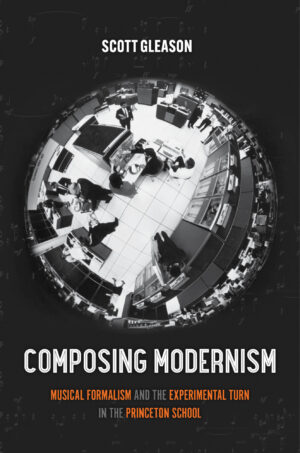
In my new book, Composing Modernism: Musical Formalism and the Experimental Turn in the Princeton School, I argue that the post-World War II music composition practiced at and around Princeton University defines musical modernism in the Cold War United States. I make this argument in three ways: by theorizing the practices of high modernist compositional theory, by historicizing the experimental turn taken by many of the musicians working at Princeton, and by analyzing the subjectivity and seat of musical modernism itself, the composer-theorist.
This sounds abstract, but it needn’t be. We can hear these changes of musical identity thanks to the individual composer’s styles and how they change over time. So, let’s listen to a selection of pieces that demonstrate some of the ways the Princeton School composed itself by composing pieces which could reflect its shifting conceptions of just who is making the music.
Milton Babbitt’s Composition for Four Instruments (1948) sounds typical of his early Bachian aesthetic, which he later termed “maximization”: the music strives to present every conceivable arrangement and ordering of instruments, pitches, durations or lengths of sounds, gestures, and dynamics, yet all within a subdued affect.
Example: Milton Babbitt (1916–2011), Composition for Four Instruments (1948)
Benjamin Boretz’s Group Variations II (1972) was realized on the IBM360 mainframe computer, a photo of which serves as the cover image for my book, with Boretz’s score for the piece serving as the cover’s overlay. Group Variations II brings Babbitt’s maximization to the forefront of our listening by presenting multiple sound-events per unit of time. In other words, in this music, any given beat sounds wondrously complicated because so much is going on. As the music moves forward in time it dramatizes the sense that the composer-theorist sits at the center of our musical experience.
Example: Benjamin Boretz (b. 1934), Group Variations II (1972)
Around 2000, Princeton professor Paul Lansky found himself in the unlikely position of achieving a level of notoriety, fame even, as the composer of a sample that Radiohead used for their 2000 song, “Idioteque” off Kid A. Lansky’s otherworldly opening emphasizes fade-ins/crescendos and fade-outs/decrescendos, the former eventually giving rise to multiple overlapping voices that remember the opening’s melody through its implicit harmonies. These overlaps, wherein one sound ends after another begins, build in intensity and proximity such that instead of the didactic tone of the very beginning, the swells and decays summon their source text, the waves of Wagner’s Tristan und Isolde.
Example: Paul Lansky (b. 1944), Mild und Leise (1973)
In Stephen Dembski’s Alta, for solo piano, high notes pop out of the piano figures that create an otherwise consistent texture. The music encourages us to hear through its melancholic G–F# dyad to a plane of consonance which the piece then works around or through, yet never quite finishing.
Example: Stephen Dembski (1949–2021), Alta (1982)
During the 1970s, Randall, Boretz, and many others in the Princeton orbit started to turn their backs on music composition in a traditional sense and instead began improvising on instruments in their basements. These real-time, co-creative sessions sought to suspend an advanced musicality and replace it with a kind of learned naivete. A noisy, problematic musical subjectivity thus emerges, one that dramatizes how musicians can maintain their individuality in the context of group subjectivity.
In 1981, Diane Thome, the first woman to graduate from Princeton with a PhD in music composition, wrote that she was struggling to understand herself as a woman composer in a male-dominated field. UnfoldEntwine emphasizes an internal, psychoacoustic journey by featuring electronic sounds that are not easily identifiable, until an obvious flute-like series of melodic interjections combine with raintree sounds.
Example: Diane Thome (1942–2025), UnfoldEntwine (1998)
Judith Shatin recently composed Adventure on Mt. Hehuan (2021) for bass drum and interactive electronics, and in doing so placed memory, timbre, ritual, and geographical and conceptual worlds in counterpoint. To be a modern composer-theorist is to embody and perform mastery—here, of acoustic and electronic sounds and their sources and combinations, but also of the technical, material, notational, timbral, and performative expressions of music and their mediations.
Example: Judith Shatin (b. 1949), Adventure on Mt. Hehuan (2021)
After World War II, Babbitt argued that listening and musical perception are remarkably pliable. David Lewin therefore emphasized the many ways we can learn to change our hearings of—how we mentally understand—music. Boretz argued that when we listen to music, we in fact compose it, as we are hearing it, as it moves by. John Rahn argues that because we compose music, we project ourselves into pieces; complementarily, we hear a musical life unfold before our ears. Finally, J. K. Randall argues that because we compose music, in doing so we seek to compose ourselves.
In all these creative strivings, the Princeton School locates its utopian dreams in music.