The "Journal of the American Musicological Society" Publishes Colloquy for 250th Anniversary of the United States
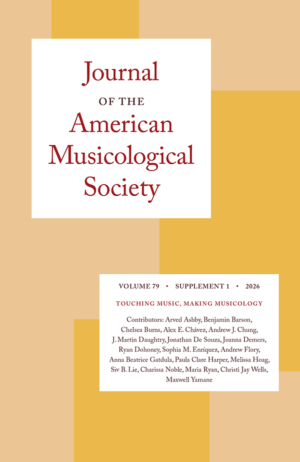
The Journal of the American Musicological Society (JAMS) has published a special issue to coincide with the 250th anniversary of the Declaration of Independence. Called “Touching Music, Making Musicology,” this supplemental issue features eighteen different experts on music and music history reflecting on objects that speak to aspects of American music. The first of two special issues coinciding with the semiquincentennial, it explores the many ways that American music history is embodied in the objects that shape and surround us.
For example, Chelsea Burns, Associate Professor of Music Theory at the Butler School of Music at UT Austin, takes us to the Country Music Hall of Fame and Museum to reflect on a Singer-brand sewing machine once owned by fashion designer Nudie Cohn. An immigrant from Kiev who began his career in the ladies’ undergarments industry, his “Nudie suits” are central to country music’s visual landscape and his sewing machine is a lesser-known artifact of American country music history.
Alex E. Chávez, by contrast, reflects on something of infinitely greater scale: the US–Mexico border. Associate Professor of Anthropology at the University of Notre Dame, Chávez argues that the border and the many different types of border crossings attest to the ongoing story of race, belonging, and cultural exchange in America.
Looking further north, Andrew Flory, Professor of Music at Carlton College, spotlights the popular music venue First Avenue in Minneapolis. Flory traces the history of First Avenue from its disco-oriented beginnings in 1969 and argues that music venues, like First Avenue, shape the way we understand and experience music.
Each of these reflections as well as the fifteen other essays in the supplemental issue offer insights into how music is perceived, experienced, and shared in America. As JAMS Editor-in-Chief Jake Johnson explains, these short reflective essays engage with objects and topics at once vast and intimate. "They range from descriptive to analytical to ethnographic to poetic about objects that could disappear in your hand as much as objects that lay out for thousands of miles."
One of the premier journals in musicology, the Journal of the American Musicological Society publishes scholarship on music from a broad range of scholarly perspectives. Recognized for their breadth of intellectual scope and penetration in the field, JAMS issues include articles, reviews, and scholarly conversations. Three issues are published annually.
The American Musicological Society (AMS) is a nonprofit organization dedicated to advancing research in the various fields of music as a branch of learning and scholarship. The AMS supports a vibrant community of scholars, educators, and leaders through publications, conferences, and advocacy, fostering a deeper understanding of music's role in culture and society and promoting initiatives that ensure the field's resilience and growth.
We invite you to read “Touching Music, Making Musicology” for free online for a limited time.
We are pleased to publish JAMS in partnership with the American Musicological Society. AMS members receive free online access to JAMS. If you are interested in becoming a member, information about AMS membership can be found on the Society's website.
You can also receive free access to JAMS if your library subscribes to the journal. If your library is not currently a subscriber, please ask your librarian to subscribe. We also offer library subscriptions to JAMS as part of our UC Press Music Subject Collection, which packages all of our music journals together for one low subscription price. You may want to consider asking your librarian to subscribe to the full collection. Libraries may also purchase copies of individual print issues, including the special issue (Volume 79, Supplement 1), on the journal's site.