Considering the Revolution: A Virtual Issue of "The Public Historian"
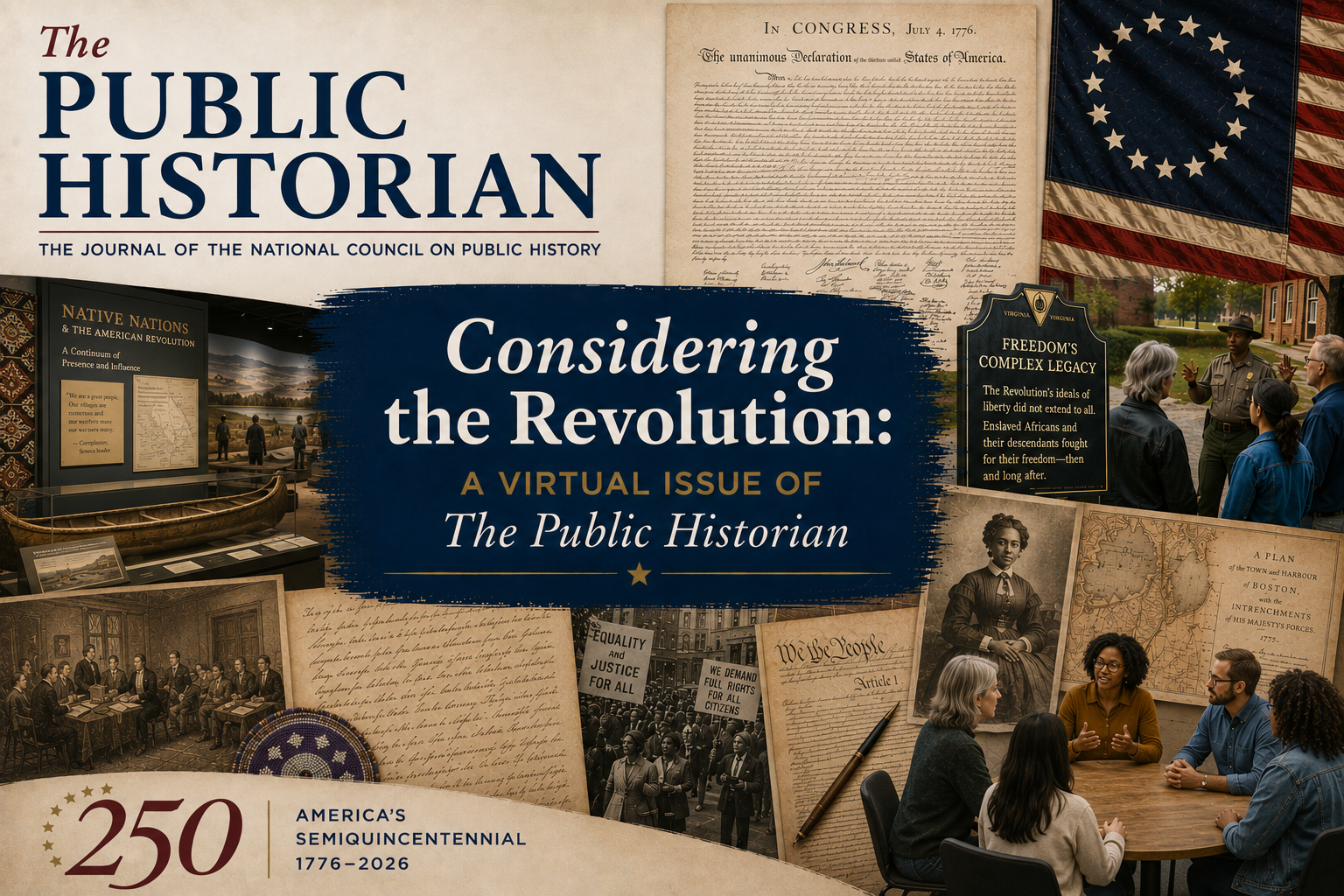
Introduction by M.J. Rymsza-Pawlowska
This special virtual issue of The Public Historian gathers five years of conversations about the content and substance of commemoration in the lead-up to the Semiquincentennial of the Declaration of Independence in 2026. Between 2021 and 2025, a convenor and panelists met (sometimes virtually and sometimes in person at the annual meeting of the National Council on Public History) to discuss a thematic aspect of American history and its commemoration. The format seemed naturally suited to the task: if public history has a signature mode of knowledge production, it is conversation. In conversation we offer explanations, exchange ideas, share examples, and provide affirmation. As a form of engagement, conversation embodies many of the core ideals of public history practice: it is inherently multivocal, it models collaboration, it makes processes visible, and it invites participation.
These conversations—and the essays that grew out of them, originally published in The Public Historian—are part of an ongoing initiative called “Considering the Revolution.” Conceived in late 2020 as a collaboration between the National Council on Public History and the National Park Service, the project responded to a growing sense among practitioners, both inside and outside the Park Service, that the Semiquincentennial would offer a significant opportunity to refine and reshape how Americans engage with the histories and legacies of the nation’s founding moment.
It seemed like the right time for such reflection; coming in the midst of a national reckoning over persistent inequalities which brought with it a wholesale re-evaluation of history and history institutions. In the popularity and resonance of efforts like the 1619 Project, in the widespread protests and removals of Confederate and other monuments, in the surge of history content on social media, it was evident that Americans have been interested and engaged in rethinking how we remember and acknowledge our collective history. Efforts from the National Park Service and the National Council on Public History joined a wave of institutional investments in reframing how the public engages history. A future historian looking at this special issue as symptomatic of this moment might analyze it alongside efforts such as the Mellon Foundation’s Monuments Project, the Pomeroy Foundation’s historical marker campaign, and engagement studies undertaken by the American Historical Association and the American Association for State and Local History.
As a scholar of commemoration, I was invited to serve as series editor of the project in late 2020. In conversation with representatives from both NCPH and NPS, I was struck by a shared sense that the Semiquincentennial—like the Bicentennial before it—could significantly deepen and change the way that we understand and engage our collective history; but also, through telling different, more, other stories, help more people connect with this nation’s past, present, and future. The purpose of each roundtable conversation was to model new approaches for thinking about the history of the Revolution and its legacies. While the roundtables featured scholars and practitioners reflecting on these themes and their applications, the accompanying articles—written by convenors, with input from panelists—are a treasure trove of additional sources and resources, intended to help public historians inside and outside of the Park Service to adapt some of these approaches for themselves.
Looking over them together, these essays also trace the five-year history of the project as well as the unfolding of current events that surrounded each. The first panel, “Indigenous Histories and Memory in Alaska, Hawaii, and the Indigenous Plateau,” took place in March of 2021. It was convened and chaired by Laurie Arnold, and featured as panelists, Miki’ala Ayau Pescaia, Maija Katak Lukin, and Amy Lonetree. As Arnold and Pescaia note in their summary article, it took place just hours after Deb Haaland was sworn in as Secretary of Interior under President Joseph Biden, the first Native American person to serve in a Cabinet position.
A year later, Jean-Pierre Morin convened and facilitated “The Identities Created by the American Revolutionary War,” a conversation between Rebecca Brannon, Michael Hattem, Bonnie Huskins, Patrick O’Brian, Taylor Stoermer, and Seynabou Thiam-Pereira. That wide-ranging discussion, which examined the aftermath of upheaval and the accompanying redrawing of boundaries and identities, came shortly after the Russian invasion of Ukraine, as well as the continued winding down of COVID-19 response.
In 2023, Sylvea Hollis led “The Rhetoric of Freedom: Remembering Slavery during the Semiquincentennial of the American Revolution” with panelists Yveline Alexis, Ista Clarke, Maya Davis, and Marcus Nevius. Their dialogue emphasized interdisciplinary approaches to the study of African American history and culture, even as attacks on such histories were brewing, with legislation in multiple states that banned the teaching of structural racism in secondary and higher education.
By 2024, NCPH President Gregory Smoak’s panel on “Citizenship and Sovereignty,” which included Kristen Hayashi, Katherine Kitterman, and Nicole A. Moore, provided, for historians and publics alike, a valuable framework to consider the importance of citizenship and individual rights in the wake of the Dobbs decision and the continued challenges to immigrant and transgender rights.
In June 2025, when I convened the final conversation, "'Play the Long Game': Public Historians’ Approach the Semiquincentennial and Beyond," which brought back panelists Clarke, Hayashi, and Moore, it was impossible not to consider lost opportunities—the National Park Service, by this point, took big steps back from the project to protect the integrity of the discussions—as rangers and members of the public were being asked to flag and remove any interpretive material that questioned a celebratory narrative of American history. But, even with the acknowledgment that the commemoration was going to look quite different from how it was conceived of at the start of the project, the panelists—and people in the audience—offered encouragement and suggestions for practitioners continuing to look for ways to help people use the past to understand the present and future.
Long after the 250th is over, these essays will remain useful to scholars and practitioners of public history. Together, they serve as documentation of a particularly charged interval in contemporary history. As importantly this special virtual issue is a snapshot of a field that is always striving to include more perspectives, represent more complex realities, and inspire publics and historians alike to continue engaging in the deep and rich history of our nation. Throughout these five essays, public historians share methods, explain interpretive framings, and reflect on their experience. They are inspirational in how they approach questions, engage each other, and express hope for the future. It’s been a pleasure for me to revisit them again and again—first as a audience member, then as editor, and now as compiler. Each time, they have offered fresh insights and ideas. We do not know yet the ultimate legacy of the Semiquincentennial, but I am confident that these will be part of it.
Table of Contents:
Considering the Revolution: Indigenous Histories and Memory in Alaska, Hawai‘i, and the Indigenous Plateau
Laurie Arnold, Miki‘ala Ayau Pescaia
The Public Historian (2021) 43 (4): 7–20.
Considering the Revolution: The Identities Created by the American Revolutionary War
Jean-Pierre Morin
The Public Historian (2023) 45 (1): 8–24.
The Rhetoric of Freedom: Remembering Slavery during the Semiquincentennial of the American Revolution
Sylvea Hollis
The Public Historian (2024) 46 (1): 7–28.
Considering the Revolution: Citizenship and Sovereignty
Gregory E. Smoak
The Public Historian (2024) 46 (4): 21–43.
“Play the Long Game”: Public Historians’ Approach the Semiquincentennial and Beyond
M.J. Rymsza-Pawlowska
The Public Historian (2026) 48 (1): 8–21.
Considering the Revolution webinar series
Accompanying this special virtual issue are recordings of the original roundtables. These recordings highlight conversation itself as a form of engagement, embodying public history values such as collaboration, participation, and multivocality.
Considering the Revolution: Indigenous Histories and Memory in Alaska, Hawaii, and the Indigenous Plateau
NCPH 2021 | Thursday, March 18, 2021
Considering the Revolution: The Identities Created by the American Revolutionary War
Virtual NCPH 2022 | Friday, May 6, 2022
Rhetoric of Freedom: A Conversation About the Conditions of Black Life in the American Revolution
Considering the Revolution
June 5, 2025

We have removed the paywall from this special virtual issue commemorating the Declaration of Independence's semiquincentennial and invite you to read these essays for free online through the end of 2026.
To secure ongoing access to TPH, please subscribe to the journal, ask your library to subscribe, and/or become a member of the National Council on Public History (NCPH) to receive access to TPH, as well as other member benefits.