Revitalize Your Syllabi with “Architectural History and Trans Experience” & JSAH Roundtables
by Sheila Crane, Associate Editor of the Journal of the Society of Architectural Historians (JSAH)

For those of us whose lives follow the rhythms of the academic calendar, summer offers the opportunity for a different pace, no matter whether you are teaching summer classes, relaxing at the beach, or taking advantage of dedicated time for your own research. This period can also offer opportunities for leisurely and non-instrumental reading, connecting you with new, exciting work that might provoke fresh ideas, while simultaneously providing fodder for the courses you will be teaching in the coming academic year.
In between reading new submissions to the Journal of the Society of Architectural Historians, working on an article of my own, and determining which recipe for lemon cake stands up best at a picnic during a heatwave, I am taking some time to reimagine my classes. To this end, the JSAH Roundtables provide distinctly engaging material for class discussions, whether in a smaller seminar, like the Theories and Methods in Architectural History course I’ll be teaching this fall, or in the large lecture course I often teach in the spring term, introducing mostly first-year undergrads to global histories of architecture and urbanism. This fall, I am looking forward to discussing the wide-ranging essays included in the most recent JSAH roundtable, “Architectural History and Trans Experiences,” with students in my Theories & Methods seminar. This new collection of relatively short and readily digestible essays responds to our current moment of extreme political polarization with well-researched and engaging reflections that contribute to a growing archive of trans spatial histories, while also opening new methodological and theoretical questions rife for further exploration. For those who might be teaching courses focused on more delimited topics, geographies, or time periods, the range of materials in this roundtable is worth underscoring, as authors explore sites and experiences ranging from the Temple of Magna Mater in Rome and “trans saints” in Byzantine monastic architecture, to the early American settlement of New Jerusalem, New York and the site of the 1966 Compton’s Cafeteria riot.
I have no doubt that these interventions will spark similarly enthusiastic engagement from my students, as was the case when I assigned “Spaces of Indigenous Learning and Unlearning in Canada and the United States” and “What Frameworks Should We Use to Read the Spatial History of the Americas?” in a previous iteration of the seminar, or when I asked undergrads in my global histories of architecture and urbanism course to read selections from “Asian American and Pacific Islander Architectural Histories: Mapping the Field and its Futures,” “Constructing Race and Architecture 1400–1800: Part I,” and “Constructing Race and Architecture 1400–1800: Part II.”
Another important change I’ll be implementing this summer is how my students will access this content. While I have previously made PDFs of readings from the JSAH available through Canvas (our web-based learning management system), I would urge you to join me in directing your students to a link that connects them to the online version of the JSAH via your institution’s library interface. Not only is this best practice in terms of digital accessibility, but your students will also have the added benefit of learning how to navigate library systems and databases, skills that will serve them well both in and beyond the course they are taking with you. This approach also helps to ensure there is an accurate record of how many times a given article has been accessed—data that is critical for the journal and its contributors. In the process, you can confirm that your library has maintained its subscription to the JSAH, which is equally important for the journal and for the long-term well-being of the Society of Architectural Historians. If you discover, as my colleagues and I at the University of Virginia did a couple of years ago, much to our chagrin, that your library does not currently subscribe to the Journal of the Society of Architectural Historians, please do request that your library’s subscription be renewed. In a moment when the dynamics of publishing are shifting rapidly, and in a period when professional organizations, like SAH, are navigating challenging political and fiscal headwinds, introducing our students to the power of innovative, field-changing work, like the essays featured in “Architectural History and Trans Experience” and other recent JSAH Roundtables, is more important than ever.
May time spent reading and reflecting this summer have the further benefit of engendering a revitalized fall term.
JSAH Roundtables:
“Architectural History and Trans Experiences,” JSAH, 85:2 (June 2026): 173–189.
edited by Lidia Klein
“Spaces of Indigenous Learning and Unlearning in Canada and the United States,” JSAH, 84:3 (Sept. 2025): 294–321.
edited by Anne Lawrason Marshall and Jason Tippeconnic Fox (Comanche/Cherokee)
“Race and the Built Environment in the Iberian World, ca. 1400–1800,” JSAH, 83:3 (Sept. 2024): 268–286.
edited by Laura Fernández-González
“Asian American and Pacific Islander Architectural Histories: Mapping the Field and its Futures,” JSAH, 83:1 (2024): 6–28.
edited by Gail Dubrow, Sean H. Mcpherson, and Alice Tseng
“Dialogues on the Global within and beyond Australasia,” JSAH, 82:3 (Sept. 2023): 250–274.
edited by Macarena De La Vega De León and Paul Walker
“What Frameworks Should We Use to Read the Spatial History of the Americas?” JSAH, 81:2 (June 2022): 134–153.
edited by Fernando Luís Lara
“Rethinking the Urban Landscape,” JSAH, 81:3 (Sept. 2022): 268–298.
edited by Thaïsa Way & David Karmon
“Constructing Race and Architecture 1400–1800: Part II,” JSAH, 80:4 (Dec. 2021): 385–415.
edited by David Karmon
“Constructing Race and Architecture 1400–1800: Part I,” JSAH, 80:3 (Sept. 2021): 258–279.
edited by David Karmon
We are pleased to make these roundtables free to read online for a limited time, so that after reading the recommendations above, you may evaluate them for possible course use. If you are not a subscriber and would like to secure ongoing access to JSAH, please ask your library to subscribe and/or become a member of the Society of Architectural Historians (SAH) to receive access to JSAH, as well as member grants and fellowships, annual conference opportunities, and online academic resources.
bio:
About the Author
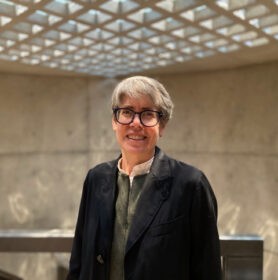
Sheila Crane is Associate Editor of the Journal of the Society of Architectural Historians and Professor of Architectural History at the University of Virginia. She is the author of The City in the Shadow of the Shantytown: A Critical History of the Bidonville, forthcoming from the University of Pittsburgh Press in fall 2026.