From Harmonicas to Fiddles: JAMS Contributors Explore the History of American Musical Objects
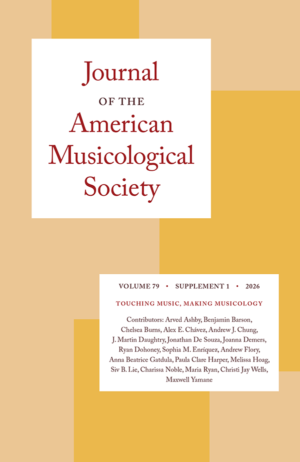
What can a fiddle, a sewing machine, a music video, or a powwow tell us about American music? In Touching Music, Making Musicology, the first supplemental colloquy from the Journal of the American Musicological Society (JAMS), scholars explore the objects, places, and practices through which music is made, remembered, and experienced. Published in a year marking the 250th anniversary of the United States, the colloquy brings together reflections on American music and on the ways musicologists study it.
Now, the American Musicological Society has created a series of short videos featuring six contributors to the colloquy. The videos offer a starting point for exploring the colloquy’s wide-ranging essays, which consider subjects from a family fiddle and a country music fashion designer’s sewing machine to music venues and a harmonica that went to outer space.
Sophia Enríquez explores the many meanings of her great-grandaddy's fiddle. Her great-grandaddy, Nicolás Enríquez, was born in 1914 on the US-Mexico Texas border and his fiddle is a deep mahogany, well-preserved instrument with a rattlesnake's tail inside. The experience of inheriting a family fiddle or other instrument is a common one, and Sophia Enríquez reflects on how inheriting such an instrument can connect one to the past.
https://www.youtube.com/shorts/fWtdoEfKxTg
"Great-Grandaddy’s Fiddle" by Sophia Enríquez
Maxwell Yamane discusses "Desert Thunder" and its place in Powwow, which refers both to an Intertribal social gathering and a genre of music and dance. "Desert Thunder" is a Drum created by Native soldiers of the 120th Engineer Combat Battalion in 2004 and played at a Powwow held at Camp Taqaddum, Iraq. "Desert Thunder" embodies the layered and complex meanings of Native soldiers in the American military.
https://www.youtube.com/shorts/5Wr0FTvAcrQ
"Desert Thunder: Powwow and Native Veterans in a Modern War Zone" by Maxwell Yamane
Jonathan De Souza tells the story of how, in December 1965, astronaut Walter "Wally" Schirra brought a miniature "Little Lady" harmonica on the Gemini VI mission. It was a tiny version of an instrument that is part of many different forms of American music, including blues, folk, country, rock 'n roll, and jazz. The harmonica is also closely tied to the American West and, thus, audibly links the astronaut and the cowboy in the popular imagination.
https://www.youtube.com/shorts/kZTj1Qoha40
"A Space Cowboy and His Little Lady: The Diatonic Harmonica at the New Frontier" by Jonathan De Souza
Joanna Demers analyses the logo of the band Salem. Salem was formed in Traverse City, MI, in 2006 by Jack Donoghue, John Holland, and Heather Marlatt. Its noise-meets-Southern-hip-hop sound attained some mainstream success and the band deployed its logo in order to generate both mystique and a consumer appetite for the group.
https://www.youtube.com/shorts/O3vRlyyWoks
"Salem’s Logo" by Joanna Demers
Chelsea Burns discusses a modest, black Singer-brand sewing machine once owned by fashion designer Nudie Cohn. Cohn was an immigrant from Kiev who began his career sewing ladies' undergarments and eventually became the leading designer of ornate and brightly colored outfits for country music performers.
https://www.youtube.com/shorts/9bpdGPaLfdA
"At the Country Music Hall of Fame with Nudie Cohn’s Singer" by Chelsea Burns
Charissa Noble discusses the little-known, yet impassioned, modernist music scene in 1920s Carmel-by-the-Sea, California as evinced by the publication New Music Quarterly. The scene was led by two women, pianist Ethel "Dene" Denny and artist-architect Hazel Watrous, both close friends of avant-garde composer Henry Cowell.
https://www.youtube.com/shorts/-IcGkziZsdk
"Cut, Paste, Circulate: Revisiting New Music Quarterly in Carmel’s Ultramodern Community" by Charissa Noble
We invite you to read “Touching Music, Making Musicology” for free online for a limited time.
We are pleased to publish JAMS in partnership with the American Musicological Society. AMS members receive free online access to JAMS. If you are interested in becoming a member, information about AMS membership can be found on the Society's website.
You can also receive free access to JAMS if your library subscribes to the journal. If your library is not currently a subscriber, please ask your librarian to subscribe. We also offer library subscriptions to JAMS as part of our UC Press Music Subject Collection, which packages all of our music journals together for one low subscription price. You may want to consider asking your librarian to subscribe to the full collection. Libraries may also purchase copies of individual print issues, including the special issue (Volume 79, Supplement 1), on the journal's site.