Q&A with Benjamin Olin, Author of "Underground Networks"
New York City’s downtown scene of the 1970s and 1980s is synonymous with underground film, video, and performance art. Many of the artists who would come to define this period also dabbled in the then-new technology of public-access cable television, as host, producer, guest, or studio audience member.
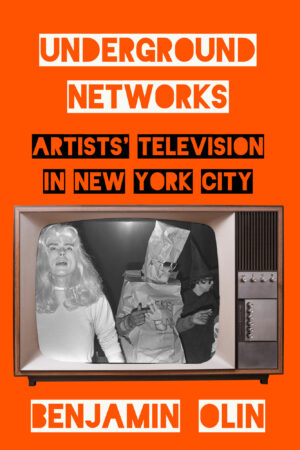
Drawing on archival research and personal interviews, this book—the first full-length study of this vibrant body of work—explores how poets, painters, and filmmakers produced talk shows and soap operas that warped the heteronormative conventions of primetime fare. Working outside the established art world, artists screened their shows in lofts and nightclubs, airing them live on Manhattan Cable and provoking frequent tabloid censure. Underground Networks affirms the importance of cable television to the downtown art scene and recovers an essential strand of avant-garde screen culture and a user-driven media ecology with uncanny contemporary resonance.
Author Benjamin Olin is Assistant Professor of English Language and Literature at Hong Kong Shue Yan University, where he teaches literary, film, and cultural studies. His writing has appeared in Art Journal, Framework, and Millennium Film Journal.
What drew artists in 1970s and ’80s downtown New York to public-access television, and what could they do there that they couldn’t do in other artistic spaces?
Introduced in 1971, public access was a novel platform which enabled downtown artists to instantly connect with audiences beyond the confines of the conventional artworld. Most shows were captured in a bare-bones municipal studio on 23rd Street, which, for forty dollars an hour, provided artists with airtime, two cameras, a mixer, a phone line, and folding chairs to accommodate a small studio audience. Compared to film, or even video, public access was an incredibly affordable medium, and that was another key draw for artists accustomed to working on shoe-string budgets Gathering to produce a show each week was fun, and screening parties held in local nightclubs and lofts were a prominent feature of the downtown social calendar.
Public access allowed downtown artists to bypass the gate-keeping processes that they would been likely to encounter at conventional art spaces. Anyone could have their own show, and there was no need to first win the approval of influential critics or curators. While many artists who were closely involved with public access—such as Jean-Michel Basquiat and Debbie Harry—are now household names, at the time most downtown artists were unknown above 14th Street.
Public access was the perfect medium for artists, who worked collaboratively, eschewed formal training, and sought to blur the line between high art and popular culture. Artists formed bands, launched magazines, venues, and fashion lines, and exhibited their work in nightclubs, Times Square massage parlors, and on the sides of subway cars. Public access similarly provided a blank slate for hybrid forms of interdisciplinary practice—artists could imaginatively transform the tiny 23rd Street studio into a makeshift literary salon, art cinema, nightclub, catwalk, or live punk venue.
The shows you write about often borrowed familiar TV formats—like talk shows and soap operas—while subverting their conventions. What were these artists trying to say about mainstream television and popular culture?
Rather than rejecting mainstream television outright, artists working with public access generally hijacked familiar primetime staples and warped their conventions. For example, the first artists’ public-access show, Anton Perich Presents featured semi-improvised soap-opera style dramas starring local queer icons, such as Candy Darling, Jayne County, and Taylor Mead. The irreverent content of Perich’s show immediately led to censorship by the cable company and precipitated a minor moral panic in the tabloid press. Shows such as TV Party and The Willoughby Sharp Show, borrowed the conventions of the commercial talk show, featuring interviews with local artists, raucous call-ins, vaudeville performances, cooking demos, and health and beauty segments.
While the cookie-cutter formula of these shows was familiar, their eccentric content, experimental editing, and amateur camerawork, was unlike anything that viewers would encounter on adjacent channels. In this sense, public access extended the politics and poetics of underground movies from the 1960s. Where films by Jack Smith, Ron Rice, and Andy Warhol, appropriated the motifs of Hollywood, drawing from silent film, the melodrama, and the B-movie, artists’ television re-purposed the tropes of primetime television.
At the same time, there was a dynamic interrelation—rather than a clear-cut division—between these low-budget public-access shows and commercial television. Instead of somberly critiquing the hypnotic allure of mainstream television in videos destined for white cube galleries, downtown artists regarded infiltrating popular culture as vital for socio-cultural change. For example, Fab-5 Freddy, who was closely involved with TV Party, went on to host Yo! MTV Raps and has played an instrumental role in introducing hip hop to audiences worldwide. Candace Bushnell, author of Sex and the City, published early writing in Anton Perich’s NIGHT magazine. Long before Drag Race, RuPaul frequently performed on Atlanta public-access show The American Music Show and at the The Pyramid Club in the East Village. Conversely, David Letterman has often cited TV Party as a formative influence, and Saturday Night Live has regularly parodied Manhattan public-access shows.
Your book shows that television wasn’t just a way to broadcast art, it also helped artists build communities. How did public-access TV shape the downtown art scene itself?
Public access performed a significant auto-ethnographic function. Each of the shows I write about embodied a group sensibility that was incubated at local venues—such as Max’s Kansas City, CBGBs, and the Mudd Club. Artists typically recorded their shows as a warmup for a night out (or during the after-party) and then screened the recordings in living lofts and nightclubs. Artists’ television evolved in tandem with local art journals, magazines, literary mimeographs, photography, and film.
Attending to these off-screen social spaces and charting the shared imaginaries that nurtured these shows, became vital to make sense of the action on screen. Rather than radically reshaping the local arts community, then, public-access cable television bolstered the downtown scene by plugging into a broader independent media ecology. Approaching downtown culture through the lens of artists’ television also challenged romantic notions of downtown as harmonious bohemian enclave, revealing a complex constellation of partially over-lapping, and frequently fractious micro-communities.
Much of this work has been overlooked in histories of both television and contemporary art. Why do you think it disappeared from view, (and what changes when we put it back into the story?)
When I started work on this project, the downtown art scene of the ‘70s and ‘80s was undergoing a renaissance. Major cultural institutions mounted large scale retrospectives of downtown art, and yet the numerous public-access shows were rarely mentioned. One of the primary aims of this study was to recover this significant, previously overlooked, aspect of cultural history. At the same time, I wanted to investigate what this omission might reveal about the historicization of moving image culture more broadly. Why had this vibrant body of work, which featured so many well-known figures, effectively fallen to the side of art, film, and television history?
Hovering between video art, punk performance, underground film, and expanded cinema, artists’ television is difficult to contextualize using familiar medium specific categories. The collective authorship (and the sheer volume) of artists’ television complicates its inclusion in institutional archives. Few of the shows I write about were professionally archived and researching this material necessitated locating the artists involved, conducting personal interviews, and borrowing viewing copies. Recordings were stored in basements, attics, storage units, and stashed under beds, and most hadn’t been played since the 1980s. The absence of these shows from conventional archives has directly affected their broader cultural visibility. Notably, landmark retrospectives of downtown art which have shaped cultural narratives of the epoch, have been hosted by institutions—such as New Museum, the Whitney, MoMA, and New York University—who were understandably eager to showcase their archival holdings.
Recovering this previously overlooked body of work opens the way for further studies of artists’ public-access shows from the epoch—both from New York and further afield. Putting this work back into the picture provides a framework for understanding similarly hybrid, ephemeral forms of experimental screen culture that may have been overlooked. For example, several canonical underground filmmakers dabbled in live performance, video, and television, and yet their work in these mediums is seldom discussed. This study reveals a valuable pre-history of more recent work by contemporary queer artists such as Ryan Trecartin, Wynne Greenwood & K8 Hardy, Vaginal Davis, and Jibz Cameron, whose videos and performances similarly subvert the heteronormative codes and conventions of commercial television.
What can the public-access experiments of the 1970s and ’80s teach us about social media, independent creators, and who gets to make and distribute culture today?
At first glance, the low-budget, ludic elements of these public-access shows resemble self-shot online content, and the cultivation of larger-than-life media personae by downtown artists bears an uncanny resemblance to the construction of homespun digital avatars and self-fashioned influencers. On the surface, the democratic aims of 1970s grassroots media activists have been realized—currently anyone with a phone and an internet connection can create and distribute media content. At the same time, user-generated content is mined for lucrative personal data and monetized by an ever-shrinking number of global media conglomerates. Rather than enumerating the similarities between downtown public-access experiments and social media, or suggesting a teleological progression, I have found it more productive to ask how this historical media ecology can provide valuable resources that can be utilized in the present.
As this book went to press Paramount Skydance was in the process of acquiring Warner Bros. Discovery, creating an unprecedented concentration of media power, and Meta agreed to a multi-billion-dollar settlement to resolve claims it had intentionally designed Facebook and Instagram to addict children. Notably, the past year also witnessed renewed interest in the history of public access. In May 2026, Stephen Colbert hosted a retro 1990s-themed episode of Michigan public-access show Only in Monroe, following the abrupt conclusion of The Late Show—CBS’s decision to cancel Colbert’s show was announced shortly after the host publicly criticized Paramount (who owned CBS) for agreeing to a $16 million-dollar legal settlement with the Trump administration. Two recently released feature length documentaries have focused on public access. Jyllian Gunther and Stephanie Schwam’s, Bang My Box: The Robin Byrd Story (2026), produced by Sarah Jessica Parker, chronicled the legendary public-access host Robin Byrd. David Shadrack Smith’s Public Access (2026) which premiered at Sundance, surveyed a range of public-access shows from the 1970s to the 1990s.
Ultimately, rather than attempting to provide definitive answers, I hope that this book prompts questions about the balance of power within contemporary commercial media culture, and that by mapping this historic local and specific analog media ecology this study can contribute to the imagination of more just and equitable, community governed, media futures.