Q&A with Robert McRuer, author of "Disability, Revolution"
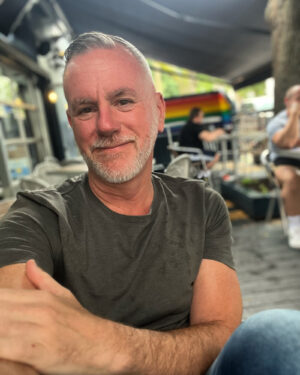
Robert McRuer is Professor of English at George Washington University and author of Crip Theory: Cultural Signs of Queerness and Disability and Crip Times: Disability, Globalization, and Resistance.
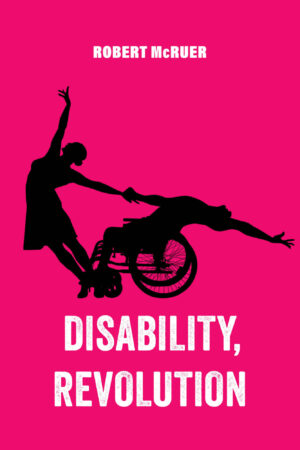
His book, Disability, Revolution, provides an accessible overview of disability justice movements and their relevance to larger emancipatory coalitions.
What does the term “one-dimensional disability” mean, and how does this approach to disability rights leave people out?
“One-dimensional disability” refers to a phenomenon that has emerged over the past several decades under neoliberal capitalism. For the past few centuries, there have been deeply problematic and at times deadly figurations of disability: disability as freakishness to be put on display, disability as something to be eliminated, as in the eugenic period. Additionally, disability has long been figured as something to be overcome. Scholars in disability tend to sharply critique individualized “supercrip” overcoming narratives.
Disability, Revolution traces something more unique to our own moment. A certain kind of identity politics has given us disabled figures such as Greg Abbott and Madison Cawthorn in the United States (who are both wheelchair users) or Jair Bolsonaro in Brazil (whose disabilities were temporarily on display after he was stabbed during his campaign for president). These public figures are “out and proud” about their disabilities or impairments but arguably use disability identity as a smokescreen for far-reaching policies that are hugely-detrimental to other disabled people, and marginalized communities in general. For example, Texas governor Abbott has cut back health care, criminalized gender-affirming care for young people, changed voting laws that made it easier for (other) disabled people to vote by mail or through proxies, and sustained border camps where those who have crossed over are held in unhealthy, disabling environments, often separated from their families.
So, I’m not just arguing that certain disabled people discriminate against others but that their one-dimensional disability is a vehicle for maintaining relations of oppression in our era.
Your book connects disability justice with queer, trans, neurodiversity, and mental health movements. Why is it important to see these struggles as interconnected? What do we gain?
My focus is on multidimensional disability movements. I partly follow Roderick Ferguson’s argument in One-Dimensional Queer that an intersectional LGBT movement (legible around the Stonewall Riots, for example, and the emergence of the Gay Liberation Front) has been diluted into a one-dimensional movement focused largely on white men, and on domesticity, privatization, and consumption.
In contrast, I don’t think that disability movements have been diluted over the past few decades. Instead, I suggest that multidimensional movements have been obscured by one-dimensional disability. I examine queercrip movements, movements for disability justice forwarded by Black, Indigenous, People of Color (BIPOC) with disabilities, Mad Pride and pride in neurodiversity, and global trajectories whereby U.S.-centric models for disability have been displaced in favor of disability/crip models forged elsewhere and shared across borders. This form of intersectionality is important not only because all these movements are already disability movements, but also because multidimensionality moves beyond mere inclusion into the system as it is towards a thicker, structural critique. Mad Pride, for example, reorients how we think about institutions such as BigPharma, that can only comprehend mental disability through a medicalized model. Such singularity shuts down the value and dynamism of disabled ways of knowing, what Merri Lisa Johnson and I have called cripistemologies. I’ll add that the book is certainly argument-based (in its critique of one-dimensional disability) but also that it is curatorial. The chapters are intended to direct readers outward to queercrip, Mad, disability justice, and global movements, to writers, activists, and artists forwarding multidimensional modes of thinking.
Disability, Revolution extends beyond the United States to consider the globalization of disability alliances. What can we learn by looking at disability movements outside the United States?
I take a global approach not just because the majority of disabled people live outside the United States, but also because solidarity across borders and structural critiques are arguably more developed in non-U.S. locations.
I spotlight global trajectories of disability justice partially through a critique of the almost universally-lauded documentary Crip Camp. I appreciate what the film does and what the activists represented in the film were able to accomplish, but I’m critical—partly building on arguments that Marrok Sedgwick put forward in a short piece—that the genre of the film has limitations. It is about integration into the system as it is, and it concludes with an apotheosis of heteronormative triumph (represented by three heterosexual couples, mostly with children). Crip Camp also puts forward an outdated argument, defining disabled people against those who are sick. Sick and chronically ill people for three decades or more have advocated for their right to be legible beneath the sign disabled.
I counter-pose Crip Camp to events that took place in 2016 and that were documented in another documentary called La Lucha [The Fight]. La Lucha looks at a disability protest in Bolivia—arguably the longest disability protest in history. Using wheelchairs, walkers, or assistance from others, activists marched from Cochabamba to the capital, La Paz, to protest cuts to monthly subsidies for disabled people. They remained outside the Plaza Murillo, the center of political life in the city, for several months, sometimes (in a beautiful and dangerous move) suspending wheelchairs from an overpass to draw attention to their cause. The cut to subsidies happened under a socialist and indigenous president, Evo Morales. La Lucha thus resonates with another book in the American Studies Now series, Macarena Gómez-Barris’s Beyond the Pink Tide: Art and Political Undercurrents in the Americas, which argues that faith in Left governments in the hemisphere is often misplaced and that a focus on change from below is more important. The action, in contrast to actions represented in Crip Camp, was a “failure” in that subsidies were restored to only a small minority of disabled people. The action nonetheless put forward the necessity of ongoing struggle, ongoing structural critique, and ongoing solidarity across difference [the asterisk is a move to make the Spanish gender-inclusive]: “vamos a seguir luchando porque hemos aprendido que nuestra lucha es una lucha de tod*s l*s bolivian*s. . . . No solo nosotr*s, no solo l*s indigenas, no solo l*s obreros, no solo las mujeres, no solo los homosexuales. Tod*s.” [we are going to keep fighting because we have understood that our fight is a fight for all Bolivians. . . . Not only us, not only indigenous people, not only the workers, not only women, not only gays. Everybody.].
This, to me, is what a true disability revolution looks like.
What key lesson do you hope readers will take away from the book?
I hope that readers understand that we should always resist the ways in which neoliberal capitalism highjacks disability identity and mobilizes it against other forms of social justice. I also hope they see that we should focus on and learn from the vibrant and multidimensional disabled movements that have brought us to this moment. That should be what guides us—as thinkers, activists, artists—moving forward.