Drawing and Disrupting Borders: A Q&A with Carlos Alonso Nugent
Each year, the Andrew W. Mellon Society of Fellows in Critical Bibliography selects “a scholarly article that exemplifies [its] mission of advancing the study of texts, images, and artifacts as material objects through capacious, interdisciplinary scholarship.” This spring, the Society recognized Carlos Alonso Nugent’s “Drawing and Disrupting Borders in the Wake of the US–Mexico War,” which first appeared in Representations 166 (2024), and which will soon reappear as part of his forthcoming book, Imagined Environments: The Making of the Borderlands. Since UC Press is behind both the journal and the book, we wrote to Nugent with a few questions about his research.
Tell us about the award-winning article.
Between 1846 and 1848, the US seized more than half of what had been Mexico. In 1849, the two nations created a Boundary Commission to survey these lands. As many scholars have argued, this institution failed to fulfill its official objective of building physical border monuments. However, as a few scholars are starting to see, the commission succeeded at making media, from bestselling books and widely circulating articles to traveling art exhibitions.
By analyzing these media, my article tells a new story about the Sonoran Desert, the Chihuahuan Desert, and the Llano Estacado. For readers across the Americas, the Boundary Commission invested these more-than-human ecologies with all-too-human rationality: while eschewing the most preposterous predictions about Manifest Destiny, it paved paths for what it saw as a modest prosperity. Anxious that Indigenous Peoples might foreclose this future, the Boundary Commission disparaged their cultures and communication practices. But when it transcribed Mescalero Apache pictographs, and when it translated Chihene Apache speeches, it inadvertently illuminated an alternative way of understanding and using one’s surroundings. In both the Boundary Commission’s copies and the Apache originals, this imagined environment defied US and Mexican attempts to produce fixed places, instead modeling Apache methods for migrating across vast spaces.
What do you mean by “imagined environments”?
This is my term for the frameworks through which human groups represent, relate to, and reside on the more-than-human planet. Like what Benedict Anderson calls “imagined communities” and what Edward Said calls “imaginative geographies,” what I call imagined environments are seemingly natural sensoria that take shape in circulating media. Unlike these other “social imaginaries,” though, imagined environments involve not only human identities such as gender, race, and class, but also nonhuman entities from earth and water to plants and animals to chemicals and machines. Sometimes, imagined environments influence aesthetic judgments: so in the borderlands, many white Americans agree that Santa Fe is beautiful, that Yosemite Valley is sublime, and that the Trinity nuclear test site is ugly. Other times, imagined environments enable ethical evaluations, so while many Nuevomexicanas/os associate the Rio Grande with irrigated agriculture, some of their Pueblo neighbors tie waterways to sacred power. At all times, imagined environments help produce what they seem to simply portray: much as imagined communities fuel nationalism, and much as imaginative geographies contribute to colonialism, imagined environments constitute subjects in and as spaces.
Interesting theory! But how does it work in practice?
My book begins with a chapter adapted from my Representations journal article and then moves to a chapter about the California Gold Rush. Together, these chapters reconstruct two types of imagined environments: with the first, US and Mexican officials tried to impose sedentary economies, whereas with the second, Latinas/os like Vicente Pérez Rosales and Natives like Mangas Coloradas fought to sustain migration-based ecologies. After analyzing these two types of imagined environments, the book moves through the late nineteenth and early twentieth centuries to argue that a third type made it easier for US Americans to ignore and thus intensify their exploitative practices. By reading the cultural production of the Southern Pacific Railroad and Bureau of Reclamation alongside John Wesley Powell’s essays, Willa Cather’s novels, and other media, I explain why many came to tolerate—and, indeed, celebrate—the planet’s most invasive infrastructures. However, as I advance into the late twentieth and early twenty-first centuries, I also show how a fourth type of imagined environment promoted resilience and respect: in New Mexico’s harsh highlands, this type helped Nuevomexicanas/os like Fabiola Cabeza de Baca prioritize collective survival over individual success, while in California’s Central Valley, it allowed the United Farm Workers and allies to cultivate communities that opposed capitalism’s toxic tendencies. In the conclusion, therefore, I emphasize how imagined environments can create both problems and possibilities: under the post-1994 policy of “Prevention through Deterrence,” the US is putting more-than-human means (heat and aridity) to an all-too-human end (killing border-crossers), but, in response, Latina/o diasporas and Native nations are using literature to reimagine life itself.
That gets us to our last question: what does your work teach us about today’s borderlands?
The easiest way of explaining it would be to echo Bad Bunny by saying “ICE out”: since my scholarship shows the US to consist of stolen labor plus stolen land, it concludes that this country has no right to police peoples’ movements, particularly when so many of these movements are about escaping US-driven violence.
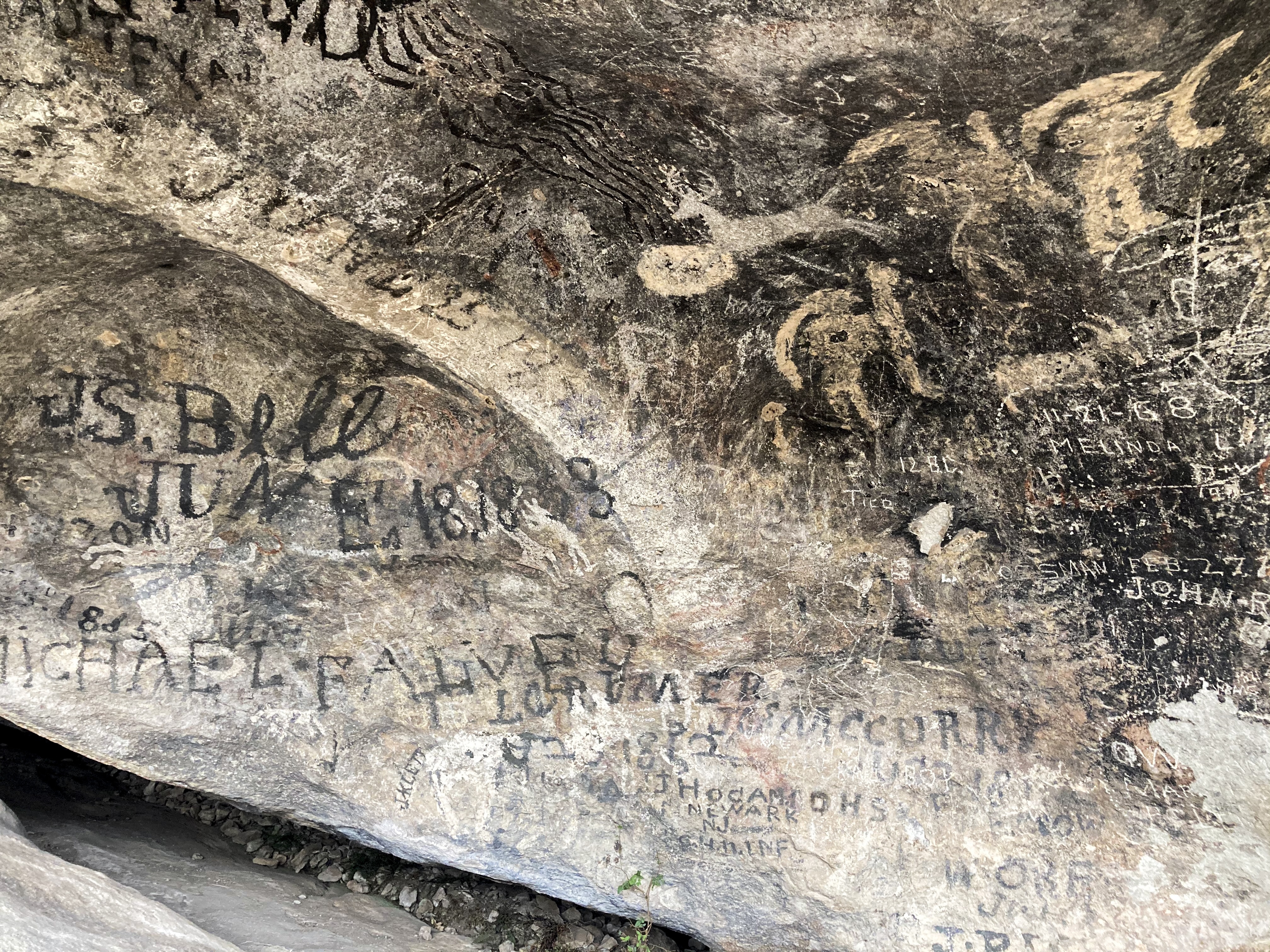
However, if my scholarship is able to make this and other prescriptions, it is only because it develops a far wider range of descriptions. When I took the photograph that illustrates this post, and when I analyzed the photograph as part of my article and then my book, I felt frustrated with how the English and Spanish words overshadowed the Indigenous images. But rather than rushing to prescribe a solution to such processes of colonization, I slowed down to describe the full variety of relations.
Composed of clay and gypsum, these pictographs blur the figure/ground boundary so crucial to settler aesthetics. In space, they shift in relation to the rocks, so as a dog hides near the hearth, a snake slithers up the slope. And across time, they endure elements both all-too-human (the Michaels and Melindas who have inscribed their names in charcoal and paint) and more-than-human (the dust and wind that have eroded even this sheltered spot).
Beneath and beyond our bordered present, we can see a borderless past. How might it help us build a borderless future?
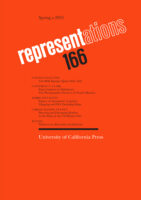
For a limited time, “Drawing and Disrupting Borders in the Wake of the US–Mexico War” will be available for free online. At any time, individual print copies and/or full subscriptions can be purchased on the Representations website.
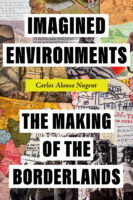
With code UCPSAVE30, you can get 30% off Imagined Environments: The Making of the Borderlands. Currently available for preorder, it will be released on November 3, 2026.
About the Author
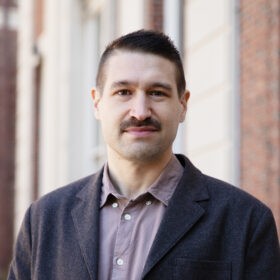
Carlos Alonso Nugent is Assistant Professor at Columbia University, where he offers courses on Latinx literature and culture, critical race and ethnic studies, and the environmental humanities. In Fall 2026, his book Imagined Environments: The Making of the Borderlands will be published in the American Crossroads Series at the University of California Press. Previously, his articles have appeared in journals such as American Literature, American Literary History, American Quarterly, and Representations.