How Community Coalitions are Fighting Back Against the Harms of Technology
By Colin Rhinesmith, author of Digital Equity Ecosystems: How Community Coalitions Reduce Inequality and Strengthen Democracy
There’s one positive thing that’s come out of the fight against AI data centers: people in communities across the U.S. are coming together to combat the real and potential harms of technology. This visceral frustration among the general public—caused by the real and potential harms created by enormous investments in data centers the size of several American football fields—is moving people off their devices and into the streets. And, as the New York Times reports, “savvy politicians are converting pitchforks into votes.” Americans are rightly concerned that they, and not the billionaire data center owners, will foot the electricity bills to power these behemoth centers. Politicians’ interest in joining the fray is also evidence that communities have their own power when they come together to address technology harms.
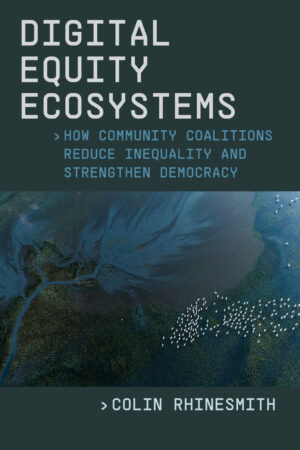
In my new book, Digital Equity Ecosystems: How Community Coalitions Reduce Inequality and Strengthen Democracy I share stories of people in communities across the U.S. who are coming together to address another harm caused by technology. In five case studies of what I call digital equity ecosystems in Chicago, San Antonio, Baltimore, Essex County, Massachusetts and Los Angeles County, I describe how people are working together across their differences to address the digital divide and its root causes of poverty and racism:
“The purpose of this book is to introduce a framework to study and understand the groundswell of social activity—in the form of community coalitions—to address technological inequity and social injustice. By focusing on digital equity ecosystems as sites for community engagement, civic participation, and organizing towards social justice, this book presents an opportunity to make sense of this current moment. I hope it will help us to see a social movement taking place in communities that has chosen tolerance, discussion, deliberation, and shared decision- making over a disregard for democratic ideals.”
Drawing upon scholarship in the fields of information, communication, technology, and public health, I introduce an ecological framework for researchers, digital equity practitioners, and policymakers to address social and technological inequality. Grounded in community coalition action theory and inspired by insight from functional ecology, the book was written for those concerned about technology and its harms on our natural world while providing a roadmap to help people create stronger, healthier communities.
I also share my own experiences working as the Community Media and Technology Manager at Cambridge Community Television in Massachusetts during the late 2000s, where I witnessed how poverty shapes people’s experiences with, and without, technology. In our ComputerCENTRAL public computer lab, I, along with eight volunteers from the community, supported residents in Cambridge without access to computers and the internet at home. Much like a public library, we helped these individuals and families to not only gain access to technology, but to one another. As a community media center, our mission was to provide a free speech public forum where individuals, as community media scholar and visionary Bob Devine described, “move from private citizens into public life.” It is here at CCTV that I learned about the process of community-power building to enhance democratic communication and community ownership of information and communication technology.
I close the book by situating this work of community coalitions within a global perspective. I characterize coalitions as civil society actors, building on this recognition from the United Nations, which describes coalitions as entities working to “resolve problems and address issues that are important to society,” including “combating poverty, corruption and economic inequality; responding to humanitarian crises, including armed conflict; promoting the rule of law and accountability; protecting the environment; and advancing social justice.” I use the three conditions for healthy digital equity ecosystems—energy, diversity, and resilience—to provide a roadmap to ensure that coalitions prioritize equity, social justice, and environmental sustainability in their work to address the harms of technology.
As the fights against AI data centers, e-waste, and digital inequality continue, Digital Equity Ecosystems is a reminder of what’s possible when people work together for the greater good. It is inspiring to see the leadership of everyday people, as “network weavers,” who stand tall in the face of social and technological uncertainty.
About the Author

is Associate Professor of Information Sciences and Director of the Digital Equity Action Research Lab at the University of Illinois Urbana-Champaign.