Recovering Women’s Film History in the Archive
By Aurore Spiers, author of Archiving the Past: Women’s Film History in France, 1927–1978
Since the 1890s, many women have contributed to global cinema, not only as actresses but also as directors, producers, screenwriters, editors, costume designers, critics, and more. The list of their known achievements in fact keeps growing as feminist film historians continue to recover women’s extensive work in film.
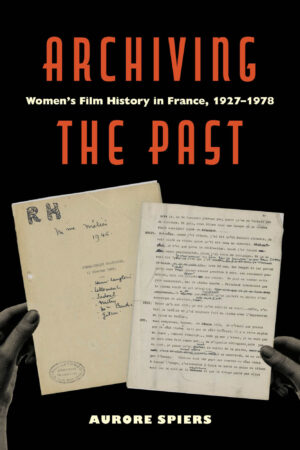
In Archiving the Past: Women’s Film History in France, 1927–1978, I add to that list by showing that “women have long been active in the production of global cinema’s history; they have served as archivists charged with collecting films and other materials, as witnesses tasked with remembering their past film careers, and as activists committed to recovering women’s contributions to film history.” As I write in the introduction, the book also offers “a more complex understanding of how gender politics informs the production of global film history; it reflects on film history’s biases, oversights, and erasures and models strategies for inclusivity, recuperation, and liberation within film historiography.”
While writing the book, I myself visited many archives where I searched for traces of how women worked toward safeguarding cinema’s historical past. I expected to find very little, mainly because I knew that women’s work in any field had rarely been a major focus of archival preservation. The women I was researching rarely appeared in the catalogs of the Bibliothèque nationale de France, the Archives Nationales, and the Cinémathèque française where I was most likely to find anything about them. Yet these institutions held many pleasant surprises in the end, which allowed me to tell the story of how women have contributed to the writing of French and global film history in various fascinating ways since at least the 1920s.
For example, at the branch of the Bibliothèque nationale de France located near the Palais-Royal in the second arrondissement of Paris, the collection named after the well-known communist film critic Léon Moussinac included quite a few documents that revealed the extent of his wife Jeanne’s involvement in the Bibliothèque du Cinéma (1927–29). While largely forgotten, Jeanne Moussinac was an actress, painter, and writer whose work for the Bibliothèque du Cinéma represented one of the earliest efforts to collect books and papers about the first decades of the film industry. Evidence of that work was everywhere in the Léon Moussinac collection, hiding in plain sight, neglected by traditional historiography but ripe for feminist recovery.
It is necessary for feminist film historians, and for the women and other people we aim to recover, that we return to the archive again and again and again, looking for evidence that others perhaps uninterested in women’s achievements have missed before us.
When I went to the Archives Nationales and the Cinémathèque française, something similar happened. I consulted hundreds of documents—letters, administrative memos, interview transcripts, etc.—from collections dedicated to the Cinémathèque Nationale (1932–39) at the Archives Nationales, and to the Commission de Recherches historiques at the Cinémathèque française. While none of these documents offered a straightforward account of women’s labor in, and with, the film archive, more than a few carried the physical marks of that labor, sometimes even small ones like a signature or handwritten notes in the margins. Only by adopting an almost forensic approach, one attuned to those physical marks, was I able to learn about the historiographical work of photographer Laure Albin-Guillot at the first national cinematheque in the 1930s, and of actress and filmmaker Musidora at the Cinémathèque française in the 1940s and 1950s.
At the same time, Archiving the Past required that I expand my parameters even further, to include other significant women whose engagement with the film archive took different yet no less impactful forms. Within the collection dedicated to the Commission de Recherches historiques at the Cinémathèque française, for example, I considered the testimonies by the widows and daughters of so-called film pioneers as significant contributions to the writing and preservation of French and global cinema history. Importantly, I also paid close attention to the work of the feminist film collective which was named after Musidora and which organized the first women’s film festival in France, published writings about women’s film history, and released the first French edition of Alice Guy Blaché’s memoirs in the 1970s. That work challenged the ways in which film archives had contributed to the marginalization of women filmmakers and movie workers. Ultimately, I found that, “as the film preservation movement continued to develop around [such masculinist practices as] cinephilia and auteurism, women’s engagement with the film archive multiplied, expanded, and intensified in ways that often put pressure on the gender politics shaping the very object and site of their work.”
In the introduction to Archiving the Past, I note that “scholars before me have gone to the same institutions” and “looked at the same collections and wrote about these women generally in works that either examined a different aspect of their careers or focused primarily on the career of someone else.” Yet it is necessary for feminist film historians, and for the women and other people we aim to recover, that we return to the archive again and again and again, looking for evidence that others perhaps uninterested in women’s achievements have missed before us. Much still lies in the archive that requires our attention as we write more inclusive film histories, fight against new fascist threats, and build better feminist futures.
About the Author

is Assistant Professor of Film and Media Studies in the College of Performance, Visualization & Fine Arts and the Women's and Gender Studies Program at Texas A&M University.