Making Care Affordable is Key to Our Economic Future
By Nancy Folbre, author of Making Care Work: Why Our Economy Should Put People First
At some point in our lives, most of us commit time and money to taking care of others, especially children, the elderly and people experiencing illness or disability. Most of us consider such commitments both morally valuable and personally satisfying. Yet there is widespread disregard for their economic value to society as a whole—a disregard that contributes to mounting private costs.
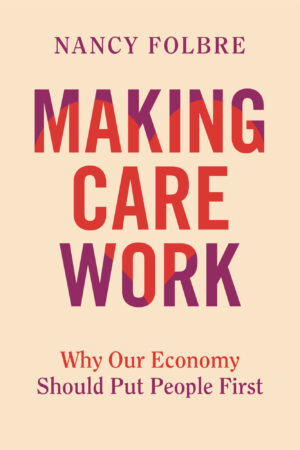
My forthcoming book, Making Care Work: Why Our Economy Should Put People First, traces this long history of misplaced priorities. It explains how unpaid care came to be disqualified as productive work and how expenditures on ourselves and others came to be classified as consumption rather than investment. Not everything we produce can be bought or sold, and market prices seldom reflect the social benefits of good care or the social costs of failing to provide it.
Conventional measures of economic success don’t capture the experience of everyday life in the U.S. The stock market is booming, and Gross Domestic Product is trudging upward. But inflation remains endemic, and the cost of care services is going up even faster than the “cost of living” measured by the standard Consumer Price Index.
Our most immediate experience of sticker shock comes at the grocery check-out counter. But health care, education, child care, and elder care are big ticket items, and their prices have long been increasing much faster than those of the standard basket of consumer expenditures. At any point in time, these out-of-pocket expenditures vary more across different households than, say, expenditures on food. But they too, are necessities.
Many families rely heavily on care time provided by parents, grandparents, relatives, and friends, but while this help is unpriced, it isn’t actually free, because it often reduces caregivers’ opportunities to earn market income. Mothers of children under five are often caught in a circular trap—without child care assistance they can’t find a decent-paying job, but if they can’t find such a job, they can’t possibly pay for the assistance they need.
In the U.S. today, care provision is at least partially subsidized by public investment, with good reason—it provides public benefits. It produces and maintains workers for the labor market and taxpayers who contribute to Social Security and national debt repayment. It produces and reproduces the families and friends that we all rely on. It helps stabilize our social climate and protect our collective future.
Public spending on health, education, and social assistance improves our opportunities to fully develop our own capabilities and those of others. Yet it is seldom recognized as investment, treated instead as a luxury that we can ill afford, unlike tax cuts for large corporations and the wealthy. Over the past year, significant cuts to federal Medicaid benefits, Affordable Care Act spending, the Supplemental Nutritional Assistance Program (SNAP) and education have increased pressure on many states to limit eligibility for child care and home and community-based care for elderly and disabled persons.
Private investment in so-called artificial general intelligence is booming, because it promises to cut labor costs and generate huge profits. Consumers may also benefit. But while new technologies may lower costs for some goods and services, they are unlikely to encourage investments that provide public rather than private benefits. Indeed, they may well constrict economic opportunities for the younger generation and displace many of the job ladders that have historically provided access to a modicum of economic prosperity.
No amount of economic growth is going to make care provision affordable unless we commit to putting people first.
If new technologies reduce the demand for competent human workers, they will also reduce employers’ incentives to support public investments in producing, developing, and maintaining human capabilities. Humans will likely continue to provide the face-to-face, hands-on and highly personal care that we require in order to thrive, but we might receive less remuneration than ever for this essentially unprofitable activity.
Are we all just inputs into a market that generates dollar-denominated Gross Domestic Product, or could we treat ourselves as the more valuable final product? No amount of economic growth is going to make care provision affordable unless we commit to putting people first. To do that we need to develop equitable, efficient and sustainable ways of sharing both the costs and the benefits of investing in one another.
This is not something that a market economy based only on buying and selling can do on its own.
About the Author

is Director of the Program on Gender and Care Work at the Political Economy Research Institute and Professor Emerita of Economics at UMass Amherst. She is the author of many books, including The Invisible Heart: Economics and Family Values.