How Transpacific Contemporary Art Reveals Imperialism’s Role in the Global Rise of Fascism
By Namiko Kunimoto, author of Imperial Animations in Transpacific Contemporary Art
Today, it is critical that each of us reckon with our complicity in the growth of fascistic power. Do we remain silent because speaking out makes us uncomfortable, even when we know what is happening is wrong? Do we choose compliance because we believe it is better to protect our own interests, even at the micro level? On a larger scale, how do liberal institutions accommodate fascism through their emphasis on safety and comfort (for the privileged few), their bureaucratic pressure to conform, and their willingness to censor and control?
These are the critical questions that my new book Imperial Animations in Transpacific Contemporary Art addresses, by examining art that exposes colonial trauma and reveals its role in shaping political liberalism in Japan, as well as the global rise of aspirational fascism.
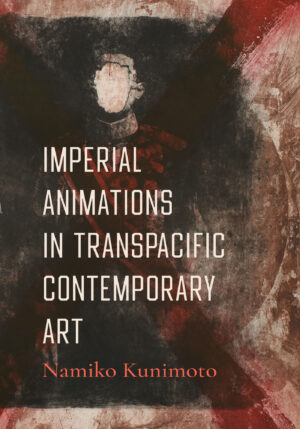
The cover of Imperial Animations in Transpacific Art offers a relevant example. It features an etching by scholar, activist, and artist Shimada Yoshiko. Her 1993 artwork, A Picture to Be Burnt was among those exhibited at the 2019 Aichi Triennale which focused on freedom of expression. The work was widely perceived to be an expression of anti-imperialism—an accurate assessment. However, this singular reading overlooks the history of Shimada’s practice and ironically obscures her critique of censorship and institutional power, thereby losing her insight into the broader mechanisms of bourgeois liberalism at work in Japan and beyond.
The work responds to the Toyama Museum of Art’s decision in the early 1990s to remove artist Ōura Nobuyuki’s artwork from an exhibition after complaints that it cast the emperor in an unfavorable light. Museum officials went so far as to burn exhibition catalogs containing the image and later sold the purchased works to an anonymous buyer. Although controversy initially arose from right-wing criticism, it was the museum itself that enacted censorship, revealing the depth of institutional accommodation to nationalist affect.
After the incident, Ōura retreated from public controversy. Shimada, by contrast, created A Picture to Be Burnt: a two-plate copper etching depicting the young Emperor Hirohito marked with a red X. She burned one print, sent the ashes to the Toyama Museum with a letter of protest, and later exhibited a partially burned image alongside the returned letter and ashes. Her project directly exposed the museum’s role in accommodating fascistic drives – and the hollowness of institutional commitments to core liberal ideals like free expression.
A Picture to be Burnt demonstrates how wartime mythologies of imperial devotion might seem distant, yet bourgeois liberalism in Japan continues to protect imperial “traditions” without reckoning with responsibility for wartime atrocities. Shimada links her critique of the emperor to the continuities of present-day politics and its reflexive, uncritical nationalistic values. A large, red X cuts through the center of the body, its size and uneven color conveying the intensity of its execution. Anger is palpable here. Hirohito’s face is burned through, leading us to gaze at the void behind the paper rather than into the eyes of someone many believed they “knew.” His identity can be inferred from his uniform, ceremonial decorations visible through the darkened paper, but the emperor is depicted without a face. The empire is empty: we can observe the imperial body, but the imperial gaze cannot be returned. Critically, Shimada forecloses the possibility of the powerful affective encounter between the emperor’s representation and the viewer.
Imperial Animations tracks how contemporary transpacific artists like Shimada have responded to Japan’s imperial past, articulating the present-day ramifications of Japanese empire through installation work, painting, digital media, and performance art in Japan, Canada, South Korea, Taiwan, and Singapore. I refer to these artworks as “imperial animations.” Throughout the book, I use “animate” in its most capacious senses: to create apparently lifelike movement, to give life to, to give vigor and zest, or to move to action. To animate is to bring life to the two-dimensional, to the ruin, to the resurgent effects of colonialism. The term also calls up the Latin word anima, meaning “breath, soul,” and it is the term that gave us “animal,” signaling the instinctive and alive. To animate history, then, is not just to consider historical context but to create political consciousness that is enlivened through historical interpretation. Imperial Animations urges us to develop a more complex understanding of imperialism and its links to such eminently contemporary phenomena as the digital age, and the global rising tide of fascism.
Author Note
I refer to fascism as a form (not just of the state but of ideology and thought) available during capitalist crisis, which as Tosaka Jun describes, emerges from liberalism rather than in opposition to it. William E. Connolly describes an aspirational fascist as one “who pursues crowd adulation, hyperaggressive nationalism, white triumphalism, a law-and-order regime giving unaccountable power to the police, a militarist, and a practitioner of a rhetorical style that regularly creates fake news and smears opponents to mobilize support.” Aspirational Fascism: The Struggle for Multifaceted Democracy under Trumpism (Minneapolis: University of Minnesota Press, 2017), 7.
About the Author

is Director of the Center for Ethnic Studies and Associate Professor in the Department of History of Art at The Ohio State University. She is author of The Stakes of Exposure: Anxious Bodies in Postwar Japanese Art.