Q&A with Cindy Nguyen, author of "Bibliotactics"

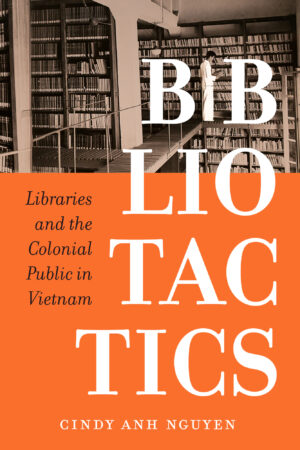
Libraries in French colonial Vietnam functioned as symbols of Western modernity and infrastructures of colonial knowledge. Yet Vietnamese readers pursued alternative uses of the library that exceeded imperial intentions. Bibliotactics: Libraries and the Colonial Public in Vietnam examines the Hanoi and Saigon state libraries in colonial and postcolonial Vietnam, uncovering the emergence of a colonial public who reimagined the political meaning and social space of the library through public critique and day-to-day practice.
Author Cindy Anh Nguyen is Assistant Professor in the Department of Information Studies and the Digital Humanities program at the University of California, Los Angeles.
What inspired “Bibliotactics”?
The inspiration is definitely a personal one. I was born in a refugee camp when my family fled post-war Vietnam in the 1980s. I grew up in public libraries in the United States, and as a young person and as an immigrant refugee, found it to be a place of possibility and community. The social and public space of the library was always at the back of my mind as I pursued my Ph.D. in Southeast Asian history. I was raised by stories from my parents and elders who would share about their homeland, Vietnam. These stories motivated me to pursue Vietnamese history in a way that was distinct from the bits of Vietnam I received from U.S. education about the Vietnam War. I wondered more about the cultural, social, and intellectual world of Vietnam that predated the war and wondered about more nuanced concepts such as cultural belonging, community, language and identity. And that is when things came full circle that I decided to write a book about libraries in Vietnam because it invited critical attention to rethink French colonialism, Vietnamese culture and language, and the role of state institutions in shaping public life.
What was the reading culture like at that time in Vietnam?
The period I focus on is during a twentieth century shift in writing systems and education, which ultimately expanded being a reader from the privileged few, to a wider community of men and women, urban and rural readers. The historical shift, which I characterize more as a “competing world of letters” is between a Confucian system of privileged elite education in characters in Chinese and Vietnamese script and trained by a very small community of teachers in order to become a civil servant in the bureaucracy to the expansion of education opportunities in French and vernacular Vietnamese. I shed light on the library as a crucial cultural and educational institution that widened the possibility of literacy and access to reading matter. While the majority of the materials I examine are in French, my argument is that during 1917 to 1958, reading culture was a multilingual one. People were engaging in three languages, in Chinese, in Vietnamese, and in French … writing in those languages and speaking in those languages. Reading culture goes beyond the book and the solitary reader. It was about reading in the library space but also reading out loud socially. Through the book I wanted to expand on the meaning of reading beyond the Western sense of solitary and quiet reading. In reality, the colonial library institution is a space where people were reading and engaging in much more dynamic ways for social life and community.
How have you been able to employ digital humanities in your research?
For this specific book, digital humanities gave me the methodological training to approach historical sources as data and as contested data too. There were a lot of library circulation statistics of how many people entered the library, how many books they checked out, when they entered, and what race and gender they were, as well as what they read. There was a lot of unstructured data because they were primary sources and digital humanities gave me the intellectual background to structure and organize the data in systematic ways and to criticize it to see which spaces have data silences and biases–this type of information literacy is even more crucial and important now with the widening impact of artificial intelligence systems upon knowledge production.
Digital humanities is also at the heart of my community-engaged scholarship. As a historian, I engage closely with archivists and librarians, and what I hear from my engagement with them that’s been of rising importance is the role of digital scholarship, digital literacy, digital information systems. My work this past summer in Cambodia with my Vietnamese colleagues and Vietnamese librarians was around questions of digital futures within libraries. My community-engaged research co-designs with my community partners around urgent contemporary needs in knowledge transmission, preservation, and information literacy. My book also engages with Cambodia as well, as part of French Indochina and the legacies of those information systems or inequalities that had roots in the colonial period, and what they might look like today in terms of language, education, and information literacy.
Why does a book on the history of Vietnamese libraries and reading culture matter today?
When I started my project on the history of libraries in Vietnam and would tell my friends, and colleagues in Vietnam, I recall being confronted repeatedly with a staggering statistic: “Did you know that last year Vietnam had one of the lowest rates of reading in the world?” Many individuals were quoting a popular statistic that circulated across Vietnamese news media in 2013, declaring that “Vietnamese read less than one book per year,” specifically .8 book. The figure is even more staggering for rural readers, where rural children might read .2-.8 book a year compared to 5 books a year for urban children (https://vietnamnet.vn/en/vietnamese-read-less-than-one-bookyear-E71670.html 2013)
This abysmal statistic was part of several decades-long initiatives to measure international reading cultural initiatives, such as through UNESCO’s World Book Day initiated in 1995 for annual designation on April 23, followed by the designation of April 21 as Vietnam Book Day beginning in 2014. With this international attention to reading culture and cultivating reading societies, the low statistic for Vietnam was part of a larger cultural phenomenon and public concern in what Professor Nguyễn Đăng Điẹp describe as the "degradation of culture and the decline of reading culture.” Nguyen Dang Diep, 2016 https://vjol.info.vn/index.php/ssirev/article/view/26616/22770 )
I remember hearing the statistic then in 2013-2014 and questioning how the statistics were collected, from the sampling size and demographics to the format of the question. For example, if reading e-books or online social media news articles at the time would be considered ‘reading.’ The statistic seemed to be contrary to my personal first hand contemporary experiences of a multifaceted reading culture that seemed to spill across spaces and formats–from older folks reading print out newspapers to younger cafe going generation constantly on mobile devices, communicating (in other words, reading and writing) in rapid fashion. And of course you had the reverse, of older folks on mobile digital devices watching youtube, listening to voice actors reenact popular stories, and younger hip kids in corners of cafes reading global translated books and writing in their favorite paper journals. This contemporary statistic and concern over reading culture had a deep and much longer complex history, a story I sought to tell through Bibliotactics: Libraries and the Colonial Public in Vietnam.
After my last return to Ho Chi Minh City in 2025 I witnessed the popularity of Nguyen Van Binh “book street”, the 100 meters pedestrian only near the Nha Tho Duc Ba, a hub of bookish culture–a headquarters for the popular Vietnamese book publishers who hold stalls and feature recent publications, as well as community book events and a photographic backdrop for visitors and locals.
Saigon (Ho Chi Minh City) along with many other metropolitan global cities in Southeast Asia, is experiencing a cultural youth renaissance of global mindsets. SEAPunk–one such reflection of this future oriented grassroots collective–and I co-organized a creative community event to reflect on the pasts, presents, and futures of libraries and reading culture in Vietnam. While a small sample, we had a dynamic conversation around third spaces, an expanded understanding of literacy (information, media, misinformation), and individual and collective motivations around reading such as self-improvement, learning and expansion of mindsets. Many of the contemporary conversations had parallels with Vietnamese reading culture nearly a hundred years ago that I write about in my book.
Ultimately, I hope that Bibliotactics invites readers to critically think about the pasts, presents, and futures of libraries and reading culture in Vietnam and beyond.