An Exclusive Look at "Sails & Shadows" by Patricia Seed
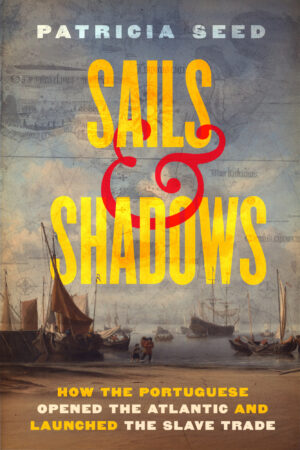
We are pleased to offer an exclusive excerpt from the Introduction of Sails & Shadows: How the Portuguese Opened the Atlantic and Launched the Slave Trade by Patricia Seed.
By 1400, sailors around the world had conquered all oceans except one. Ancient Greeks had sailed the inland waters of the Mediterranean and Black Seas. Persian, Roman, and Arab navigators had followed the east coast of Africa about two-thirds of the way south and trailed seasonal winds to India. Asian ships had crossed the South China Sea and voyaged around the Bay of Bengal to Arab settlements along the East African coast. Intrepid Polynesians had traversed thousands of miles of Pacific waters both east and west, occasionally north and south. But despite the immense reaches of the Atlantic Ocean, only the Norsemen had crossed a tiny sliver in the far north.
Thus, no one outside the Americas knew of the Western Hemisphere— because, before the Portuguese voyages, nobody could cross the Atlantic Ocean. “One cannot sail the [Atlantic] Ocean,” declared a Roman writer. “Beyond the Ocean, nothing.” Another Roman concluded that if “any habitable lands [rested] either in the Ocean or beyond the Ocean . . . it was impossible to reach them.” Nearly a thousand years later, a Muslim writer expressed almost identical sentiments: “No ship sails therein, nor is any habitable land there.”
Likewise, the Iberian writer al-Masudi expressed the dread that prevailed among Roman and Muslim writers: “Observe . . . the warring of its winds,” he wrote. “Such [is] the mad rage of the sea when stirred from its lowest depths: there is no anchorage at hand, no safety: all is unknown.” A Roman orator proclaimed: “The waves are enormous. . . . The winds are violent . . . on all sides, savage sharks and dogs of the sea, seiz[ed] their ships . . . [leaving the sailors] stranded . . . to be mangled by the wild beasts of the sea.” Even modern geophysicists agree that “the Atlantic is arguably the ocean’s most complex basin.”
Portuguese sailors were the first to overcome the obstacles to crossing the world’s second largest ocean. Still, only two of their successful Atlantic journeys—those of Bartolomeu Dias and Vasco da Gama—have remained well known. The first proved that a waterway linked the Atlantic and Indian Oceans; the second created a novel sea route from Lisbon to centuries-old trade in a small corner of the Indian Ocean. When recounted so matter-of-factly, these two events appear to have come out of nowhere. So, how did these two expeditions navigate nearly four thousand miles south and almost three thousand miles west when no one else in human history had advanced south of Newfoundland?