Mechele Dickerson on Saving the Middle Class
This interview by Jeremy Simon was originally published on The University of Texas at Austin School of Law website.
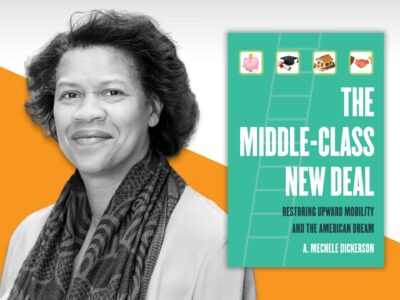
In response to the Great Depression, U.S. political leaders took decisive steps to save the economy.
It’s time they act again, according to a new book.
During the New Deal of the 1930s, “bold and comprehensive actions ensured that lower and middle- income families … could find jobs that offered high wages so they could buy homes, pay for college, pay their bills on time, and comfortably retire,” Texas Law Professor Mechele Dickerson writes in her new book. “In the process, political leaders created the middle class as we knew it.”
But today, their creation is in danger—and the U.S. economy is, too. Dickerson writes in “The Middle-Class New Deal: Restoring Upward Mobility and the American Dream” that with rising unemployment, lack of affordable housing, threats to workers’ retirement, and other perils facing lower- and middle-income Americans, leaders must respond.
Dickerson, the Arthur L. Moller Chair in Bankruptcy Law and Practice and Texas Law faculty member since January 2006, recently discussed topics including what’s different now versus the 1930s, how leaders and law students can help, and the inspiration she draws from the classroom.
The middle class drives the country’s economy. If we don’t bolster the middle class, our economy is going down the drain.
Are there lessons from the New Deal that people have forgotten?
We haven’t always had a middle class in this country—political leaders wanted to have one. There haven’t always been 15- to 30-year mortgages. Political leaders created them to make it easier for lower- and middle-income folks to buy a home. Before the New Deal, not as many people went to college. But the GI Bill enabled returning veterans to go to college or trade school, because we gave them money. If political leaders want to make something happen, they can make it happen. We saw that in the New Deal.
Also, a lot of things in 2019 that people said can’t happen, in fact happened during COVID. The government realized, “People can’t work, unemployment rates are skyrocketing, let’s give people money so they can survive.” People were struggling with food insecurity, and local entities said, “Let’s figure out a way to get food to people.” We may choose to ignore things that we saw during COVID, but we can’t unsee them.
Why should everyone care about the health of the middle class? What’s the danger if we don’t address its challenges?
The middle class drives the country’s economy. Take coffee makers, for example. There are only so many that a billionaire is going to buy, even if they have five or six houses. So, who is buying them? The reason we should care about the middle class isn’t just because of what they contribute to the economy, but we should at least be concerned about how many products like coffee makers we can sell. If the country doesn’t care about the middle class as human beings, at least understand that you need lots of people who can afford to buy basic products, because billionaires alone are not enough to save this economy. It seems like the only way to get the attention of politicians or business leaders is to say, “If you don’t bolster the middle class, your economy is going straight down the drain.”
When people work hard, play by the rules, and yet still can’t get ahead, you have anger. And it’s not healthy to have a country filled with angry people because they justifiably believe that the economic rules are stacked against them.
Out of the many examples in your book, what’s one economic warning sign?
Homeownership. New homebuyers’ average age is now creeping up to 40, and that’s a problem. A lot of cities, including Austin, have more renters than homeowners. That’s a red flag. Not everybody needs to be a homeowner; there are all sorts of reasons people might not want to own a home. But homeownership has always been viewed as part of the American dream and I would argue, at least until recently, the largest marker of the middle class. But we’re now telling people, “Homeownership isn’t an option for you.”
Housing is among the issues—as well as education and employment—you write about in the book. Which one is most urgently in need of reform?
Right now, it’s employment. It’s particularly challenging that the unemployment rates of young people are so high. If recent college graduates are struggling to find any job or a full-time job with benefits—which I refer to as a “good” job—they’re not able to buy homes or save money, they’re going to have too much debt. And I’m not going to listen anymore to people who say the problem is AI taking jobs. Because we’ve been here before in the1980s, when robots were taking jobs in manufacturing plants or we started to have self-scanners in grocery stores. Technology doesn’t change the fact that you can still pay people a decent wage for a full-time job, rather than only giving them 38 or 39 hours—never enough to be full time—or certain hours on Monday and a different set of hours on Tuesday. That’s the reality for a lot of young workers.
What’s the first step toward improving the employment situation?
Political leaders need to stop saying, “There’s nothing we can do! It’s the market causing these problems, technology is the problem.” They can control how they tax companies, limit the compensation of the people who run those companies, and break up the three or four large tech companies that basically govern everything—you’ll probably end up with more jobs. They can say that employers have an obligation to be fair to their workers, or to stop making it so hard for workers to organize. Even though organized labor wasn’t perfect—some labor unions did things that perhaps we don’t agree with—the employment situation for workers hasn’t improved since governments and business leaders gutted unions. I hope this book can force politicians to stop throwing up their hands.
If political leaders want to make something happen, they can make it happen. We saw that in the New Deal.
Why aren’t political leaders already doing more?
They don’t want to do anything about it. There’s a difference between an unwillingness and an inability to act.
Congress is so polarized they can’t even get simple things done. From the 1980s forward, we get into “them against us.” You hear arguments like, “Those immigrants are taking your jobs,” but not acknowledging lost middle-income jobs are not taken by immigrants. We’re pitting groups against each other. That allows political leaders to ignore the problems, stand there, and have people fight rather than sit down to say, “Wait a minute, the person I’ve been told is my enemy, in fact, isn’t doing much better than I am. Maybe the people at the top are the ones causing my economic hardships.”
Political leaders are deciding to protect the interests of people who earn $50 million a year, rather than people who earn $50,000 a year but can’t find any place to live, don’t have retirement savings, and are using credit cards in profoundly unhealthy ways.
Can you offer any advice to Texas Law graduates who want to help?
If you run for local government offices or represent cities, see if your zoning laws make it hard for lower- and middle-income folks to find nearby affordable housing.
If you represent a real estate developer, see if there are ways to incorporate affordable housing as part of new real estate projects. For people in Big Law, take on pro bono cases of homeowners who have been defrauded. There are all sorts of things that can change laws to benefit the middle class.
Given the scope of the challenges, what makes you feel positive about the future?
Young people. Every time I step into a law school class and talk to students, I feel more hopeful about the future. Because I teach, it’s a daily process.
Second, the current economic calamities are not sustainable. People either don’t have a job or they’re holding on to a job they loathe. People cannot find affordable housing. Young people don’t necessarily want to be living at home with their parents, which is increasingly the norm. We’re going to have to have change because young people, but also people more broadly, have been harmed by economic policy.
In 10 years, the people who will be driving the political train are those who have been negatively affected by the unwillingness of political leaders to think about anything other than people at the top of the economic scale.
Every time I step into a law school class and talk to students, I feel more hopeful about the future. Because I teach, it’s a daily process.
Your book’s “acknowledgements” section thanks many people. Are there any Texas Law colleagues you’d identify?
At one point, Wendy Wagner was working on a book while I was working on my book, and we’d have regular “research buddy” check-in calls. And when COVID hit, I had to stop, regroup, and rewrite the book. Tom McGarity, Bobby Chesney and Susie Morse were also incredibly supportive.
Finally, how did your teaching play a role in the book’s creation?
One of the greatest things about being an academic is getting to recreate yourself. I started out teaching bankruptcy and civil procedure classes; I no longer teach bankruptcy, but I still teach civil procedure and now also teach remedies—and I write about neither. As an academic, it’s a beautiful thing when you can have an interest that started from what you used to be. The book doesn’t focus on debt but has a chapter on it. The luxury we have as law professors is teaching and writing about things that interest us. For the last 10 years, as I’ve been working on this book, I’ve been able to teach courses on the middle class at both the Law School and undergraduate level. What a dream to go into class with your research and then take your classroom experiences to enhance your research.