Erosive Forms and a Climate of Violence in the Work of Juan Rulfo: A Q&A with Mark Anderson
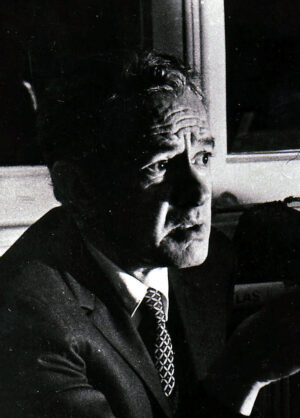
In the current issue of Mexican Studies/Estudios Mexicanos, scholar Mark Anderson analyzes the entanglements between representations of the environment in Juan Rulfo’s literary works and historical transformations in land-management regimes in the Altos de Jalisco region of Mexico. We invite you to read Anderson's article, "El enigma del páramo: formas erosivas y el clima de violencia en la narrativa de Juan Rulfo" for free online for a limited time and to learn more about Anderson's work in our interview with him below.
Juan Rulfo is one of the most celebrated writers in Mexico, and deservedly so. What does an approach to his work from the perspective of ecocriticism tell us that we didn’t know before?
I’m fascinated by one of the foundational questions of literary studies: how distinct aesthetics emerge during specific historical contexts and the critical perspectives they provide on them. It is paramount to look deeply at the connections between the material (the specific cultural practices, social structures, economic regimes, and environments) and the symbolic (language). In the case of Rulfo’s writing, many critics have examined the social conditions underpinning his works, especially the caciquismo associated with the liberal capitalism of the Porfiriato (1876-1911) and the 1910-1920 Mexican Revolution. But only a few critics have taken his representations of the environment in Los Altos de Jalisco seriously. Most critics have viewed them as pure symbolism, as representations of the underlying violence of that historical period or in humanistic terms as capturing supposedly timeless, universal qualities of the human psyche and social relations.
In my article, I show how Rulfo’s representations correspond to specific environmental transformations caused by the transition from sustainable agrarian modes of production to intensive cattle ranching during the Porfiriato. I argue that his tropes of heat, aridity, and erosion are designed to foreground the entanglement between economic regimes, environmental transformations, social change, and the molding of individual subjetivities and collective identities. At the same time, they draw out what Rob Nixon called the “slow violence” of colonial capitalism and its extractive practices, which is not always immediately visible due to its long duration. Finally, I argue that Rulfo’s aesthetics of erosion are highly effective in drawing out the effects of anthropogenic climate change, making his writing more relevant than ever despite its status as Mexican classic.
Rulfo’s writing is full of echoes, ghosts, and remembrances. It’s arid. What was the hardest part about tracking back from the text to try and understand the pastoral world that lies behind the echoes?
Since ecocritical analysis depends on disentangling the relations between materiality and literary symbolism, it typically requires a good deal of interdisciplinary research. In this case, I read numerous environmental histories of Mexican land management practices and the cattle industry, as well as ecological studies regarding the deforestation and desertification caused by intensive cattle ranching. I wouldn’t say it was particularly difficult since I was a Biology-Spanish double major as an undergrad and I have a long-standing interest in sciences of different kinds, but it does require stepping outside rigid disciplinary boundaries and using a bit of analytical creativity to envision the connections between literary imagery and environmental transformations. Of course, that creativity must be backed up by textual evidence—so paying close attention to the language the author uses to describe the environment is also a must! You can’t just rely on plot summary.
Do you have a favorite Rulfo short story to recommend to our readers? If so, why choose that particular one?
I have honestly loved Rulfo’s writing since even before I learned Spanish, so I recommend all of it! However, “Nos han dado la tierra” (They Have Given Us the Land) holds a special place in my heart, and I frequently teach it in my undergraduate classes. I think it truly exemplifies Rulfo’s subtle genius in using seemingly simple language in a completely ambiguous way to draw out the complexities of the intersections between land management practices, politics, and social life, as well their effects for local people, who often don’t have full access to the information that would allow them to understand or control the situations in which they find themselves.
Rulfo was famously reserved and enigmatic. Would you have wanted to meet him? What might you have asked him?
I am a little bit like Rulfo in the sense that I often feel more comfortable interacting with others through writing than directly conversing with them, at least about topics they might consider sensitive. However, if I had had the opportunity to meet Rulfo before he died (in 1986), I would have liked to hear about his own experiences with the environment in Los Altos de Jalisco and how he thought they had influenced his aesthetics. I have always found it fascinating how certain artists, musicians, and writers develop styles that appear to be radically innovative, even singular, although there are always points of connection with prior and contemporaneous cultural trends.
Are there any other Mexican writers that you’d like to study in relation to ecocriticism? Why?
There are so many. In reality, ecocriticism is simply the process of taking environmental history and/or ethics into account when analyzing artistic and literary texts. So, it can be used as a methodology for reading any text, even those that take place in urban environments or that have no descriptions of the environment. After all, absence can tell us as much as presence, particularly when it comes to how people relate to their environments (and we can never live beyond environments).
One project I am currently working on involves analyzing representations of animal revenge in a short story by Mexico’s most famous author of kitsch-horror stories, Francisco Tario, “La noche de la gallina.” In the story, a pampered hen realizes that her loving family plans on killing and eating her, leading her to consume a poisonous plant that kills them all. I contrast this story with Uruguayan author Horacio Quiroga’s more subtle “Los cazadores de ratas,” a story in which a settler family kills a male rattlesnake and subsequently his female partner bites the family’s toddler child. Juxtaposing these literary fictions with ethological studies regarding animal altruism and morality, I explore the limits of concepts of justice and equality as they cross species boundaries. Neither of these stories contain detailed descriptions of the natural environment, but both portray human-nonhuman relations within an ecological framework of multispecies sociality, so I would argue that this is also a kind of ecocriticism.

We invite you to read Mark Anderson's article, "El enigma del páramo: formas erosivas y el clima de violencia en la narrativa de Juan Rulfo" for free online for a limited time.
Print copies of Mexican Studies/Estudios Mexicanos's Winter 2026 issue (issue 42.1), in which the article appears, as well as other individual issues of MS/EM, can be purchased on the journal’s site.
For ongoing access to Mexican Studies/Estudios Mexicanos, please ask your librarian to subscribe and/or purchase an individual subscription.
About the Author

Mark Anderson is professor of Latin American literatures and cultures at the University of Georgia. He specializes in the environmental humanities with a specific focus on Mexico and Brazil. He is author of Disaster Writing: The Cultural Politics of Catastrophe in Latin America (University of Virginia Press, 2011) and The Rights of Nature and the Testimony of Things: Literature and Environmental Ethics from Latin America (Vanderbilt University Press, 2024).