Q&A with the Editors of "Environmental Sociology Now"
It is a critical time for environmental sociology. Against a backdrop of increasingly dynamic environmental and social change, contemporary scholarship must reorient itself to cut through the noise and directly confront the urgent socio-environmental questions of today.
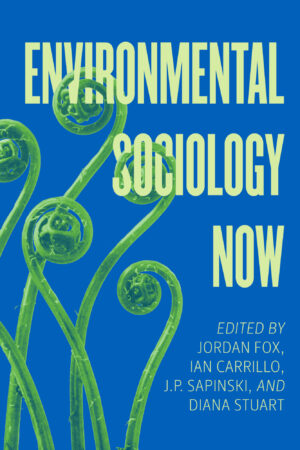
In Environmental Sociology Now, Jordan Fox, Ian Carrillo, J. P. Sapinski, and Diana Stuart have gathered original essays from many of the emerging scholars who are advancing new ideas and making innovative connections across disciplines to lay new foundations. Each essay centers on the prompt "What does a more interdisciplinary, more diverse, and more justice-oriented environmental sociology look like, and what does that mean for our collective future?" Bringing together different—and often conflicting—points of view, this book outlines an inclusive, forward-looking classroom and research agenda. Challenging both students and scholars to critically reconsider what our environmental relationships currently look like (and what may be in store), this timely book will be a vital resource for the research and teaching of environment and society for years to come.
Jordan Fox is Associate Professor of Sociology and of Environment and Sustainability at the State University of New York (SUNY) at Buffalo.
Ian Carrillo is Assistant Professor of Sociology and affiliate faculty in the Center for Brazil Studies at the University of Oklahoma.
J. P. Sapinski is Associate Professor of Environmental Studies at Université de Moncton, in Canada.
Diana Stuart is Professor in the School of Earth and Sustainability at Northern Arizona University.
Environmental Sociology Now brings together essays that imagine a more interdisciplinary and justice-oriented environmental sociology. What motivated you to frame the book around that core question, and how did that shape your approach to selecting contributors?
We wanted this book to focus on the present and future of environmental sociology, not its past. All signs point toward environmental sociology becoming more interdisciplinary and more justice oriented. This is for at least two reasons. First, conversations about our shared environmental futures need multiple perspectives because our environmental problems are tremendously complex. We need to be more open to sharing ideas within and between disciplines if we are to come close to fully understanding them. Second, amongst all this dizzying complexity, the only stable element of our contemporary environmental problems seems to be that they increase inequality. It would be both ethically and analytically myopic if we avoided questions of justice.
This focus on interdisciplinarity, justice, and the present and future of environmental sociology is built into the foundation of the book. The four of us, for example, come from quite different intellectual and societal backgrounds. We immediately saw this difference as a strength because it meant that while we all identify as environmental sociologists, the book would not come from a single environmental sociological tradition or viewpoint. Similarly, when we approached potential contributors, we took care not to ask established scholars within our own networks but instead sought out early and mid-career scholars from outside our networks, with an emphasis on asking people from a variety of institutional, social, and intellectual backgrounds. To our delight, most people immediately agreed to be part of the project. This was likely not only because a volume like this is needed, but also because we assured potential contributors that they could write about whatever they wanted so long as they did not dredge up old debates and instead focused on the present and future of environmental sociology. We made it clear that we would not worry much about control or sticking to a specific plan.
Can you talk about some of the key opportunities and challenges you see for advancing environmental sociology as a field that crosses disciplinary and methodological lines? What future directions for the field are you most excited about?
We believe environmental sociology has never been more relevant and will continue to play a key role in inter- and transdisciplinary research. The public is more aware then ever of environmental change, making the environment a more pressing issue. Additionally, more researchers are recognizing that to adopt environmental solutions we must not only do research to identify those solutions, but also understand the factors that determine if individuals, societies, governments, or companies will adopt those solutions.
Conversations about our shared environmental futures need multiple perspectives because our environmental problems are tremendously complex. We need to be more open to sharing ideas within and between disciplines if we are to come close to fully understanding them.
Understanding these social factors is key to addressing issues like pollution, biodiversity loss, and climate change. Therefore, sociologists are increasingly serving key roles in inter- and transdisciplinary environmental research. Moving forward, we are most excited about the increasing number of environmental sociologists doing work that is applied (focused on solving real-world problems), justice and equity focused, and that is rethinking and re-navigating disciplinary and theoretical perspectives in ways that open up new areas for scholarship.
Themes like racial capitalism, settler colonialism, and ecofeminism feature prominently in the book. How do you see environmental sociology contributing to broader public debates about environmental justice, equity, and policy? How do the essays in this volume speak to the current moment?
Compared to a decade ago, the broader public now has a much stronger understanding of ideas like structural racism and hegemonic masculinity. Many students are eager to study how racism and sexism, among other forms of social division, underpin environmental inequality. And these students also want to gain the skills to develop policy solutions to those specific problems. Many researchers, students, and observers increasingly recognize that justice and equity need to be central to any environmental and climate policy.
The current moment undoubtedly presents a deep challenge to people and communities who desire environmental and climate justice. The loss of scientific and community investment in justice and remediation projects is distressing. However, the essays in this book make clear that there is a deep well of expertise and commitment to pursuing environmental and climate justice in its many forms. We hope that the readers of this book will feel energized to continue pushing for justice, whether it is through research, policymaking, or community activism.
As a resource aimed at both students and scholars, how do you envision Environmental Sociology Now being used in classrooms or research agendas?
We think it can be used in both. This split between classroom-focused work and research-focused work is a false one. The four of us use “classroom” focused books in our research all the time! These texts often serve as entries into the broad contours of a specific field or substantive area, and they can also be rather interesting in their own right. We also often assign “research-focused” texts to our students, pushing them to take part in sophisticated conversations. Indeed, some of the best writers are able to produce texts in which it is difficult to tell whether they had their students or colleagues in mind. Stephen Jay Gould was likely the best at this. Some more contemporary names might be Verlyn Klinkenborg, David Pellow, John Dupré, or Jessica Riskin.
That said, we envision this book being used as an anchor text for an environmental sociology, environmental studies, or similar class. It covers significant enough ground that one can build a class around it, providing supplementary readings as the instructor sees fit. It could also be used as one of several texts. The book is broken into three distinct sections, and an instructor could assign on section per week.
No matter how it appears on a syllabus, we encourage instructors to use the book critically. It is funny to actually write this about a book we spent years working on, but there are elements of this book that we disagree with! And we even disagree with each other about what we should disagree with! In other words, this book is designed to engage. It is designed to spur curious conversation. It is designed to be actively, and not passively, read.
The same goes for those who might want to use this book for research. No one will agree with everything in these pages, because these essays do not always agree with each other. Yet if someone wants a Rorschach test of where environmental sociology is at and where it is going, or is interested in any interdisciplinarity, inequality and justice, contemporary socio-environmental changes, this volume will be of immense help.
We also hope that it’s an enjoyable read! Too many academics forget that reading and writing should be a pleasurable experience. While we don’t think a Pulitzer is on the horizon, we do think that in giving authors free reign to write as they like inspired some really interesting essays.