What the Artemis II Astronauts Revealed About Awe in Space
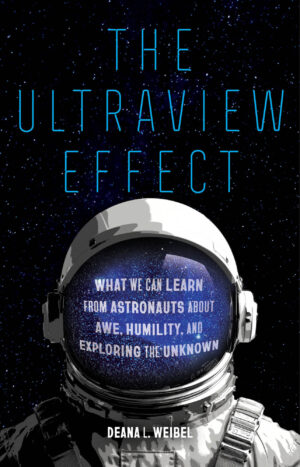
By Deana L. Weibel, author of The Ultraview Effect: What We Can Learn from Astronauts about Awe, Humility, and Exploring the Unknown
The flyby portion of the Artemis II mission was stunning to listen to live. We had the rare opportunity to hear the astronauts share what they were seeing and experiencing in real-time with the science team more than 200,000 miles away in Houston, Texas.
As someone who studies astronauts’ experiences of awe, I was on the edge of my seat.
The first humans to travel to the Moon in more than 50 years had a number of stunning visuals competing for their attention – the crescent-shaped Earth hovering in space, the crisply-detailed craters pocking the surface of the Moon (including the stunning Orientale), and the breathtaking eclipse that backlit the Moon, giving it a halo of undulating coronal light.
Before I knew the date of the Artemis II launch and about NASA’s plans to include an extraterrestrial solar eclipse, I had hoped that the astronauts on Integrity would be able to experience the intense star field seen by my astronaut interviewee “Zack” during his own lunar mission. In my book, The Ultraview Effect, Zack shared an unforgettable experience that so few astronauts have been able to witness:
At some points in my orbit around the Moon, I was in shadow from both the Earth and the Sun. It was a complete darkness. And all of a sudden, the star patterns out there became something that I was not ready for. So many stars I couldn’t see one. It was just a sheet of light… When I saw the starfield out there in a way that nobody else had ever seen, yeah, I had some pretty profound thoughts.
Several other astronauts I talked to had also been deeply moved when witnessing dramatic starfields from outer space. This profound experience is what I’ve named the “ultraview effect” — inspired by Frank White’s term the “overview effect” for the overwhelming awe and appreciation many astronauts feel when looking at the Earth from space.
While both the overview effect (looking back at Earth) and the ultraview effect (looking out into space) can evoke awe, one major difference seems to be how astronauts process the visual before them. Astronauts looking at the Earth from space often feel their understanding sharpen, as something they only experienced in pieces snaps into place as a whole object. It’s like the parable of different individuals describing an elephant differently depending on whether they examine the elephant’s ear, tail, or trunk. The overview effect is like standing back to see the whole elephant at once. Comprehension increases.
In contrast, the ultraview effect brings about disorientation and confusion. Zack explained to me that looking out into space didn’t make him understand space better. Instead it made him realize that “We don’t know crap about anything. We really don’t.”
Seeing an immense starfield from behind the Moon wasn’t like viewing an entire elephant – it was more like trying to understand an elephant from an impossibly small vantage point, like a bacterium sitting on a flea riding on an elephant’s back. Zack was thrown into a period of introspection, writing poetry, lying awake at night and trying to make sense of what he’d seen.
Zack was very lucky to see what he saw. The ultraview effect, unlike the overview effect, is very rare. He was in a very dark place during a time when the body of the Moon caused a “loss of signal,” meaning NASA couldn’t reach him. He was alone. He was traveling in space at a time of year when the densest part of the Milky Way was visible from his spacecraft. Everything aligned.
Other astronauts, though, haven’t been so fortunate. Many are unaware that it is even possible to see such intense starfields. Others who have tried to see Zach’s “sheet of light” haven’t been able to make it happen.
Another astronaut who I call “Theo” became aware of the phenomenon, but as a member of a space shuttle crew was unable to get others to shut down the lights to make a thick starfield visible. He explained that on his first two flights “I was never permitted to have a dark experience because those people were not interested and they wouldn't let me turn all the lights off… They don't care. They don't want to look out the window.” Eventually on later flights he was able to convince others to darken the shuttle interior and saw what he called “an outrageous view of the heavens.” He went on, “the number of stars you can see and the planets and galaxies … there's so much out there, you can barely find your own constellations because there is so much you're looking at.”
The Artemis II crew were in a unique situation when they entered the flyby portion of their lunar mission, passing behind and around the Moon in a maneuver powered by momentum and lunar gravity. Their April 1st launch date let them arrive beside the Moon just in time to see the Earth’s satellite pass directly in front of the Sun for nearly an hour, blocking the full disc and leaving just the outer rays of the Sun’s corona.
From a darkened Integrity, the astronauts were asked to look at the Moon’s surface and the solar corona. They described the scene as something haunting and mysterious. The eclipse made a “starfield” visible, along with the planets Venus, Mars, and Saturn, while the Moon itself was illuminated by “earthshine.”
Although the Artemis II astronauts weren’t able to experience the conditions required for the ultraview effect or experience the way it illuminates the limits of human knowledge, their sense of awe was apparent throughout the mission. In The Ultraview Effect I write, “To understand why certain experiences in space trigger awe, it’s important to recognize how strange and biologically unfamiliar outer space is to humans. Our species is fundamentally connected to Earth, shaped by it, and linked to it no matter how far we go.”
This was evident during Artemis II. Christina Koch described a moment of being emotionally moved by her lunar view, realizing that “A moon is really its own body in the universe.” Victor Glover, describing the eclipse, reported, “Humans probably have not evolved to see what we’re seeing.” Mission commander Reid Wisemen said, “Our brains are not processing this image in front of us.”
I argue that experiences of awe and incomprehension make people feel small and encourage a humble perspective. This was apparent in an April 6th interview with Koch, who was asked what words she would use to describe her experience on the mission. She answered, “I’ll be honest with you, the main word, because superlatives just don’t do it justice, is humility.”
Humility born of awe leads to curiosity. And who knows where this renewed sense of wonder, inspired by the first crewed moon voyage of the 21st century, will lead?
About the Author

is Professor of Anthropology at Grand Valley State University and author of A Sacred Vertigo: Pilgrimage and Tourism in Rocamadour, France. A frequent contributor to The Space Review, Weibel is also a Fellow of The Explorers Club and Chair of its Chicago/Great Lakes chapter.