"A People's Guide to the San Francisco Bay Area" authors lead a first-ever, book-based tour
by Alexander Tarr and Rachel Brahinsky, co-authors of A People’s Guide to the San Francisco Bay Area
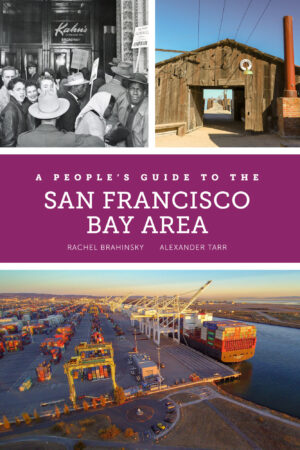
A People’s Guide to the San Francisco Bay Area was first published in October 2020, as the full scale of the COVID-19 pandemic was becoming apparent, long before vaccines and widespread masking enabled more of a return to public life. It was a strange moment to bring into being a radical guide book that sought to get people out into the world to collectively rethink the spaces and places that make up the big, complex region that is the San Francisco Bay Area. Because of this, we’re so pleased to be celebrating the book this week at the American Association of Geographers (AAG) annual meeting, where we’re leading our first-ever “mini-tour” based on the book.
The Bay Area People’s Guide tells the stories of people and movements based in a hundred sites where people have contested what it means to belong to a place. The site essays are interspersed with reflections from Bay Area activists, organisers, writers and others, alongside maps and tours that thematically connect the sites. When the book came out, we gave virtual tours and lectures over zoom and radio. Despite the disruption of the pandemic, we sought to use it as a tool to help ground a sense that collective action had been integral to survival thus far and that even if it was temporarily only available at a distance, the results could be seen in the material world around us. There are so many additional sites and stories that we wish could have fit into A People’s Guide to the SF Bay Area. But there are none we would take out of the book, so it will have to stand on its own as, we hope, a tool that continues to guide all kinds of people to see the region differently. As we wrote in the introduction:
The People’s Guide series is interested in an ethically oriented public-geography approach to urbanism. Our curiosity about the connection between how people shape the landscape and are shaped by it themselves has taken the form of a guidebook because, in our experience, walking and moving through a place is critical to one’s ability to understand it. This is a long tradition within our academic discipline of geography and is shared with community historians and those interested in participatory forms of urban design and planning [...] This is an academic effort, exhaustively researched and reviewed, but it is also a work that seeks to connect across communities. If you are visiting the region, we want to help you both enjoy and see beyond the beauty of the hills, the boats, the bay, and yes, the food. But this book is not for tourists only; we hope it may be a useful tool for students, researchers, activists, and organizers in the Bay Area. Whether you are one of the many new migrants or a longtime resident, we hope to help you better understand and engage with the geography and stories that surround you.
This week, several thousand academics will gather in San Francisco for the AAG conference. This is a “big tent” event, welcoming geographers who study everything from the impact tech platforms have on everyday urban life to how ancient pollen can be used to better understand climate change, as well as historians, sociologists, anthropologists, urban planners and designers, film and media scholars, and anyone grappling with the relationship between people and place. It is the first time in a decade that the conference has been in San Francisco and the first that we, the co-authors of A People’s Guide to the San Francisco Bay Area, will be able to share our book together in the place it documents, in person–and with many of the people whose work inspired the project. In developing our “mini tour,” we’re excited to help visitors from around the world better understand San Francisco, and also to celebrate the underlying spirit and motivations of the People’s Guide series to critically engage the spaces we are, wherever they may be. Several of the contributors to our book will also be giving their own tours, taking visitors through landscapes of legacies of militarism, ecological destruction and renewal, the brutality of racialised violence and the never ending resistance to it, and a cornucopia of cultural hearths and hotspots.
For those who can’t be in San Francisco this week, or who missed the chance to sign up for a tour, we hope our book will continue to be a valuable guide to reading our landscapes for a collective history of resistance and survival in the face of ongoing oppression, and a reminder to continue asking what future claim we can make to a better world.
About the Authors
Alexander Tarr is Assistant Professor of Geography at Worcester State University. His research, writing, and cartography examine the development of cities, food politics, and digital culture.
Rachel Brahinsky is Associate Professor at the University of San Francisco, affiliated with Urban and Public Affairs, Politics, and Urban Studies. Her research is focused on race, property, and urban change.