When is a Diaper More than a Diaper? More Often than You Might Think.
By Jennifer Randles, author of Living Diaper to Diaper: The Hidden Crisis of Poverty and Motherhood
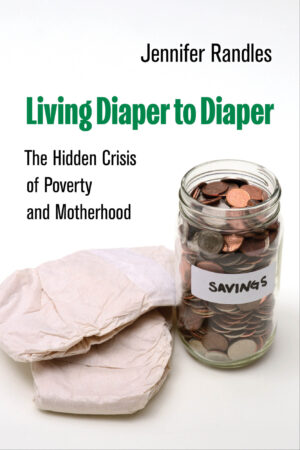
A diaper is more than a diaper. I heard this statement from mothers and diaper advocates alike during the decade I studied diaper insecurity, the diaper bank movement, and diaper policies in the United States. These groups taught me that, although diapers may seem like any other humble household or hygiene product, their social, economic, and political significance goes well beyond their practical purpose. Nearly one in two families with young children in the United States struggle with diaper insecurity–limited or uncertain access to enough diapers to keep children comfortable and healthy.
For my book, Living Diaper to Diaper: The Hidden Crisis of Poverty and Motherhood, I interviewed more than 80 mothers coping with this common, harmful, and often invisible problem of poverty. I spoke with them about the practical and emotional role of diapers for early childcare, what caregivers must do to stretch diapers, and the many consequences for children and parents of not having enough. These mothers shared how diapers are one of the most basic needs babies have. Going without them puts children at risk of health problems, like rashes and urinary tract infections, and development delays. Not having enough diapers also puts mothers at risk for depression, anxiety, and other health problems, as they sacrifice their own needs like food to afford them.
Nearly one in two families with young children in the United States struggle with diaper insecurity.
A diaper is more than diaper. It’s a necessity for children’s health and development, for mothers’ physical and mental well-being, and for a sense of self-efficacy as a parent.
Diapers are also necessary for families’ economic success. If parents cannot bring diapers to childcare providers, they cannot drop their children off so that they can go to school or work. Children younger than five years old–those most likely to wear diapers–are the most likely to live in poverty. Diaper insecurity creates a vicious cycle for poor families. When parents can’t afford diapers, they often cannot access the educational opportunities and jobs they need to pull their families out of poverty.
Yet a diaper is also more than a diaper when it becomes an anti-poverty educational tool and work support.
The story isn’t entirely without hope. For Living Diaper to Diaper, I additionally interviewed nearly 50 diaper advocates committed to preventing early childhood poverty, many of whom founded and ran community-based diaper banks. Some of their diaper banks distributed millions of diapers a month to families in need through large warehouses, while others served a handful of families from the trunks of their cars. All were working tirelessly to get more diapers to families who desperately needed them. Many were also trying to raise awareness of diaper insecurity by working with local, state, and federal policymakers to have diaper support become a permanent part of the social safety net. Currently, diapers are not part of any nationwide public program like food stamps or WIC, and welfare cash aid benefits are often not enough for families to readily afford diapers along with other needs.
A diaper is more than diaper. It’s a necessity for children’s health and development, for mothers’ physical and mental well-being, and for a sense of self-efficacy as a parent.
A diaper is more than a diaper when current public programs don’t recognize it as a basic need of early childcare. No systematic public program or policy provides targeted support so that families get diapers.
Ultimately, diaper insecurity reveals a profound injustice and deeply entrenched inequalities in family life. The U.S. social safety net is not set up to support our country’s youngest and most vulnerable. Living Diaper to Diaper explores why and how we can change that through better public programs and policies that recognize diapers as a basic need and help families afford and access them.
About the Author
is Professor of Sociology at California State University, Fresno, and author of Proposing Prosperity? Marriage Education Policy and Inequality in America and Essential Dads: The Inequalities and Politics of Fathering.