Meeting Microbes Halfway: A Conversation with the Authors of a New "Gastronomica" Special Section
Gastronomica's Spring 2026 issue features the first of two planned special sections on microbes in food studies. We asked co-guest editor of the section, Maya Hey, to interview her fellow section authors about their work. The following narrative is by special section contributors Nikolai Siimes, Sevgi Mutlu Sirakova, Lukáš Senft, Annie Sandrussi, and Katy Overstreet, as told to Maya Hey.
Microbes are curious creatures, both everywhere and nowhere we can easily see. And yet, a growing number of scholars are turning their attention to studying these critters. Microbes can be found all around the food system, from causing animal and plant diseases, to fermenting food and drink, to digesting waste. Besides their more familiar role in fermented cuisines, microbes also play weird, awkward parts: they feed snails, moisturise our elbows, and make high fructose corn syrup from an enzyme found in the black spots of onion skins. Whether we notice them or not, microbes and humanity have a relationship stretching to the beginning of our species—and we literally could not live without them.
For many of us, microbes became a point of interest through ethnographic attention to what we or our interlocutors were caring about. Nikolai Siimes, who lives a double life as a winemaker, shares that his interest in ‘going microbial’ was the growing awareness of microbes in human sociality (see Merlin Sherldrake’s Entangled Life), food flavor (see Heather Paxson’s Life of Cheese), and, of course, wine quality. Others, like Katy Overstreet, quickly learned that microbes were everywhere in her fieldsite. Efforts to influence them pervaded many aspects of the dairy industry, from farmers spraying probiotics on their crops that would eventually become feed, to feeding probiotics to calves to try to keep them healthier. Even though a food system perspective would emphasize the milk of a dairy industry, she notes how much of feeding focuses on the microbial universe of cow rumen, even to the extent of obscuring the cow. To be sure, microbes are also added to milk in cheesemaking, where cheesemakers at local factories told her about all the precautions they take to create the right environments for the “good bacteria” to thrive (see the book by Neal’s Yard Dairy, Reinventing the Wheel, for more on this). Microbes, it seemed, were invisibly shaping all the stages of dairy production from feeding cows, to milking, to processing milk.
For others of us, microbes were simply a part of everyday life through household practices and community care. Sevgi Mutlu Sirakova recalls her grandmother sharing a story about “ant yogurt” that, almost a decade ago, inspired Sevgi to study traditional yogurt-making practices at her village in Bulgaria. In one conversation, her grandmother shared that when they used to go up to the highland pastures, they would use ant colonies to make yogurt. “It was one of the 'a-ha moments’ of my research,” recounts Sevgi. “At first glance, it did not sound like a microbial story, but I sensed it would lead me toward unexpected microbial relations. I lost my grandmother last year, which makes this story particularly special to me.” For Annie Sandrussi, a similar family memory comes to mind: “When I was a child, my mother would make a kind of yogurt called Laban (in Lebanese Arabic). I watched as she and our neighbor exchanged cups of a fermented culture that came from a previous batch. She would add the culture to boiling milk, then slowly cool the cultured milk, wrapping the large steel pot in thick blankets and placing it under a particular window in a corner of our home overnight. I found the sharing of the culture fascinating because it occurred to me that each ‘new’ batch of Laban bore in it a genealogy of earlier batches.” Coupled with Sandrussi’s research interests in both the gestating body and the care of a feeding figure, Sandrussi notes how embodied care practices make it so that microbial sharing is an unavoidable—even crucial—aspect of social connection: “Preparing food in a shared home, with many hands and breaths and skins involved, sharing beds and blankets, and being body to body in feeding small children makes for the very cosy and lively exchange of microbial life.”
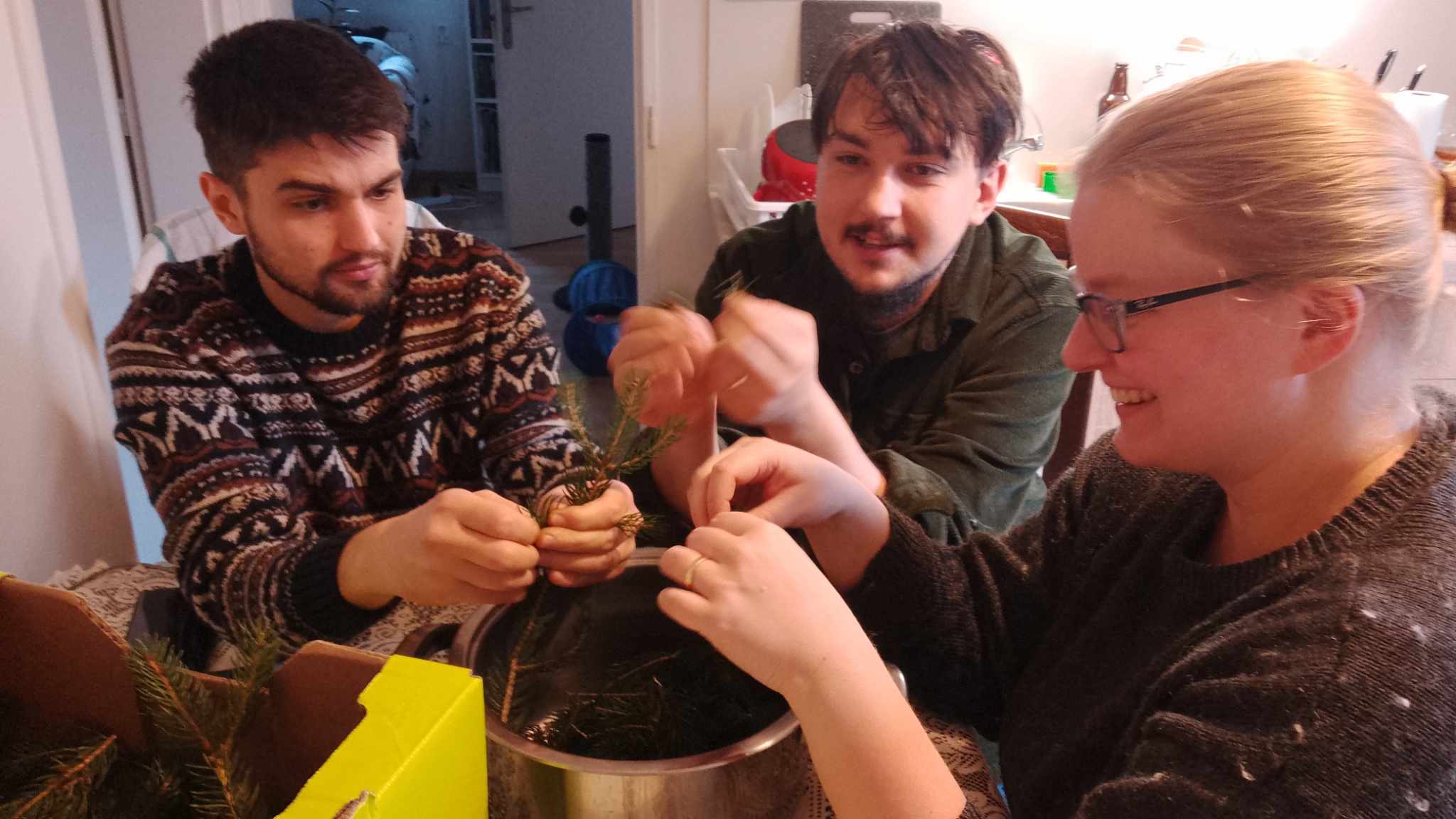
Lukáš’s favorite microbial memory takes a slightly more rambunctious turn with Czechian beer. Beer is considered a “national beverage” in Czechia, yet Lukáš had to travel all the way to Helsinki and visit his friend Will LaFleur to learn how to brew a batch himself. There, Lukáš learned how to handle the pots and hops in an apartment setting, and a year later Lukáš organised a workshop for the public where he brewed beer with herbs foraged from the surrounding landscape. It smelled of sage and mint, he recalls, and conservative beer drinkers didn’t like it very much. But its sour taste was appreciated by wine lovers. Later, Lukáš invited close relatives to his house and brewed a family beer together using spruce tips collected in nearby woods to add local terroir. “We used the bottles as Christmas gifts for our extended family and offered them to our neighbours during the winter carnival in our village. Through it, we became recognisable to other villagers and were no longer strangers. It seemed that microbes enabled us to feel at home.”
Fermented foods aside, there’s still work to be done in interdisciplinary microbial research. After putting together our recent special section, and in anticipation of our next special section on microbes in issue 26.2, we note key areas in need of scholarly attention. Nikolai Siimes implores, “We urgently need to research new approaches to managing fungal diseases in agriculture, and particularly in horticulture. Our paper raises more questions than it provides answers, and since publication I’ve heard from a number of grape growers wanting to know more about how they could apply some of these probiotic approaches on their farms, but there are basically zero resources for them.” Other areas to pursue include the importance—and threat—to microbial diversity in an increasingly standardized and monetized food system. We also see the need for more humanities-based questions of imaginaries and narratives that see microbes past their utility. If we have been living with microbes, and will continue to do so out of necessity, might there be some way to meet them halfway? We look forward to research that engages with a reciprocity mindset, asking what kinds of relations become possible with a shift toward understanding microbial sensitivities and responsiveness. This query goes beyond interdisciplinarity and debates within food studies to affect us all in the long haul of eating well together.
We invite you to read Gastronomica's Spring 2026 issue, including the special section, "Making Microbes Explicit," for free online for a limited time.
Print copies of Gastronomica's Spring 2026 issue (issue 26.1), as well as other individual issues of Gastronomica, can be purchased on the journal’s site.
To ensure ongoing access to Gastronomica, please ask your librarian to subscribe and/or purchase an individual subscription.