Q&A with Benjamin R. Weiss, author of "The Price of Justice"
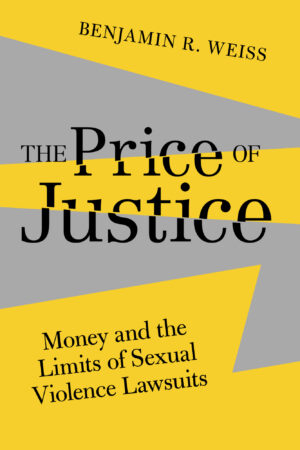
Given an unpredictable criminal legal system and a fraying social safety net, sexual violence victims increasingly turn to civil lawsuits to find justice. They sue offenders and responsible organizations directly, seeking recognition, resources, and reform. But at what cost? Benjamin R. Weiss uses in-depth interviews and legal case analysis to reveal how the civil legal system's reliance on financial compensation to remedy sexual harm limits who can seek civil justice and on what terms. He shows that instead of delivering justice, the process often deepens inequalities and compounds suffering, especially for those most in need. In The Price of Justice, Weiss offers victims, advocates, and academics alike an astute assessment of the law's promise to rectify harm and redistribute power—and inspires readers to imagine what it would take to meet all victims' needs and drive lasting social change.
Benjamin R. Weiss is Assistant Professor of Sociology at Occidental College in Los Angeles.
What led you to write this book?
In graduate school, I studied collaboration between different stakeholders at a rape crisis center, where I also served as a volunteer victim advocate. Volunteer training emphasized empowering victims with all options available to them following harm. During a presentation on the criminal legal process, a prosecutor admitted that few police reports lead to prosecutions, and even fewer of those result in convictions. A fellow volunteer, dismayed, asked where victims can turn if prosecutors decline to file charges. The prosecutor, after some hesitation, suggested victims pursue civil litigation under civil rights or personal injury law. The Price of Justice draws primarily on interviews with lawyers to understand whether, or for whom, those civil lawsuits actually work.
Why are civil lawsuits potentially attractive to victims?
Criminal cases are brought by the state, not victims, and require prosecutors to meet a very high burden of proof. As such, prosecutors pursue and win very few cases. Even victims whose police reports eventually result in conviction often experience the criminal legal process—skeptical law enforcement officers, noncommunicative prosecutors, hostile defense attorneys, frequent intimate disclosures over indeterminate timelines—as harmful, and find that an offender's punishment does little to heal their wounds.
Civil lawsuits, conversely, are brought directly by harmed parties and, because they serve primarily to make victims whole rather than punish wrongdoers, demand a much lower burden of proof. They appear easier to bring and win on victims' terms, and more likely to facilitate healing by yielding monetary damages victims can use to pay for healthcare, housing, childcare, and more. In practice, however, victims stand little chance without lawyers, who not only decide whether to take a case but also shape many dimensions of it—who to sue, what evidence to marshal, what to demand of defendants—in ways that systematically bar many victims from accessing civil justice.
What surprised you most about how lawyers pursue these cases?
Attorneys had diverse personal reasons for this work—some had experienced sexual violence themselves, while others treated it as no different from a car crash, faulty product, or other personal injury. But regardless of motivation, they chose to represent remarkably similar victims in remarkably similar ways, emphasizing "recoverability"—the likelihood of getting money—as a central consideration. Most cared whether, as one lawyer said, “the juice [is] worth the squeeze” because they were paid contingency fees out of their clients' eventual winnings, but they also genuinely believed that money is the best way to heal victims and force wrongdoers to change. Guided by this belief, which I call the "financial logic," attorneys went after wealthy or well-insured organizations rather than individual offenders, represented only the most sympathetic victims—a designation laden with gendered, racialized, and classed biases—and highlighted harms most legible to jurors. These preferences functionally close off civil suits to many victims, including those harmed in private rather than in an organizational context, those with a discrediting biography like a substance use disorder, criminal record, or irregular immigration status, and those who responded to harm in unexpected ways by, for instance, opting not to report to the police.
Even when victims "win," you argue the victory is often hollow. Why?
What justice means to victims is complicated. Attorneys identified three versions victims typically want: recognition of the harm caused; accountability, meaning real consequences for offenders and organizations; and reform, or changes to prevent future harm. Victims who find a lawyer might get money—often as a settlement after a torturously long process of intimate disclosures and hostile depositions—but are far less likely to get the rest. Individual offenders are rarely named in suits because they have no money. Organizations that enabled harm frequently require victims to sign non-disclosure agreements (NDAs), avoiding public responsibility entirely. Commitments to preventing future harm are rarely enforced and probably ineffective even when they are. Even victims who "win" often don't get the justice they sought.
You studied lawyers rather than victims. What are the limits of that choice?
Lawyers are worth investigating because they—operating under legal, resource, and professional constraints—shape whether and how victims use the law. While my focus is on lawyers, victims' experiences of harm and the legal process appear throughout, drawn from legal cases in the public record. Formal legal documents filter, sanitize, and condense victims' voices, however, and missing entirely are those who considered a lawsuit and opted against it, those who couldn't secure representation, or those who settled before ever filing. Thus, I'm grateful to scholars and practitioners like Nicole Bedera, Alexandra Brodsky, Bethany Nichols, and Jane Palmer, to name just a few, who document how victims themselves navigate the civil legal system. I hope to see many others join them.
The book ends with both targeted legal reforms and a sweeping call for universal social welfare. Are these in tension?
Civil lawsuits are life-changing for some victims who really do get the recognition, accountability, and reform they deserve. Still, I question whether civil lawsuits, even post-reform, will ever be enough. Instead, I imagine a world where everyone, regardless of their capacity to secure legal representation and spend years litigating, simply gets the care they need to thrive.
What do you hope different readers take from the book?
I identify ways policymakers—and the lawyers and advocates who push them—can make the civil legal system better for victims: broader interpretations of organizational liability, clearer statutes of limitations, meaningful guardrails on NDAs, and rollbacks on tort reforms that artificially limit victims' recoveries. My larger hope is that readers enter coalition with those already fighting for just housing, healthcare, and childcare policies. Affordable housing benefits victims fleeing abusive partners or unsafe neighborhoods just as much as it benefits new immigrants, recent graduates, and people rebuilding their lives after incarceration. Sexual violence is a public problem. It demands a public response.
About the Author

is Assistant Professor of Sociology at Occidental College in Los Angeles.