An Exclusive Look at "Chile in Their Hearts"
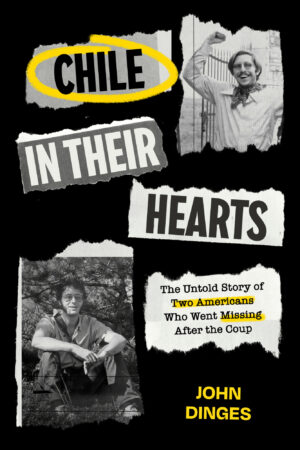
UC Press is delighted to offer an exclusive excerpt from the introduction of Chile in Their Hearts: The Untold Story of Two Americans Who Went Missing after the Coup by John Dinges.
The North Americans who arrived in Chile in the early 1970s loved that the new Socialist president was committed to revolution and democracy. Salvador Allende had come to power in an indisputably fair election, lending him international credibility and confounding a hostile U.S. government. Hundreds of Americans came to experience the revolution. They described themselves as progressives and were inspired by Allende’s plan to defeat poverty and restructure an unfair economy. In the excitement of the times, they didn’t think they were in danger. After all, they had U.S. passports.
Among the arrivals were Charles Horman, a freelance journalist, and Frank Teruggi, a student, making their way separately to Chile in 1972, embarking on a grand adventure. Living there soon evolved into a serious political commitment. Then, in the first days of a violent military coup, they were picked up, executed and their bodies thrown in the street. This is their story.
I began to investigate the case in the early 2000s . . . I had lived in Chile at the time of the coup and for five years thereafter. I was a journalist, but I shared the enthusiasm for the Chilean experiment and was part of the informal community of pro-Allende foreigners. I was one of the few Americans to stay on after the coup.
The evidence I found led me to conclusions I had not expected, especially about the U.S. role. The facts that came to light contradicted major elements of the widely-accepted view of Horman as the “man who knew too much” who was killed with U.S. approval. A careful examination of U.S. documents and Chilean court records failed to show any U.S. involvement in the deaths of the two Americans. Far from exonerating the U.S. government, the evidence demonstrates definitively that the U.S. Embassy and State Department shielded the Pinochet regime by hiding the truth, conducting a sham investigation, and sanctioning Chile’s official cover-up of the murders. . . .
Why should we relitigate these events that occurred a half century ago? The short answer is that history deserves the truth, especially regarding key moments in U.S. government actions that paved the way for anticommunist dictatorships and changed the lives of millions of people. From a moral and historical point of view, the United States bears indisputable responsibility for enabling the Pinochet dictatorship and supporting it regardless of the massive human rights crimes it committed. Yet an argument from outrage should not mislead us into an assumption of U.S. officials’ guilt in the executions of the two leftist Americans. In a serious investigation, a dispositive showing of evidence is necessary to resolve the key questions one way or the other. That is the challenge I have taken up in this book.
Learn more about Chile in Their Hearts