"I hope 'One Battle After Another' wins a million awards": A Q&A with Peter Coviello
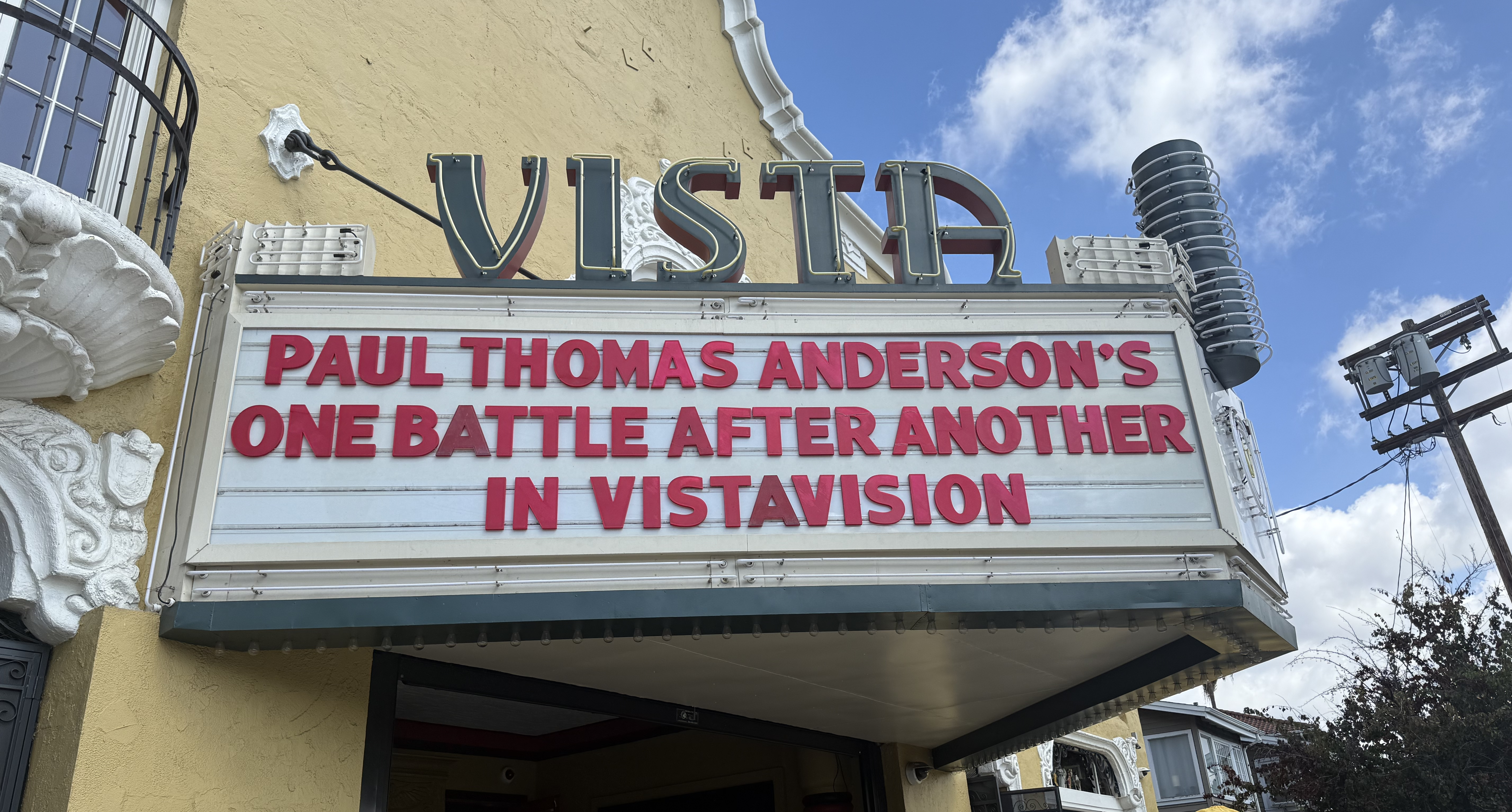
Paul Thomas Anderson’s One Battle After Another premiered in the fall of 2025 and, after winning four Golden Globes in January and six BAFTA awards in February, stands nominated for thirteen Academy Awards. In the current issue of Film Quarterly, Peter Coviello, a writer and professor of English, considers the reach, consequence, and political timeliness of One Battle, in an essay entitled “Infrastructures of Escape.” We invite you to learn more in our Q&A with Peter Coviello below and to read Coviello's article in Film Quarterly for free online for a limited time.
So, as you say pretty frontally, you really liked One Battle—but you come at it from a distinct angle, is that right?
Very much so, yes—in two ways. First, I’m not any kind of student or scholar of Paul Thomas Anderson. But I have thought a lot about Thomas Pynchon, whose delirious, incendiary 1990 novel Vineland is the source-text for One Battle. Second, I live in Chicago. I watched the movie in the fall, in a city being besieged by a heavily armed and manifestly hostile federal occupying force. Those two things—longstanding Pynchon fandom, lived proximity to a recrudescent American fascism—are pretty deep inside my reaction to the film.
Can you talk about your sense of the movie's relation to Vineland?
Anderson’s earlier movie, Inherent Vice, is a more or less straight and, I think, successful adaptation of a different Pynchon novel. One Battle is much less an adaptation than it is a riff—a borrowing of plot-throughlines and motifs, yes, but really an effort to think alongside the Pynchon of Vineland. To my mind, Pynchon is, preeminently, two things: a comic fabulist and a scrupulous, far-sighted antifascist. Anderson, I think, wants to see what those look like not in the ‘60s and ‘80s—Vineland’s setting—but in the calamitous present tense.
What do you think caused the movie to land in the way it did, inside a cycle of high-flown praise unusual even by the standards of Hollywood hyperbole?
The short version of the answer for me is that, for all its comic exaggeration, One Battle is a film that takes ultra-seriously what I call in the piece “the sociopathic antipathy to the human” proper to the amassed forces of security. It doesn’t ask you to sympathize even fractionally with battalions of armed men in flak jackets; it doesn’t offer implacable opposition to those forces as deluded or deranged. The forces of security are malignant, irredeemably racist, arrayed against human community and on the side of the blessed of capital: saying so, right now, seems all at once obvious, urgent, and every day just a little closer to prohibited. I think the film’s desire for frontal clarity on this point is jolting.
In fairness, there has been a fair amount of dislike for the movie as well, a lot of it rooted in a sense of the weakness of its political vision, the inadequacy of its sense of race and Black rebellion, its heavy-handed typology. Do you have any response to those who really did not like it?
Well, the first thing I would do is quote Pynchon himself, who when looking back over his youthful stories and all the ways people might object to them, says, “Whatever’s fair.” I don’t have any interest in backing people off their dislike! It’s not a perfect movie. I, for one, hate the alack-our-revolution-failed voice-over ending; I get that the leaning toward the antic, which is borrowed from Pynchon’s detuning of historical realism, might scan for some as puerile, a misapprehending of the actual tenor of political action; I get the off-puttingness of the super-sexualization of Black femininity (though I think the counterstrain visible in Regina Hall’s grave composure, and in the convent of revolutionary nuns, at least invites a kind of inquiry into those polarities); I’m not sure it has much of a register for thinking about capital, as such. That’s all fair! If I’m less persuaded than I might be by these accounts of the film’s, let’s say, failures, it’s not because I take them to be without any kind of purchase.
I would want to say, though, that these readings seem to me to understress how seriously even this sometimes cartoonish film takes two things in particular. The first is fear—how brutally fearful it is to live in the shadow of a security apparatus that understands itself as free to act with near-total impunity. The lived mortal dread of its characters: I don’t think One Battle dissembles at all on that front, whatever its tonal weirdnesses. But the second is what the film keeps discovering on the other side of that fear, which is again and again and again—and here I confess to finding the movie genuinely heartlifting—collective endeavor, ordinary people acting in concert with one another, at scales both very large and very local, in opposition to what we have no reason, now, not to call fascism.
You say in your conclusion that you hope it wins a million awards. Why?
It’s just that latter point. For me, whatever its infelicities, One Battle is pleasingly frank in its conviction that “fascism” is an apt name for the lavishly carceral, incandescently racist security state turning inward, and coming for scapegoated internal populations. Ok. But better than that, the film seems to me supremely interested in showing us countermobilizations operating at every human scale—revolutionary cells, heroic nurses, underground networks, kids on skateboards fanning out into the night. It shows us scenes and solidarities and whole living worlds knit together by the action, resolve, and astounding bravery of everyday people, committed to sustaining one another even in the teeth of extravagant state violence.
You don’t have to live in a city being occupied by a federalized brownshirt militia for all this to strike you and urgent and moving. But it sure fucking helps.
We invite you to read Peter Coviello's, “Infrastructures of Escape,” as well as other articles in FQ's Spring 2026 issue, for free online for a limited time.
Print copies of Film Quarterly's Spring 2026 issue (issue 79.3), in which Coviello's article appears, as well as other individual issues of FQ, can be purchased on the journal’s site.
To ensure ongoing access to Film Quarterly, please ask your librarian to subscribe and/or purchase an individual subscription.
About the Author

Peter Coviello is the author of six books, including Long Players, a memoir selected as one of ARTFORUM’s Best Books of 2018; Make Yourselves Gods, about the Mormon nineteenth century; Vineland Reread; and most recently Is There God After Prince?: Dispatches from an Age of Last Things. His writing appears regularly as well in venues like Frieze, N+1, Parapraxis, Public Books, and The Believer. He taught for many years at Bowdoin College and since 2014 has been at UIC, where he is Professor and Head of English.