Excerpt from Charlotte Brooks's "The Moys of New York and Shanghai"
by Charlotte Brooks, author of The Moys of New York and Shanghai: One Family's Extraordinary Journey Through War and Revolution
The Moys of New York and Shanghai mixes conventional archival materials with privately-held letters, documents, diaries, and photographs to tell the story of one family over more than a half century. This combination of sources was crucial to helping me understand not just the events that shaped the family but also the personalities and motivations of the six Moy siblings and their spouses.
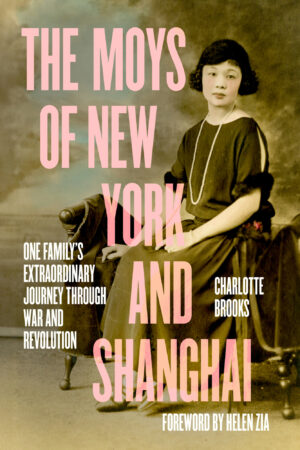
Youngest daughter Alice Moy Lee’s character came through most vividly in her son’s scrawled Chinese-language diary entries and in the interviews I did with her friends and family members. They remembered her as a charming and spoiled free spirit whose love of material things caused the failure of her marriage to the penniless Chinese student K.S. Lo. Most saw her second husband, the successful Chinese American businessman Alfred Lee, as almost an appendage of charismatic Alice. He was simply the indulgent man who gave her the luxurious life and deep devotion she craved.
But I discovered a different side of Alfred in a favorite nephew’s recollections, a brother-in-law’s diaries, and a slew of articles in China’s interwar press. These revealed his other great love besides Alice: Shanghai, the city that gave him the opportunities and acceptance he could never achieve in San Francisco, which was both his birthplace and the political center of the anti-Chinese movement in the United States. After Alfred moved to Shanghai in the mid-1920s, he enjoyed tremendous business success and social prominence, which is why he resisted leaving the city even when life there grew dangerous. Following the outbreak of the Second Sino-Japanese War, Alfred sent Alice and their son back to the US for safety, reluctantly following two months later. But he returned to Shanghai the moment he could, arriving in early 1938 and bringing his family back a few months later. This choice proved fateful: the Lees were trapped in Shanghai after Pearl Harbor, enduring the peril and privation of life under Japanese occupation. Yet Alfred seemed to have no regrets; when the war ended and Alice wanted to move back to the US, he refused, unable to bear leaving the life they had made for themselves in his beloved Shanghai. Only the looming Communist victory in the civil war pushed him out, and even then he almost waited too long to go.
Excerpt from Chapter 39: "Alice and Alfred - Shanghai and New York 1946-1949"
In early November 1948, with Nationalist forces on the brink of losing all of North China, the US Embassy began to advise Shanghai’s Americans that “unless you have compelling reason to remain, you consider the desirability of evacuation while normal transportation facilities remain available.” Foreign businesspeople increasingly discussed the risk of becoming Communist prisoners, and those with the money began booking passage on every available ship and plane. US citizens unable to pay high fares signed up for one of the three US Navy transports that arrived to evacuate Americans from the city. Unnerved, Alfred suggested that Alice go to Hong Kong, but she initially refused to consider leaving without him.
Throughout early December, she held fast, though the various rumors—that the Communists had reached the Yangzi River, that the Nationalists had stopped the PLA’s progress, that ordinary residents were fleeing Nanjing—rattled everyone’s nerves. One day she was sure she would relent, only to hear contradictory news the next morning that made staying seem safe. Then, right before Christmas, a group of soldiers broke into the Shanghai home of a European and ransacked it, while Chinese military police stood by. Shaken by the tale, Alice agreed to go if Alfred accompanied her as far as Hong Kong. Getting a berth on a ship proved difficult, but Alfred asked around and managed to book them on a southbound steamer leaving right after the holiday. As much as he loved to lavish Alice with gifts, they did not exchange presents that year; instead, they spent their last Christmas in Shanghai hastily gathering and packing their most important possessions, including personal papers and photo albums.
Alice had first seen Hong Kong more than two decades earlier, and, in many ways, she could measure the changes in her life by her visits to the colony: in 1926, with K. S. Lo; in 1937, as a refugee from wartorn Shanghai; in 1938, about to return to Shanghai with Alson; and now, fleeing from yet another conflict. In the 1920s, the place had seemed like such a backwater compared to Manhattan, though by the time she and Alson arrived there in 1937, tall buildings were starting to rise along the waterfront. She had grown familiar enough with Hong Kong that she could see both its recovery from the war and the occasional glaring gaps between structures, the blackened stones, even an empty pedestal where she vaguely remembered a statue in prewar days. The harbor was clogged, with ships of all descriptions entering or sitting at anchor, many of them carrying refugees from the civil war. The new arrivals found everything expensive, from food to housing, which only those with gold could secure.
The Lees had discussed the possibility of Alice waiting in Hong Kong, but the crush of desperate people there and the spiraling prices convinced them to shift gears. Alice sailed on to San Francisco while Alfred returned to Shanghai—just for a little longer, he promised. In the end he remained well into the spring of 1949, unable to let go. When fighting threatened outlying areas of the city, he slowly and lovingly shut up the country home where he and Alice had lived since restoring it after the war. He was staying with Billy and Lenore Chang when well-connected friends advised him to leave while he still could. By then, PLA troops were starting to encircle the city, so the one way out was to fly, and airplane tickets were difficult to come by. Only on May 17, with the Communists closing in, was he able to reserve a seat on a Hong Kong–bound flight.
As the plane took off from Lungwha Airfield, Alfred looked out to the south and saw long lines of PLA soldiers waiting to cross the Huangpu by boat. Another passenger pointed out an eerily related sight to the north: columns of Nationalist troops massing by the city’s central waterfront, preparing to board a large evacuation ship bound for Taiwan. But the plane climbed quickly and steeply in order to evade possible gunfire, so the city below quickly faded from view. A few hours later, the flight landed safely at Kai Tak, which was crowded with refugees arriving from Shanghai. Alfred even recognized a few people as he waited patiently to purchase another ticket, this one to San Francisco. When he finally arrived in the city of his birth a week later, the first thing he noticed was the newsstands’ blazing headlines: Shanghai had fallen to the Communists the day before.