Carlyle’s "Past and Present" and Dickens’ "A Christmas Carol"
By Marylu Hill, coeditor of Essays on German Literature and Culture, Part I and Part II
At this holiday time of year, it seems like references to Charles Dickens’ A Christmas Carol are everywhere. Yet many people today miss the connection that would have been more obvious to its original readers in 1843—the influence of Thomas Carlyle’s important work Past and Present—published earlier that same year.
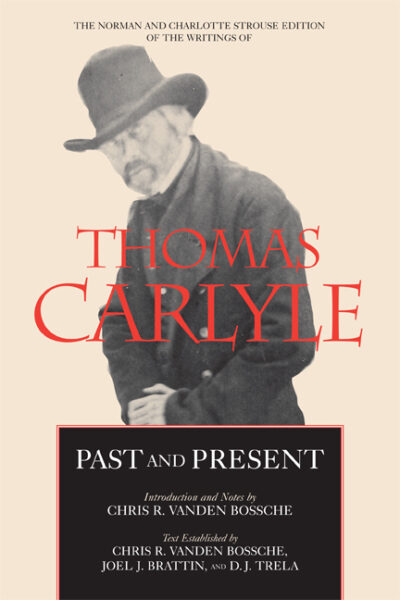
Carlyle and Dickens were friends—and as Chris Vanden Bossche notes in his insightful introduction to the Strousse edition of Past and Present —Dickens was very moved by the themes Carlyle addressed in the book, the problems of greed, poverty, and isolation in modern society and the need for leaders who use generosity and love to encourage and support workers. Indeed, as Vanden Bossche notes, the very structure of A Christmas Carol that is manifested in the ghosts of Christmas Past, Present, and Yet to Come,parallels Past and Present’s structure of Ancient Monk, Modern Worker, and Horoscope” (liii).
The parallels don’t stop there. From Carlyle’s first chapter entitled “Midas,”modern wealth is described as “enchanted fruit” which none “shall be the better for it” (5). As Scrooge’s nephew Fred observes, “His wealth is of no use to him. He don’t do any good with it. He don’t make himself comfortable with it” (87). He may be rich, but he doesn’t enjoy it.
Contemporary readers of 1843 might have noticed how the Ghost of Christmas Past seems to use the "magic mirror" that Carlyle speaks of in the Ancient Monk chapter to allow the present to view the living past without being seen—similar to how Carlyle invites his readers to see the monks alive and active again. The first readers also might have seen Mr. Fezziwig as a sort of captain of industry, with the power of inspiring his workers with joy and gratitude. And in Scrooge’s grim preference for solitude and isolation, the first readers would have glimpsed Carlyle’s description of the miserable results of the Gospel of Mammonism : “isolation is the sum total of wretchness” (269).
Scrooge’s elation at the end of A Christmas Carol and his resolve to “live in the Past, the Present, and the Future” (117) illustrates Carlyle’s reminder “for the Present holds in it both the whole Past and the whole Future” (40). So in a Dickensian mood, it’s worth exploring further Carlyle’s Past and Present, especially the lovely section on the Ancient Monk and the sections like “The Gospel of Mammonism,” “Labour,” “Reward,” and “Captains of Industry” that are clearly reflected in the unreformed Scrooge and the oppressed Bob Cratchit. These themes were not simply sentimental but drawn from the issues of the day.
And perhaps in rereading A Christmas Carol, you will find yourself moved as Carlyle was to a “perfect convulsion of hospitality” inspired by “visions of Scrooge” (as Carlyle’s wife Jane Welsh quipped at the time). Of course, in the words of Tiny Tim (and I feel certain Carlyle would approve), “God bless Us, Every One!” (118).
About the Author

is Teaching Professor in the Augustine and Culture Seminar Program at Villanova University. Her publications include “A Tale of a Table: Oscar Wilde, Virginia Woolf, and the Legacy of Thomas Carlyle" and Mothering Modernity: Feminism, Modernism, and the Maternal Muse.