The Future of Work in Hollywood
by Miranda Banks and Kate Fortmueller, authors of Boom to Bust: How Streaming Broke Hollywood Workers
Preparing Students For Work in Hollywood
Three years goes by in a blink of an eye. 2023’s Hot Labor Summer brought Hollywood to a standstill when writers and actors simultaneously went on strike. Now in 2026, American film, television, and streaming companies find themselves back at the negotiation table across from their employees: actors (SAG-AFTRA), writers (WGA), and directors (DGA).
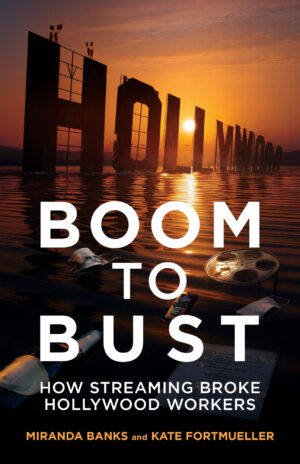
Our book Boom to Bust: How Streaming Broke Hollywood Workers examines how the business of entertainment has changed since Netflix dropped its first major streaming series– House of Cards. To set the stage for these evolving changes in the media industries and why this matters for its workers, the Introduction of Boom to Bust providesa primer for both understanding Hollywood labor negotiations and that making entertainment is work.
We’ve selected three excerpts from our Introduction that we think are useful for understanding what is currently happening in Hollywood’s union negotiations. In a section called “10 Questions About Hollywood Labor Negotiations,” we offer readers an overview of a few key things to consider when discussions of labor, guilds, unions, and contracts become newsworthy. To help you understand what’s happening today, we have pulled excerpts from three of these questions. “Who Cares About Contracts?” and “What is Being Negotiated?” explain what is important in our current stage of negotiations. Our last question, “Why Should Anyone Outside of Hollywood Care?”explains why these negotiations matter.
We hope these details give you a better sense of what’s happening today–and we are sure that Boom to Bust will help you and your students better prepare for Hollywood’s future.
Excerpts from the Introduction of Boom to Bust:
1. Who Cares About Contracts?
The parties who sign a contract have the most at stake: the AMPTP and the union that is negotiating the workers’ contract. Hollywood unions are comprised of thousands of members who work in different subfields, so even when a particular contract is negotiated, it rarely, if ever, impacts every member. For example, in 2000, SAG and AFTRA commercial actors had a tense negotiation with the AMPTP and ultimately went on strike over their contract. While SAG and AFTRA members stopped acting in commercials during that time, many continued to work on films and television.
When a union starts negotiations, members may or may not agree about what is needed. Internal disputes can surface and become fractious or even hinder a union’s ability to come to the table with a clear vision and membership support. Every labor group has its struggles internally between and among members, as well as with other labor groups. While the WGA and SAG-AFTRA have been reliable sister guilds to each other, both groups have historically struggled with internal divisions (film workers vs. television workers, New York vs. Los Angeles, A-listers vs. journeymen). The WGA consists of two distinct labor unions that are separated geographically, one on the East and the other on the West Coast, and at times they have been at odds in their priorities or vision. And SAG-AFTRA is a factious group: Not only does it comprise what was originally two unions until 2012 (historically SAG represented film and prime-time actors and AFTRA represented the rest of television), it brings together a professionally diverse group of stars, journeymen actors, background actors, dancers, reality hosts, and more.
Sister unions are invested, as well, when they are on the sidelines, watching negotiations involving another sector of the industry. Each union negotiates their own contract, but fraught negotiations have the power to affect the industry or signal future difficulties for sister unions. Negotiations are also interconnected. The WGA, SAG-AFTRA, and the DGA all negotiate in the same year and on the same schedule; IATSE negotiates their contracts a year later, and the Animation Guild (TAG), a separate IATSE local, follows. If the AMPTP fails to reach a timely agreement, or if a union walks out, this can lead to a delayed schedule for other unions. For example, IATSE’s slow and tumultuous negotiations in 2021 led to delays for TAG. Each union and guild negotiates on their own work-specific issues, but they practice a degree of pattern bargaining, which means that on big issues like residuals (payments for reairing) and health and pension contributions, they expect similar terms and treatment.
Many businesses beyond those directly involved in negotiations are affected by the resolution of contract negotiations. Businesses that support productions; service professions that support media workers who work long hours; and people who rent equipment, costumes, and props and who supply and serve catering all want smooth negotiations so there is no interruption in their work. When production primarily took place in Los Angeles and New York, the implications of a strike were restricted to those coastal cities. As states across the US, Canada, and other nations around the world have established more permanent production hubs, the number of service workers and small businesses that are impacted by a rise or fall in film and television productions on account of business practices or negotiations have increased.
2. What Is Being Negotiated?
A union negotiation centers on the revision of a union contract, known as the minimum basic agreement (MBA). The MBA is negotiated on a three-year cycle and generally sets the floor of what is offered to unionized workers. Most workers will be paid “at scale,” meaning they receive payment based on the numbers quoted in the MBA. An individual worker with decades of experience and a savvy manager or agent might get more than this, but an MBA ensures that early and mid-career workers are fairly compensated. Most negotiations start when union leadership and staff begin researching which issues are most important to the membership. The union will come to the negotiation with a pattern of demands: Some of them are key concerns and others might be on a wish list. Commonly, there are questions about how work is compensated and the minimum rate offered for each type of work. Negotiations might also address work rules; this was the case, for example, when IATSE negotiated with the AMPTP in 2021 to secure minimum turnaround times (breaks between shifts) to ensure that workers were able to sleep and rest before returning to work. Since 1960, when health care and pension benefits were secured for writers and actors, there have also been adjustments to calculations.
Typically negotiations are routine and settled without much fanfare. The people negotiating across the table often know each other, have partnered on work in the past, and may want to collaborate in the future. Leonard Chassman, former executive director of SAG (1984–2000), emphasized that negotiations could even feel collegial and suggested that this collaborative spirit might not have always benefited workers.
You were dealing with the same people over and over again, year after year, that you became so friendly—maybe too friendly for the good of the union. Rhetorically, they were the enemy, but there were some very nice people that I got to know and became friendly with. . . . There was rarely a tone of hostility that would break out across the table. And again, maybe that’s one of the problems the unions have. . . . It was just too friendly.
The fluidity of roles and relationships in Hollywood has historically contributed to the fact that so many negotiations have gone so smoothly.
The AMPTP and the unions begin negotiations months before their contracts expire. In 2023, the WGA began negotiations with the AMPTP and their president Carol Lombardini (2009–2025) on March 20, six weeks before the May 1 expiration date. How often they meet or whether each side comes to the table willing to compromise can often be in question.
Negotiations happen in private; once negotiations begin the union will compromise on issues, but they cannot add or dramatically change their demands mid-negotiation. For example, in 2021, IATSE’s leadership decided to negotiate a tempered slate of demands. But once negotiations started and the membership saw how widespread support was across the industry, it was angered and disappointed that the leadership couldn’t backtrack on the negotiations and ask for more. Details regarding changes to a contract are generally not announced until both sides make at least a verbal agreement.
10. Why Should Anyone Outside of Hollywood Care?
If you write about or want to be a part of Hollywood or work in partnership with industries or workers there, it’s useful to understand Hollywood production logics and histories. Those who aspire to jobs in Hollywood should know the nature of work and how change happens for those in the industry. Journalists who write about Hollywood need to understand the specificities of unionized labor to understand how and why negotiations happen in Hollywood— as well as how and when they might break down. Potential partners might wish to understand the power structures and hierarchies to build more effective working relationships.
Not everyone working in Hollywood is unionized—producers, corporate and production office employees, many reality TV workers, and studio administrative staff do not have unions. Those in industries adjacent to Hollywood—video game workers, digital creatives, and people working in social media—might also be interested in unionization or actively organizing to join a union. Some will watch industry negotiations to see which way the industry is heading and whether and when they might try for unionization.
Labor norms in Hollywood often influence workplace cultures and set the stage for contracts in other countries. Media workers across the globe most likely have stakes in what happens in Hollywood, but they are not stakeholders. Production workers and nascent unions elsewhere looked on throughout the 2023 strikes to see how Hollywood workers would fare in their fight. Negotiations can impact what content is made and where, which might also have ramifications for media workers around the world.
Audiences will feel the impact of a strike most deeply when their shows go off the air or start airing as reruns or when movie premieres are delayed. In 1980, tens of millions of US audience members had to wait two extra months to find out who shot America’s favorite villain of the time, Dallas’s J. R. Ewing, because of a SAG strike that delayed production of the next season. At the beginning of a strike, union leadership often reminds people outside of Los Angeles that not everyone working in film and television is an A-list celebrity or living in mansions in Beverly Hills. Public opinion about the striking workers is always important for the outcome of a strike, and unions have to explain why their audiences should care about Hollywood’s working conditions.
About the Authors

is Professor of Film, Television, and Media Studies at Loyola Marymount University, author of The Writers: A History of American Screenwriters and Their Guild, and coeditor of Production Studies.

is Associate Professor of Film and Media History at Georgia State University and author of Below the Stars: How the Labor of Working Actors and Extras Shapes Media Production and Hollywood Shutdown: Production, Distribution, and Exhibition in the Time of COVID.