Ragtime Romance and its Afterlives
by Allyson Nadia Field, author of Acts of Love: Black Performance and the Kiss That Changed Film History
Ragtime Romance and its Afterlives
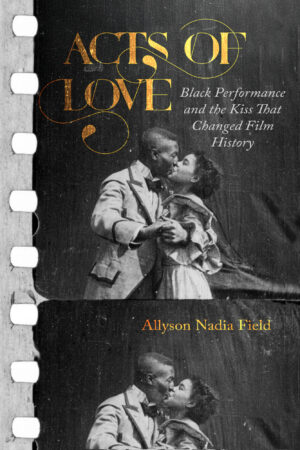
In 1898, Saint Suttle visited William Selig’s moving picture studio with his stage partner Gertie Brown, where they would record the short film Something Good—Negro Kiss, the first cinematic depiction of Black romance. While cinema may have been the most consequential media technology at the turn of the century, we also assume that it was the most important for contemporary artists and audiences. That was far from the case. Suttle’s mind, in fact, was probably not on the cinematic performance for the Polyscope but rather on his ragtime compositions. He was a composer on the rise, an author of popular tunes in the genre of “coon songs,” Black-themed syncopated ditties overtaking the popular stage and scoring the soundtrack to the ragtime era. These songs cast their themes from familiar molds, deriving humor from racialized ridicule, not least the image of Black romance as laughable. Ernest Hogan’s wildly popular 1896 “All Coons Look Alike to Me” arguably launched the genre, marrying complex yet catchy syncopated rhythms with lyrics based on derogatory characterizations of African Americans and Black romance as fickle and insincere.
While neither avoiding ragtime’s more pernicious terms nor outright eschewing its sensibilities, Suttle’s compositions nonetheless offered more dignified portrayals of Black romance. For example, with “That Creole Gal of Mine,” he casts himself as a beaming groom who weds “an angel just from heaven.” He sings, “as she will be my bride, I will do it with joy and pride.” His compositions reflected his cultivated “Black Millionaire” persona, as in “The Present Century Coon” and “Old Jasper’s Cakewalk.” With this last title, Suttle recasts the international fad for the cakewalk as an intraracial site of Black sociality, a “swell affair” where dancers “had to look the part of millionaires.” Under the banner of ragtime’s vogue for Black caricature, Suttle’s compositions celebrate community gathering, revelry, and romance. Something Good, while silent, provides a visual expression of Suttle’s musical celebration of Black love and joy. Its endearing image of affection resonated with contemporary viewers who encountered the film on social media after its 2017 rediscovery.
Spinning Home Movies: Rhythm and Love
The image of Suttle and Brown performing an act of love on film inspired contemporary engagements with this archival rediscovery. Some of these were poetic, some filmic, and many more were via social media. One engagement in particular considered the film’s depiction of romance alongside its ragtime context and Suttle’s role as a composer: this was Spinning Home Movies.
Born from the COVID-19 pandemic moratorium on public events, Spinning Home Movies envisioned a means of creating virtual community and connection around Chicago culture by pairing silent home movies in the collection of the South Side Home Movie Project with housebound local DJs. For each episode, the invited DJ mined the archive of digitized home movies, selecting visual samples to set to curated music and audio. A live online discussion, “The Rewind,” followed each episode, offering the chance to reflect on the creative engagement with archival home movies. From the enforced isolation of the pandemic, new experiments with creative reuse allowed for the activation of the archive.
Once injunctions against public gathering were lifted, Spinning Home Movies added in-person events to their repertoire. In October 2023, I had the pleasure of collaborating with the production team on Episode 19: “Rhythm and Love,” featuring ragtime pianist and composer—and MacArthur “Genius”—Reginald R. Robinson, who was undertaking an artist residency with percussionist Coco Elysses, saxophonist Fred Jackson, and house music producer Chip E. at the University of Chicago’s Arts + Public Life and the South Side Home Movie Project. For this live performance of Spinning Home Movies, Robinson offered piano accompaniment to a remix of early films and selections from the South Side Home Movie Project organized in three sections: first, “The Kiss” accompanied by Robinson’s original composition “Truly Yours,” followed “The Cakewalk” which Robinson accompanied by playing Saint Suttle’s ragtime song “Old Jasper’s Cake Walk,” a song that had likely not been played in public for over a century. The third part, “The Club,” featured a house tune Robinson co-produced with Chip E. with Robinson’s daughter, the spoken word musician Staccato, performing live as she accompanied a remix of home movies of club scenes, house parties, and dancing, curated by University of Chicago PhD student Avery LaFlamme. By integrating the early films of Saint Suttle and Gertie Brown with home movies, Spinning Home Movies traced a genealogy of moving image expressions of Black social life in Chicago from the turn of the century public performers to the private moments of family, community, and celebration.
When Dino Everett shared his initial scans of Something Good with me, he remarked that the evident candor and amusement between the couple reminded him of a home movie. Of course, we know Suttle and Brown were professional performers and Selig’s film captured a performance of affection not an actual expression of love. And yet, Spinning Home Movies allows us to appreciate the apparent amusement the performers take in their act. By taking the film out of its early cinema context—where it was surely exhibited with expected racist frameworks—Spinning Home Movies isolated affection and romance, inviting Suttle and Brown to join in a legacy of Black joy evoked across the home movies collected in the South Side Home Movie Project. Finding new audiences in the twenty first century, Suttle and Brown’s kisses filled a void in the history of moving images, an early cinematic image of Black affection that had been lost for nearly 120 years.
About the Author

is Associate Professor of Cinema and Media Studies at the University of Chicago and author of Uplift Cinema: The Emergence of African American Film and the Possibility of Black Modernity.