Q&A with Eduardo Elena, author of "Emerging El Dorado"

The scramble for distant riches has featured centrally in the history of the Global South—from the first forays of European imperialists to the recent fascination with emerging markets. In the mid-nineteenth century, fortune hunters turned their attention to Argentina, transforming it into a front line of an expanding West. While accounts of this period often emphasize impersonal economic flows, Emerging El Dorado demonstrates that this chase for wealth has a far more multifaceted, dynamic, and human history.
Eduardo Elena is currently Associate Professor of History at the University of Miami.
Let’s begin with the book’s title. What does the phrase “Emerging El Dorado” mean?
When I’m researching a project, I look out for terms used by historical actors that are somewhat strange from our vantage. In this case, I kept coming across references in late-nineteenth-century sources to Argentina being a new “El Dorado” teeming with riches. Foreign migrants, investors, and commentators spoke in these terms, as did prominent locals. This language struck me as a bit odd—not least because dreams of lost cities of gold never quite lived up to their hype in the colonial era. But it’s clear that the people chasing wealth in late nineteenth-century Argentina were enticed partly by a fabled Latin American past. And, in practice, their economic and political actions reenergized trends started by earlier colonizers, including campaigns of territorial conquest and the subjugation of sovereign Indigenous groups.
“Emerging” is drawn from the vocabulary employed to encourage investment in the Global South today—terms like “emerging markets,” “rising countries,” and “BRICS.” My research shows how similar yearnings to profit from distant lands contributed to turning steam age Argentina into a zone of explosive growth. In short, I liked the way that the juxtaposition of “El Dorado” and “emerging” in the title points the reader backward to a deeper history and forward to the concerns of our present and future.
What about the second part of the title? What’s your approach to concepts like “expansionism” and “growth?”
I was initially drawn to this topic by an interest in the scholarship on an expanding West in the second half of the nineteenth century. This literature includes classic works on British informal empire as well as newer studies of imperialism, settlement, and long-distance capitalism in the Americas and other regions. Inspired by these readings and some initial archival research, I thought that the moment was ripe to reconsider expansionist dynamics during Argentina’s so-called Golden Age. I was somewhat surprised to discover the extent to which observers then drew their own comparisons between Argentina and other “rising Wests,” including places such as California.
At the same time, I became increasingly attracted to the social history of growth. Placing “growth” at the very center of the book may be an unfamiliar move for some readers. Those of us who study the modern era can easily take for granted the rapid and sustained increases in population and economic growth per capita, even though they are arguably the most defining characteristics of the post-1800 period. Perhaps this tendency is beginning to change, as debates intensify about growth’s possible futures and the climate crisis. As I started out on this book, I very quickly realized that to understand Argentina’s emergence as a “rising country,” I had to contend with how different types of growth—commercial, financial, demographic, territorial—interacted and reinforced one another. Too often we compartmentalize these forces and present them in overly abstract ways that lose sight of the humans involved.
Looking back, what were some of the challenges that you faced in researching and writing this study?
Aside from the usual problems of balancing writing time against the things that one should (or could) be doing instead and unusual interruptions like the pandemic, I would say that figuring out how to assemble the book’s varied cast of characters was initially tricky. The “growth promotors”—that is, the business interests, state officials, journalists, and others who embraced visions of a rising Argentina—feature in several chapters. But I was also committed to telling the story of growth from the perspective of groups usually marginalized in “Golden Age” histories. These include the rural subalterns known as paysanos, Indigenous populations, and working people of different racial and ethnic backgrounds. It also meant grappling with the persistently overlooked role of women in shaping the era’s signature growth trends and the broader social foundations of transatlantic capitalism.
This approach necessitated research in many places. I had to look at actors based inside and outside the borders of the Argentinian Republic if I wished to understand comprehensively how expansionist trends unfolded. I’m thankful that I was able to work in places like London and Manchester that were a world away from familiar archives and libraries in Argentina.
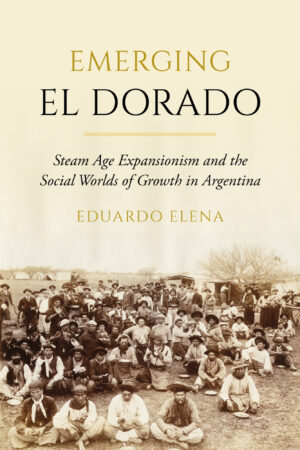
Finally, could you tell us something about the book’s cover image?
This photograph was taken in 1907 and shows a crowd of railway builders at rest. Given that the railways were of central importance, it’s fitting that this image is on the cover. But I particularly like how it reveals the intersection of different social worlds of growth. Two British bosses in nicely tailored outfits are depicted, but most of the figures are laboring paysanos from Corrientes province and southern European immigrants. The fact that only one person at the very back presents as female invites us to consider the gender dimensions of such activity. Some individuals are captured trying to act tough for the camera (including by holding up huge knives), while others stare back at the viewer with curiosity.