Author Ellen Muehlberger on Building a Book
by Ellen Muehlberger, author of THINGS UNSEEN: ESSAYS ON EVIDENCE, KNOWLEDGE, AND THE LATE ANCIENT WORLD
In the acknowledgements for my new book Things Unseen, I say that books are just the “thin, visible surface of a very deep well” of readings, conversations, viewings, and other processes of thinking. On the shelf, books can look like a finished product—and as any author will tell you, I am very happy to have a finished product! But, books are also an artificial stopping point, a short rest in a long, ongoing journey of learning about and responding to the world around you. In Things Unseen, you’ll find four essays on a theme: how do you know what you think you know?
The essays are about late antiquity, and they reflect my expertise in early Christian history. But, of course, I live in the world. What’s happening in the world around me, what I’m reading and listening to—it’s inevitable that modern culture would shape even a book about ancient history, and Things Unseen is no different. I would encourage academic authors to lean in to this feature of writing. Books are built from our expertise, but they are also shaped by our experience—especially by the things we consume from other creators.

Based on readers’ reactions so far, the most surprising peep of modern culture in Things Unseen happens in Chapter Three, where a famous comic, Alan Moore’s Watchmen, helped me make sense of a very odd late ancient Christian theological meeting. I do read some comics—my favorite is My Favorite Things Is Monsters, I love Leaving Richard’s Valley—but my taste doesn’t usually take me to superheroes. I don’t think I would have found Watchmen if my spouse weren’t teaching it in her Comics class at the University of Michigan, where we both work.
In Watchmen, to my surprise, there was something that really helped me think about the ancient documents I was reading: a character who, by accident, becomes something much more than human. Jon Osterman, an expert physicist, has an accident in a laboratory where he is subjected to deeply strange physical forces. After the accident, he experiences time and power very differently (he’s also large and blue). The presence of this new person, now Doctor Manhattan, forces change in everyone around him.
That might seem a million miles away from ancient Christian theological discussions, but in the records created for the Second Council of Constantinople, we watch as the church father Cyril of Alexandria, who had died more than a century before, is textually reanimated and acquires a status that surpasses “church father.” Experts in early Christianity have long noted that something weird happened at the Council, and for me, with Doctor Manhattan in my mind, it seemed clear as day: the Council’s actions are just responses to the new status Cyril had acquired. He was no longer a regular church father, but a superfather! You’ll have to read the chapter to learn about the “accident” that precipitated his transformation, but after the council, Cyril was not subject to the same limits as other ancient Christian writers. As a figure, he became able to bend both time and history around him. The Second Council of Constantinople is a confusing historical event, and I am not sure that I would have been able to make sense of it if I weren’t reading Watchmen.
Ultimately, this is my pitch to academic writers: work on your projects, yes, and develop your expertise. But make sure to leave time for other reading, other watching, other listening. Your writing is your response to what you are consuming, and ideas can come from unexpected places.
To hear more about THINGS UNSEEN, listen to Ellen Muehlberger's interview on the New Books Network podcast
About the Author
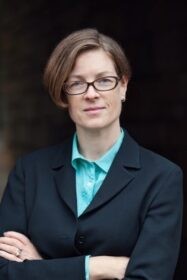
is Professor of History at the University of Michigan. She is author of Angels in Late Ancient Christianity and Moment of Reckoning: Imagined Death and Its Consequences in Late Ancient Christianity and serves as editor for the Journal of Early Christian Studies.