Climbing a Ladder or Buying a Lottery Ticket?
By Gary A. Hoover, author of Ladder or Lottery: Economic Promises and the Reality of Who Gets Ahead
Why did I write this book? Mainly to shed light on a simple question about placement on the social and economic scale, namely were people at lower or higher strata by their own choice or actions?
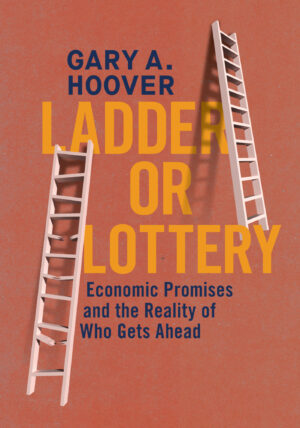
I argued that perspective seemed to matter greatly in the context of where one felt they were and should be along the economic and social spectrum. I stated that some felt the sorting out of positions along this spectrum had a very clear merit component, manifested by industry, sacrifice, and dedication, others viewed the final ordering as being much more opaque, where requested actions, once taken, did not seem to align with expected outcomes. I then referred to the actions and the resulting outcomes as being a social contract between society as a whole and the individuals who made it up.
In the end, I pointed out something that is touted in the fields of economics, science, and engineering, along with many others, about system design. If an individual designs a system, or in my words, a social contract, the same input must repeatedly and predictably produce the same output. If the same input cannot be counted on to give the same output, then there is a design flaw and some thought should be given to a redesign. I argued that at a minimum, the user should be made aware of the glitch in the system. I felt that many people in society were not willing to admit that there was a glitch in the system. They simply attributed the problem to the end users. I then stated that my economics and mathematics training had a problem with that logic. My argument was that there were approximately 45 million individuals at substantially lower rungs of the economic ladder, and that it was statistically inconceivable that so many were suffering from a culture or pathology that kept them from climbing the ladder. I stated that it was hard to fathom that some of those millions did not attempt to use the system as intended but did not get the desired result. If that was the case, then the economic system was not working as intended, and instead of a ladder, the economic system much more resembled a lottery.
I finally argued that even if it were true that people were sorted out along the economic and social spectrum due to their own abilities, and fault lied with them and not the system as created, there still was a problem. In any other business context, when nearly 15% of operators could not properly use the system or product as created, there would be an immediate demand for a recall or, at a minimum, a product redesign. Whether the product is something like faulty software in a word processing package or children’s toys with parts missing, it really did not matter. Even if the product was not posing a threat to the health or safety of the individual, 15% failure would mean that there should be some reevaluation.
About the Author

is Executive Director of the Murphy Institute, Professor of Economics, and Affiliate Professor of Law at Tulane University.