A Conversation with Alyssa Quintanilla and Benjamin Williams, guest editors of 'Processing Forms: Political Aesthetics and the Materiality of the US-Mexico Border,' a Special Issue of "Afterimage"
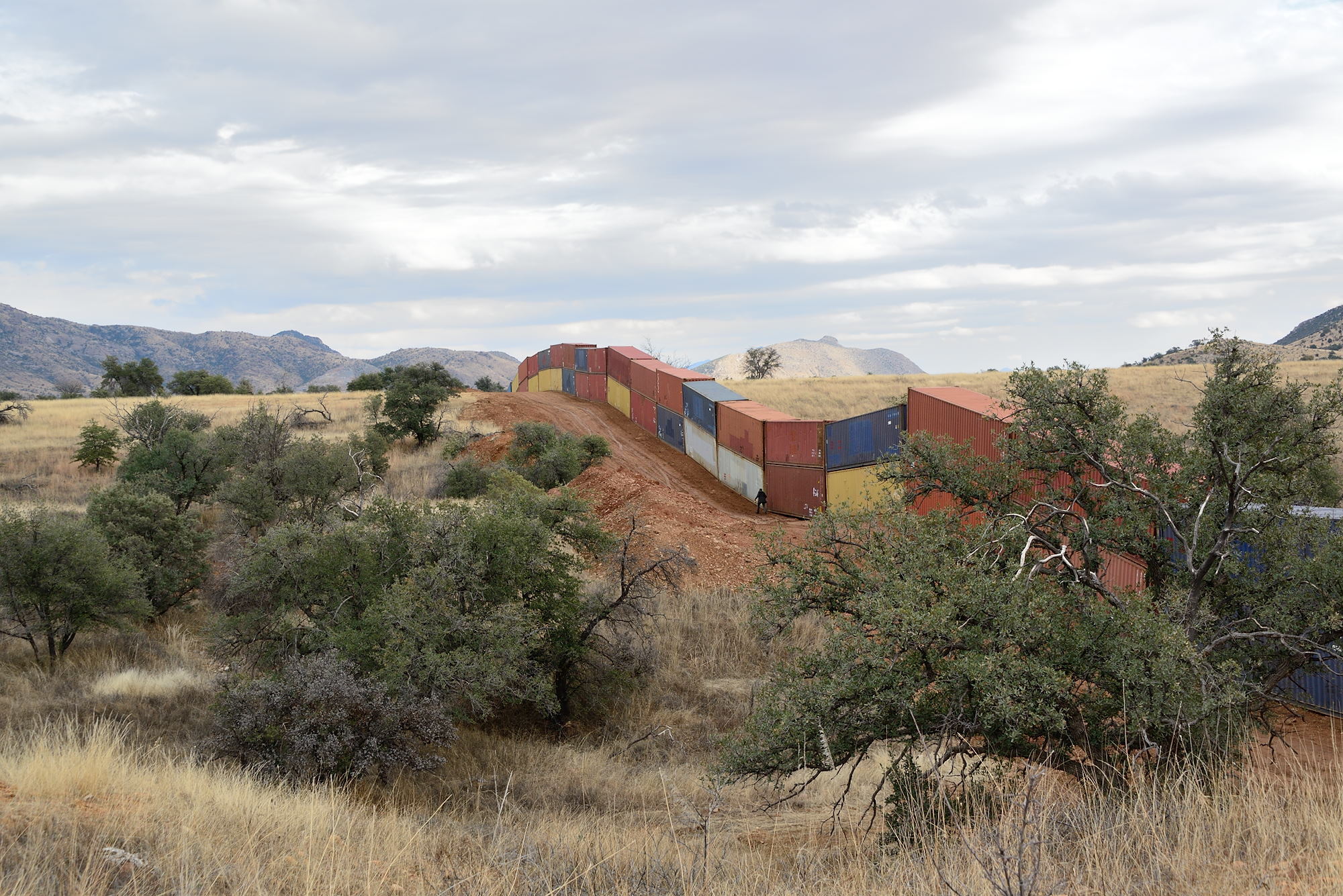
in the Coronado National Forest, 2022; photo courtesy Tomas Jonsson.
What does it mean to think about the U.S.–Mexico border not as a fixed line on a map but as an ongoing process? The new special issue of Afterimage, "Processing Forms: Political Aesthetics and the Materiality of the United States–Mexico Border," explores that question through essays examining photography, sound, film, performance, digital media, and activist practice. We spoke with guest editors Alyssa Quintanilla and Benjamin Williams about the ideas behind the special issue, the role of art in making the border's histories and material realities visible, and why these conversations are especially urgent today.
Why the US-Mexico border?
Alyssa Quintanilla: This special issue, “Processing Forms,” comes from a generative conference panel at the American Studies Association in the fall of 2023. At the time, our considerations of the United States-Mexico border followed the family separation policies and the expansive border construction during the first Trump administration. As a panel, we examined the shifting complexities of the border in the present and within a longer history of violence in the name of “national security.” Since that conference panel, so much in the borderlands has changed—there are more invasive surveillance technologies, more construction has happened, and countless sacred sites have been destroyed. The border is constantly in flux as a site where increasingly harmful policies are implemented, but that is and has always been one of the critical dimensions of the border as a space where the idea of the “nation” is tested.
During a recent trip to the U.S.-Mexico border with some of my undergraduate students from William & Mary, we explored the borderlands, met with activists in the region, and discussed the complexity of contemporary immigration issues. We also had the privilege of speaking with journalist Todd Miller, who articulated the importance of understanding the politics and practices of the border not as the edge of the nation-state but as the center. In effect, what happens along the borderlands dictates so much of what happens in the rest of the country, even when the majority of the population is not looking. Border issues (immigration, the border wall, etc.) are often tethered to the election cycle, but how we think about, discuss, and conceptualize the border in the American political imagination shapes how we understand the nation-state more broadly. Rather, the ideas of who gets to be part of the United States and who does not are decided through increasingly forceful tactics that shape the country more broadly. Seeing the border as central to American politics and life, rather than an inflammatory talking point, demands that we consider how the nation-state is constructed and maintained over time.
Benjamin Williams: Growing up and working in El Paso, Texas, a sister city to Ciudad Juárez, I saw the border expand. More fences, concertina wire, surveillance towers, and Border Patrol agents. What we recognize as the US-Mexico border is a part of a vast material and immaterial infrastructure. Some of it is in plain view, but other parts are hidden in the background. Current operations by agents who patrol the borderlands are sustained through a settler-colonial past and present, the development of new technologies, corporate profiteering, increased budgets, and the continued criminalization of racialized people. Even far from the southern border and about two hours from where I completed my graduate work, a private prison was converted into the Moshannon Valley Processing Center in 2021, a detention facility run by The GEO Group that supports the border’s fascist project. This rural space’s economy, once reliant on prison jobs and the labor of incarcerated people, is now funded by the detention of migrants. But this didn’t happen overnight.
Our special issue thinks with scholars like Camilla Fojas, who, in Border Optics: Surveillance Cultures on the US-Mexico Frontier (2021), describes the borderlands as both “laboratory and archive.” The technologies used to police the borderlands are coupled with processes that were tested and developed over time. The occupation of Vietnam inspired the Border Patrol to deploy ground sensors that agents use to brutally track and apprehend people. The borderland, in this sense, is a laboratory where the projects of racial capitalism, imperialism, and genocide converge. So, too, the borderlands are an archive. Dilapidated fencing and landing mats are strewn across the desert, and surveillance technologies from the past litter the landscape. The artists and activists that our contributors engage take on the border as both a laboratory and an archive.
Why form?
Alyssa & Ben: Our interest in form arose when we began thinking together about how artmaking in the borderlands has long been connected to activism. All art, of course, is political, but this special issue follows theorists who attend to form as the patterned arrangements of not only media and art but also of political and social life.
The United States-Mexico border is not a single thing or even a location, but rather a sprawling system of technologies, policies, and practices. Considering form in the borderlands allows us to think about the various shapes that borders have taken over time and how artists and activists have responded. As Claire Fox shows in The Fence and the River: Culture and Politics at the U.S.-Mexico Border (1999), typical representations of the border emphasize division (the fence, river, and now the wall). Artists and activists are now up against far more complex surveillance systems and increasingly invasive policing. Bordering, simultaneously a material and immaterial process, demands attention to slippery questions of form.
Artist practices and performances surrounding the border make visible how the border takes shape and sometimes illuminate what it might mean to dismantle it. These ideas are as much about form as they are about process—the two, as our contributors and we show in this special issue, are deeply entangled. Looking at form (politically, spatially, and artistically) means accounting for its longer histories.
This special issue requires that we slow down and process the many ways in which the United States-Mexico border is central, not peripheral, to political and social life. In the special issue’s introduction, we theorize what we call processing forms to attend to how activists and artists process technologies, infrastructures, spaces, and practices that are often central to the forms the state uses to fortify or surveil the US-Mexico border.

We invite you to read the special issue, "Processing Forms: Political Aesthetics and the Materiality of the United States–Mexico Border," for free online for a limited time.
Print copies of the special issue (issue 53.2), as well as other individual issues of Afterimage, can be purchased on the journal’s site.
For ongoing access to Afterimage, please ask your librarian to subscribe and/or purchase an individual subscription.
About the Authors
Benjamin Williams is an assistant professor of English at Marshall University. His interdisciplinary scholarship brings together border studies, carceral studies, and media studies. Williams’s current book project, The Carceral Border: Infrastructures of Detection and Apprehension, considers the styles of administrative violence that have come to define the media infrastructures of US border enforcement since the 1980s. His scholarship has appeared in JCMS, Cultural Critique, Hispanic Review, and ASAP/Journal.
Alyssa Quintanilla is an assistant professor of American studies and art history at William & Mary. Her work focuses on the U.S.-Mexico borderlands, Latine/x Art and Culture, and Memory studies. Quintanilla has published articles in Studies in the Novel, The Digital Review, Lateral: Journal of the Cultural Studies Association, and Journal of Media Art Study and Theory, among other venues. She has also created Vistas de la Frontera (www.vistasdelafrontera.com/about), a digital memorial for migrants who have died while crossing the U.S.-Mexico border. Her current book project is titled Border Memory: Visualizing Mourning along the US-Mexico Divide.