UC Press October Award Winners

Susan Ashbrook Harvey
Joan Kelly Memorial Prize 2026
American Historical Association
Susan Ashbrook Harvey is the Willard Prescott and Annie McClelland Smith Professor of History and Religion at Brown University, specializing in Syriac and Greek Christianity of the late antique and Byzantine eras. She is the author of Scenting Salvation: Ancient Christianity and the Olfactory Imagination.
Ministries of Song
Women's Voices in Ancient Syriac Christianity
Ministries of Song is a tour-de-force study of the power of women's liturgical singing in late antique Syriac Christianity. Extending women's religious participation beyond the familiar roles of female saints and nobles, Syriac churches cultivated a flourishing but often-overlooked tradition of women's sacred song. Susan Ashbrook Harvey brings this music to life as she uncovers the ways these now-nameless women performed a boldly sung teaching ministry and invited congregations to respond aloud. By exploring their ritual agency, Harvey demonstrates how these choirs helped to shape the formative ethical and moral ideals of their congregations and communities. Women's voices, both real and imagined, enriched the ritual and devotional lives of Syriac Christians daily and weekly, on ecclesial and civic special occasions, in sorrow or joy, with authoritative theological significance and social and political resonance. Arguing for the importance of liturgy as social history, Harvey shows us how and why women's voices mattered for ancient Syriac Christianity and why they matter still.
A free ebook version of this title is available through Luminos, University of California Press’s Open Access publishing program. Visit www.luminosoa.org to learn more.

Nidhi Mahajan
Society for Economic Anthropology Book Prize 2026
Society for Economic Anthropology
Nidhi Mahajan is Assistant Professor in the Department of Anthropology at the University of California, Santa Cruz.
Moorings
Voyages of Capital across the Indian Ocean
Moorings follows sailors from the Gulf of Kachchh in India as they voyage across the Indian Ocean on mechanized wooden sailing vessels known as vahans, or dhows. These voyages produce capital through moorings that are spatial, moral, material, and conceptual. With a view from the dhow, the book examines the social worlds of Muslim seafarers who have been rendered invisible even as they maneuver multiple regulatory regimes and the exigencies of life, navigating colonialism, neoliberalism, the rise of Hindutva, insurgency, climate change, and border regimes across the ocean. Based on historical and ethnographic research aboard ships, at ports, and in religious shrines and homes, Moorings shows how capitalism derives value from historically sedimented practices grounded in caste, gender, and transregional community-based forms of regulation.
A free ebook version of this title is available through Luminos, University of California Press’s Open Access publishing program. Visit www.luminosoa.org to learn more.
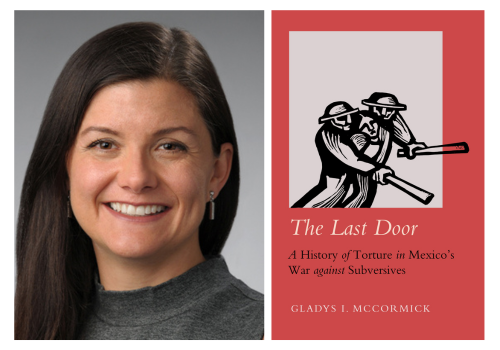
Gladys I. McCormick
Howard F. Cline Book Prize in Mexican History 2026
Latin American Studies Association
Gladys I. McCormick is Associate Professor of History and Jay and Debe Moskowitz Endowed Chair in Mexico-US Relations at the Maxwell School of Citizenship and Public Affairs at Syracuse University.
The Last Door
A History of Torture in Mexico's War against Subversives
As guerrilla groups sprouted up across Mexico in the early 1970s, the military and police routinely resorted to extreme acts of violence, including the systematic use of torture. In The Last Door, Gladys McCormick provides the most thorough account of how torture became a crucial and routine practice of the Mexican government’s war against subversives. Drawing from extensive oral history interviews and declassified government documents, McCormick describes experiences of arrest, torture, and detention in which forced disappearances became all too common and advocates for justice rallied around political prisoners. Torture was not always about extracting information; it was also about inflicting punishment on a faceless so-called enemy and instilling terror into advocates of social change. As McCormick argues, torture became a quotidian practice of state making in Mexico during the 1970s, leaving individuals and their families forever changed. The lack of repercussions for government officials notorious for employing torture, even in spite of a growing movement for truth and justice, has led to entrenched impunity that is endemic in Mexico as its contemporary security crisis continues.