The Cultural History of Prisons
By Michael Welch, author of Escape to Prison: Penal Tourism and the Pull of Punishment
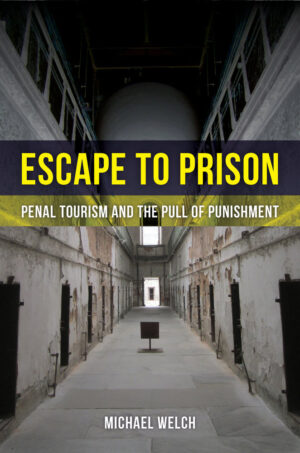
Escape to Prison emerged as what might be viewed as the first leg of a trilogy that includes my other books with the University of California Press, namely The Bastille Effect: Transforming Sites of Political Imprisonment (2022) and Visions of Prisons: Wars, Walls, and Watching (2026).
Still, that was not the original plan; in fact, there was no plan. As a starting point in 2008, my good friend and colleague Maximo Sozzo invited me to teach a short graduate course on the U.S. War on Terror and Human Rights at Facultad de Ciencias Jurídicas y Sociales of the Universidad Nacional del Litoral, Sante Fe, Argentina. While spending leisurely time in Buenos Aires, I followed the tips in Lonely Planet that directed me to the Argentine Penitentiary Museum. Since my career has been focused on interpreting themes of penology, the site was easy to decode—especially along lines of church and state. In its previous incarnation, the museum was a prison governed by Mother Superior until the turbulent 1970s when the state took control.
For me, the Argentine Prison Museum was an intellectual opportunity not to be missed because former prisons would serve as a vehicle for serious inquiry. Armed with the ideas of Durkheim and Foucault, I wrote a piece for Theoretical Criminology. At the time, I considered the topic a one-off—until I moved to Australia. There, at the University of Sydney, School of Law, Institute of Criminology, I was concentrating on the matters of crimmigration and human rights, all the while being surrounded by the history of Australian penal colonies. So, what began as a single case study on early penology in Buenos Aires developed into a comparative project with Argentina and Australia intersecting at critical junctures.
Soon thereafter, I resumed my gig as a Visiting Professor at the London School of Economics, Mannheim Centre for Criminology in the Department of Social Policy. Walking to the LSE from South Bank, I noticed an intriguing place—the Clink Prison Museum. Once inside, I recognized a phenomenon that I call the “pull of punishment” by which visitors are drawn into the cultural history of prisons. As I traveled to South Korea, Hong Kong, and South Africa, I discovered the “pull of punishment” unfolding at other former prisons which have been transformed into sites for the curious. Closer to home, Alcatraz and Eastern State Penitentiary (Philadelphia) attracted my attention to the extent that a book was within reach.
At Rutgers University, I incorporate my slide shows into a course called “Prisons & Global Culture.” For those lectures, I let photographs do the talking as we traverse the world. Visualization—both optically and mentally—has become my method for conceptualizing the realm of punishment. Thus, Escape to Prison allowed me to step foot not only into other countries but also into their complex cultural systems.
To see how my research has continued to evolve, please visit my blogs for the other books in the trilogy: The Bastille Effect (2022) and Visions of Prisons (2026).