Electric Eyes: Erica Toffoli on Border Surveillance and Visual History
Winner of the Western History Association's 2025 Michael P. Malone Award and California History's 2024 Richard J. Orsi Prize, Erica Toffoli's essay, “Electric Eyes: Surveillance, Sovereignty, and the Limits of the Border Patrol’s Technocratic Vision on the U.S.-Mexico Line” explores the visual culture of the U.S. Border Patrol during the twentieth century, revealing how photography, surveillance technologies, and carefully crafted public imagery shaped ideas about migration, sovereignty, and national security. As debates over immigration continue to dominate public discourse, Toffoli's research offers important historical context for understanding how today's border politics were built. We spoke with her about the origins of the Border Patrol's visual identity, the enduring power of surveillance imagery, and why these histories continue to matter.
What kinds of images or visual symbols did the Border Patrol use to shape public perception of migration and enforcement in the twentieth century?
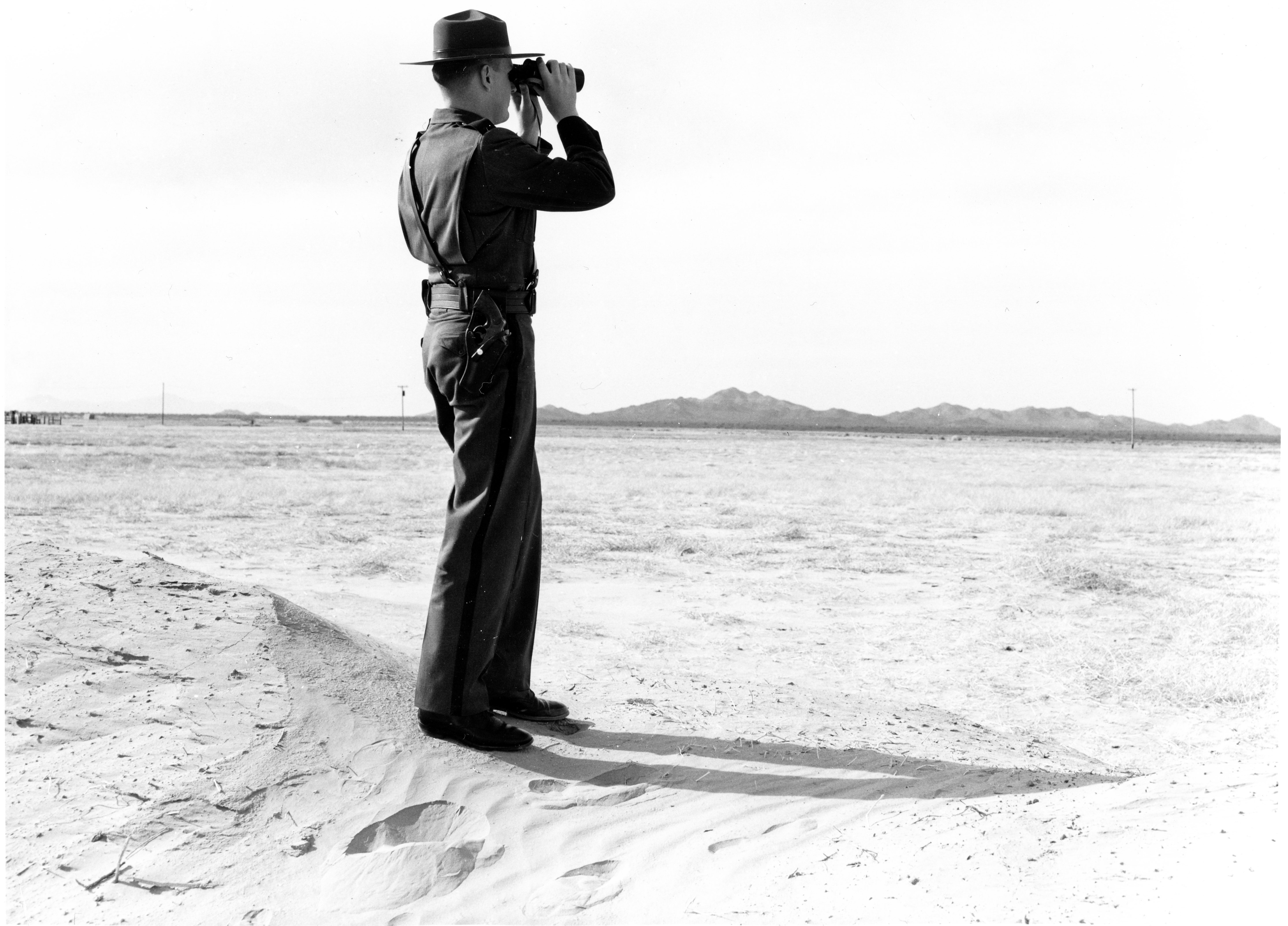
The Border Patrol was obsessed with branding. Its ideology was expressed in a variety of media: promotional materials, officers’ memoirs, Hollywood films, travel literature, and installations at local shopping centres. Given its evidentiary value—the idea that the camera records what is “true”—photography was the agency’s preferred weapon. Every day, officers took pictures in the field. Photojournalists published exposés on the agency in popular periodicals, like LIFE and National Geographic. By the 1960s, the Border Patrol was churning out photo-essays in a magazine, INS Reporter. All this publicity advertised three key traits: vigilance, modernity, and patriotism. It also sold two insidious sentiments: fear of “illegal aliens” and faith in surveillance technologies.
To connect with audiences, the Border Patrol renovated recognizable American symbols. Initially, its visual culture was steeped in Western iconography. The cowboy was a chief inspiration. Often, Border Patrol officers were pictured on horseback, wearing Stetsons, gazing across vast swaths of sandy desert. That visual trope endured long after agents were equipped with sophisticated surveillance tools. Steadily, these implements took up more space in the Border Patrol’s campaigns. After the 1970s, portraits of cutting-edge monitoring equipment, like night-vision scopes, became quite common. According to the Border Patrol, these were infallible, almost magical gadgets.
Always, the undocumented were framed as dangerous threats to national security. Photographs in INS Reporter, for example, showed migrants scurrying across the desert with a Border Patrol helicopter hot on their heels or imprisoned behind bars inside Southwestern detention facilities. This was a deeply racist, classist imagining of unauthorized migration. Together, these kinds of images—of Border Patrol officers, the Southwestern landscape, and undocumented migrants—fueled stubborn nativist stereotypes about the “wide open” border and Latin American “illegality.” As the Border Patrol pictured it, the U.S.-Mexico line was a hazardous, vulnerable zone where a forever war against criminal trespassers raged.
How did surveillance technologies change not just enforcement, but the story the Border Patrol told about itself?
The Border Patrol’s technocratic philosophy reshaped the way it policed the nation’s boundaries and articulated its own institutional identity. Until the late 1950s, its tools and tactics were fairly crude: binoculars, watchtowers, sign cutting (scanning the ground for footprints, etc.), and horse patrols. Afterwards, the agency adopted surveillance technologies designed to amplify natural human sight: mechanized ground sensors (“electric eyes”); night-vision scopes; advanced aircraft; and low-light television networks. All targeted limits to human perception. They extended the Border Patrol’s visual field in unprecedented ways. Enforcement became increasingly rigorous and all-encompassing.
Predictably, these transformations enhanced the agency’s confidence. That newfound self-assurance was reflected in the Border Patrol’s visual propaganda. Photo-essays in INS Reporter chronicled especially notable innovations. The message was simple: armed with up-to-date surveillance technologies, officers could control the borderlands. Yet the agency never discarded tradition. Western iconography remained a bedrock of the Border Patrol’s self-styling. In the 1980s, for example, El Paso’s National Border Patrol Museum hired Greg Whipple (a retired Border Patrol pilot) to paint Persistence. In the mural, two agents inspect the desert on horseback. Essentially, the Border Patrol envisioned the U.S.-Mexico line as a modern Wild West that could only be saved by officers—paragons of rugged, masculine virtue and rational, scientific prowess—strapped with cutting-edge optical devices that enhanced surveillance capabilities.
There was a marked tension at the heart of the Border Patrol’s new image: its visual culture lauded technological innovation and warned that the border would never be secure. It praised officers’ vigilance and stressed their—alleged—frailty. Agents, the Border Patrol’s visual media cautioned, were no match for the undocumented. This might seem counterintuitive! But, for the agency, it was a calculated manipulation with practical and political benefits. It bolstered the INS’s pleas for federal funding. And it encouraged U.S. citizens to sympathize with officers. For the agency, there was nothing contradictory about showing off technological progress and claiming that innovation was futile. That narrative guaranteed the Border Patrol’s longevity and incited public anxiety that fueled support for restrictionism.
Of course, this toxic rhetoric was laced with falsehoods. Disturbingly, it glossed over the intrusive, aggressive nature of surveillance infrastructure and the state-sponsored violence to which the undocumented were subjected. As the arsenal on display in the Border Patrol’s visual propaganda makes plain, the power to inflict physical, psychological, and social harm lay with the agency, not migrants.
You mention that the Border Patrol “glorified surveillance” to justify its power to police the U.S.-Mexico line. How do you see that legacy reflected in today’s border politics, technology use, or visual media?
Regrettably, the photographs I unpack in “Electric Eyes” are eerily prescient. They foreshadow the xenophobic vision—one which celebrates surveillance, denigrates the undocumented, and sanctions sovereign violence in the borderlands—regurgitated by ICE, the DHS, and the Trump administration. Compared to CBP’s Biometric Exit Mobile or Anduril’s Autonomous Surveillance Towers, the technologies on display in the Border Patrol’s twentieth-century visual culture are quaint! In spirit, the attitude toward border policing reflected in the agency’s historical media is remarkably in sync with that espoused by contemporary restrictionists. So is the logic deployed to promote enforcement.
Invariably, immigration authorities and politicians eager to cash in on nativist hysteria criminalize the undocumented. As a litany of scholars, activists, and migrants argue, that characterization is incorrect. But still, the state’s visual propaganda reinforces an intrinsic connection between deviance, undocumented status, and the violation of U.S. sovereignty.
To do so, the modern border policing apparatus exploits new types of visual media and recycles tried-and-test imagery intended to justify its invasive, discriminatory tactics. Last year, ICE’s recruitment videos riffed on Call of Duty and the apocalyptic horror genre to encourage enlistment. In her ill-fated ad campaign, former DHS Secretary Kristi Noem replicated a long-standing image: that of the Stetson-wearing, horseback-riding inspector patrolling an untamed natural landscape. To normalize deportation crackdowns and the outsourcing of detention, the DHS posted clips of Noem’s tour through El Salvador’s Terrorism Confinement Centre. In the revolting recording, guards showed off their weapons. Half-naked prisoners were the backdrop for Noem’s warning that those who flouted U.S. immigration laws would be punished. As in the past, undocumented migrants were positioned as dangerous threats to public safety.
There is a callousness to these visual spectacles that might seem shocking. Without a doubt, Trump’s DHS has turned cruelty into a badge of patriotism in an unprecedented way. From a historical perspective, though, today’s crass approach to border policing—grounded in the vilification of undocumented migrants and the weaponization of nativist hatred for nationalist ends—has deep roots. This is why the Border Patrol’s historical photography is so valuable, and so unsettling. In illuminating the material and ideological foundations of today’s surveillance culture on the U.S.-Mexico line, the visual record demonstrates that the impulses behind the contemporary politics of border policing are not new. At its core, this xenophobic imaginary is simply an old form of demonization on steroids.
For a limited time, Erica Toffoli’s “Electric Eyes: Surveillance, Sovereignty, and the Limits of the Border Patrol’s Technocratic Vision on the U.S.-Mexico Line” is available to read for free online. You may purchase single copies of California History issue 101.4, in which the article appears, on the journal's site. For ongoing access to California History, please subscribe to the journal and/or ask your library to subscribe.
About the Author

Erica Toffoli is a historian of migration, visual culture, and the modern United States. She holds a PhD (2023) from the University of Toronto, where she is a lecturer in the Department of Historical Studies. Her work is published in California History, the Radical History Review, Photography and Culture, and the Journal of Social History. As an associate at The Americas: A Quarterly Review of Latin American History, she edited Revolution and Revolutionary Movements in Latin America: A Special Research and Teaching Collection (2017). Toffoli is the recipient of a Social Sciences and Humanities Research Council of Canada Fellowship, the Charles Redd Center for Western Studies’ Research Award, and the American Historical Association’s Albert J. Beveridge Grant for Study of the History of the Western Hemisphere. She is the winner of the Richard J. Orsi Prize (2024) and the Western History Association’s Michael P. Malone Award (2025). Her forthcoming publications include a chapter in The Visual in Latin American History (University of Texas Press, 2026) and a contribution to The Texas Yawp: A New, Massively Collaborative History of the Lone Star State (Stanford University Press, 2027). Currently, she is writing a book on the visual cultures of undocumented migration in the U.S. borderlands.