Excerpt from Keren Rosa Hammerschlag's "The Chosen Race"
by Keren Rosa Hammerchlag, author of The Chosen Race: Troubling Whiteness in Victorian Painting
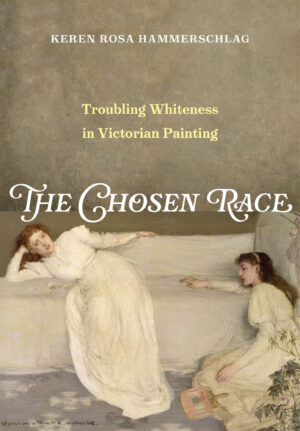
When I embarked on this project back in 2015, there existed no book on race in nineteenth-century British painting. Somehow paintings produced in England during the reign of Queen Victoria had managed to keep their distance from discourses of Empire and thereby avoid race-based scrutiny. I expected that I would write a book about how Victorian painters reinforced the racial hierarchies that provided the ideological foundation of British Imperialism. I soon realised that this was not straightforwardly the case. Victorian painters used their art to make visually manifest racial and racist ideas and concepts. No surprises there. But they also problematized the organisation of humanity according to skin, hair and eye colour through their creative use of pigment. These painters knew better than anyone that humans are not black, white, red or yellow. As a result, The Chosen Race is as much about how Victorian painters challenged racial distinctions as it is about how they affirmed them. In writing this book, I came to realize that many Victorian painters—including Dante Gabriel Rossetti, the artist discussed in the excerpt below—experimented with the representation of racial variation and racial indeterminacy, visualizing the impossibility of pinning down racial “types.” Even though (or perhaps precisely because!) they were produced at the height of British imperial strength and dominance, the Victorian paintings examined in this book expose race as malleable and unreliable, thereby offering a colourful picture of who might constitute the “chosen race.”
Excerpt from Chapter Four: “Matrilineal Descent: Racial Inheritances in Victorian Paintings of Mothers and Their Children”
The Beloved (1865–66) [by Dante Gabriel Rossetti] (fig. 1) is replete with decorative details—fabrics, flowers, and jewelry—that offset the varied complexions, hair, and eye colors of the figures in the scene. Rossetti used complementary colors to achieve this visual effect. In particular, the bride’s fair complexion, blonde-red hair, and green eyes are accentuated by her green veil and robe. The red of her lips and rosiness on her cheeks are picked up in the ruby headpiece in her hair, the red floral-patterned dresses worn by the women on either side of her, the red flowers that they hold, and the ruby gems that decorate the necklace worn by the Black child in the painting’s foreground. The jewelry that Rossetti included in The Beloved enhances the beauty and exoticism of the figures, and draws attention to the circulation of bought, traded, and stolen objects around the British imperial world at the time of the painting’s production. After all, Rossetti himself was an avid collector—of women and objects.[1]
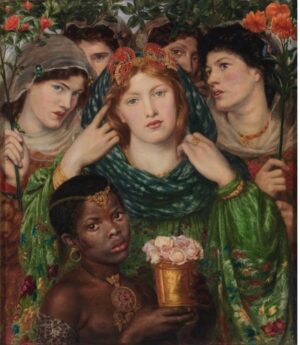
In The Beloved there is an equivalence between the bevy of racially diverse figures and the array of exotic jewels, adornments, and flowers.[2] This equivalence is highlighted by the arrangement of the women to resemble the petals of a flower or the setting of a precious jewel. Several of the objects included in the painting came from British and former British colonies—places where well-heeled Victorians travelled in search of exotic experiences and exotic things. The bride wears a Japanese kimono and a green Peruvian head scarf. Her gold and ruby feather headdress is Chinese and her gold bracelet Burmese.[3] As Shirley Bury has shown, the headpiece was originally blue (it was made from kingfisher feathers) but Rossetti altered the color for visual effect.[4] The Black attendant wears on their head a necklace borrowed from the architect and artist George Price Boyce. Boyce also provided the Japanese robe worn by the bride.[5] The large pendant worn by the child is North African in origin.[6] The child also wears a gold hoop earring (none of the other figures wear earrings), emphasizing their exoticism and status as enslaved.
But Rossetti’s The Beloved is not just about slavery; it is also about marriage, and the relationship between marriage and slavery. Both the Song of Solomon and Psalm 45 anticipate a marital union. Rossetti imagined these biblical sources coalescing in the form of a bride, pulling back a green veil to reveal her admirable fair-complexioned visage, reddish-blonde hair, and blue-green eyes. Marie Ford, a professional English model “with rosy skin and fiery red hair,” modeled for the figure of Solomon’s bride.[7] In fact, the issue of Ford’s complexion inspired the choice of subject. The picture was originally intended to be of Dante’s Beatrice, but Ford’s complexion was found to be too “bright.”[8] Virginia Surtees elaborates that Marie Ford had “fair colouring,” while Jan Marsh describes her as “too rosy skinned for the pale-faced figure of Beatrice.”[9] Matthew Francis Rarey goes so far as to claim that Ford’s complexion was considered by Rossetti to be “too swarthy.”[10] Whether the model’s complexion was too “fair,” “rosy,” or “swarthy,” Rossetti decided to turn the picture into an illustration of the Song of Solomon, a subject that he had been thinking about for some time.[11]
Rossetti imagined four virgin bridesmaids, women of different ethnicities, arranged to frame the pale-skinned “stunner,” an arrangement that Marsh describes as “firmly Anglocentric.”[12] The complexions of the bridesmaids vary from fairest on the left to darkest in the woman second from the right, but all the bridesmaids have brown or black hair. The bridesmaid on the left has blue eyes, and the two bridesmaids on the right have brown eyes. Henry Currie Marillier, one of Rossetti’s early biographers, wrote about the painting: “Of the maidens who surround the central figure, and set off her beauty, one is of a dark Asiatic cast; a second is a handsome gipsy; a third, on the left, looks languorously and enviously towards the bridegroom, and the fourth is more than partially concealed.”[13] In Marillier’s highly racialized interpretation, not only do the bridesmaids “set off” the beauty of the central fair-skinned bride, but one bridesmaid is evidently jealous. Could this be a case of always a bridesmaid, never a bride?
Even though the faces of the bridesmaids are obscured to varying degrees, the models for the figures have been mostly identified. In addition to Fanny Eaton at top right, the bridesmaid on the left is thought to have been modeled for by Ellen Smith, an English former housemaid. At the right is Keomi Gray, a Romani model. Gray’s likeness appears in Frederick Sandys’s Vivien (1863; Manchester Art Gallery), Morgan-le-Fay (1864; Birmingham Museums), and Medea (1868; Birmingham Museums), all pictures of exotic and alluring yet dangerous women. We only see a fragment of the face of the bridesmaid at the top left, although a drawing from 1865 (Tate) of a woman with thick wavy hair and a scarf loosely wrapped around her head and shoulders could be a study for this figure. The Black child is the only figure who remains entirely unidentifiable—the names of the multiple models lost to history.
The Black child is positioned in front of the central bride, inviting us to consider them together. The closeness of the figures works to contrast light and dark complexions, with the critic for the Athenaeum describing how the light tones of the bride’s flesh and garments become intensified in contrast to the darkness of the child’s “golden-bronze skin.”[14] But there are similarities between these otherwise contrasting figures. Both look directly out at the viewer, and we see more of their faces and bodies than any of the other figures in the scene. They also both tilt their heads to the left. They are the most bejeweled figures, together constituting a study in the appearance of gold accessories on diverse flesh tones.
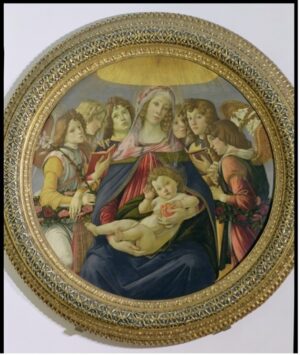
What then is the relationship between the fair-skinned bride and the dark-skinned child? Is this merely a picture of a white mistress and her Black servant? […] There is a substantial history of portraits of white female sitters appearing with their Black attendants. But there is another possible precedent for Rossetti’s The Beloved: Sandro Botticelli’s Madonna of the Pomegranate (c.1487; fig. 2). Madonna of the Pomegranate was acquired by the Uffizi in 1780. Although Rossetti never visited Italy, it is possible that he was familiar with the painting through publicly available prints and photographs.[15] In The Beloved the bride tips her head slightly and stares blankly in a way that recalls Botticelli’s Madonna, while the four bridesmaids reference the six angels that flank the Holy Mother.[16] The figure on the far left of Botticelli’s painting holds a lily and roses in worship of Christ and Mary; in The Beloved this figure becomes the bridesmaid on the far left, holding a branch of pomegranate flowers over her left shoulder. According to this reading Rossetti replaced Botticelli’s Christ Child with a Black enslaved child. If we read The Beloved as a version of the Madonna and Child, then Rossetti’s fair-skinned bride and dark-skinned attendant might be viewed as a mother and child, making the (imagined) father—God, Solomon, the viewer of the painting—Black.
[1] Julian Treuherz, Elizabeth Prettejohn and Edwin Becker, eds., Dante Gabriel Rossetti (London: Thames and Hudson, 2003), 229–34.
[2] Matthew Francis Rarey, “‘And the Jet Would be Invaluable’”: Blackness, Bondage, and The Beloved,” Art Bulletin 102:3 (2020), 28–53.
[3] Shirley Bury, “Rossetti and His Jewellery,” Burlington Magazine, February 1976,” 101; and Rarey, “And the Jet Would be Invaluable,” 32.
[4] Bury, “Rossetti and his Jewellery,” 101.
[5] Virginia Surtees, ed., The Diaries of George Price Boyce (Norfolk: Old Water-Colour Society, 1980), 42, entry for March 5, 1865.
[6] Bury, “Rossetti and his Jewellery,” 101.
[7] Rarey, “And the Jet Would be Invaluable,” 32. She was misidentified by William Michael Rossetti (and then Marillier) as Miss Mackenzie.
[8] Rossetti wrote to Ellen Heaton on July 2, 1863, that: “I have got my model’s bright complexion, which was irresistible, & Beatrice was pale, we are told”; quoted in Virginia Surtees, Dante Gabriel Rossetti 1828–1882: The Paintings and Drawings. A Catalogue Raisonné (Oxford: Clarendon Press, 1971), 105. Surtees elaborates that “the features and fair colouring of the professional model Marie Ford (wrongly called Miss Mackenzie by W. M. Rossetti), lent themselves more readily to the Bride of the Canticles” (104–5).
[9] Jan Marsh, “‘For the Wolf or the Babe He Is Seeking to Devour?’ The Hidden Impact of the American Civil War on British Art,” in Re-Framing the Pre-Raphaelites: Historical and Theoretical Essays, ed. Ellen Harding (Aldershot, UK: Ashgate, 1996), 166.
[10] Rarey, “And the Jet Would be Invaluable,” 40.
[11] William Michael Rossetti relates an incident in August 1881 over the complexion of a replica of Beata Beatrix. When the replica was delivered, “Mr. Valpy found the flesh of the Beatrix somewhat too dark for his liking.” Rossetti agreed to receive the picture back for a time and “lighten the tints.” See William Michael Rossetti, Dante Gabriel Rossetti as Designer and Writer (London: Cassell and Company, 1889), 118.
[12] Jan Marsh, Black Victorians: Black People in British Art, 1800–1900 (Aldershot, UK: Lund Humphries, 2005), 160.
[13] H. C. Marillier, Dante Gabriel Rossetti: An Illustrated Memorial of His Art and Life (London: George Bell and Sons, 1899), 140.
[14] “The Royal Academy—Winter Exhibition (Third Notice),” Athenaeum, January 20, 1883, 93. Marillier wrote of the Black figure in the foreground: “Before her [the bride], serving as a foil to the creamy loveliness of her own face, goes a little negro boy bedecked with a jewelled collar and headband, and bearing in his hands a golden vase of roses” (Dante Gabriel Rossetti, 140).
[15] Alicia Craig Faxon speculates that “one would expect that Charles Fairfax Murray could have laid his hand on a copy and passed it on”; see “Rossetti’s Images of Botticelli,” Visual Resources 12 (1996): 60. Rossetti is said to have greatly admired the work of Botticelli; see Elizabeth Prettejohn, Modern Painters, Old Masters: The Art of Imitation from the Pre-Raphaelites to the First World War (New Haven: Yale University Press, 2017), 20–21 and 150–56. In 1867 Rossetti acquired the so-called Smeralda Brandini (c.1470–75, now in the V&A) attributed to Botticelli; see Gail S. Weinberg, “D. G. Rossetti’s Ownership of Botticelli’s ‘Smeralda Brandini,’” Burlington Magazine, January 2004, 20–26.
[16] In his discussion of The Beloved (and other works by Rossetti, Solomon, and their circle), Colin Cruise brings together images of the spiritual Madonna and the sensuous Bride as reflective of contemporaneous commentaries upon the Song of Solomon. Cruise also discusses the influence of Botticelli on these artists. See “Versions of the Annunciation: Wilde’s Aestheticism and the Message of Beauty,” in After the Pre-Raphaelites: Art and Aestheticism in Victorian England, ed. Elizabeth Prettejohn (Manchester: Manchester University Press, 1999), 167–87.
About the Author

is Senior Lecturer in Art History and Curatorship at the Australian National University in Canberra and author of Frederic Leighton: Death, Mortality, Resurrection.