Q&A with Andrea Horbinski, author of "Manga's First Century"
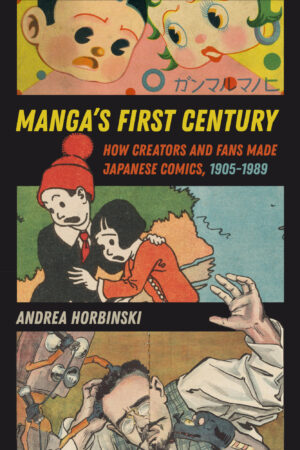
Manga is the world’s most popular style of comics. How did manga and anime—“moving manga”—become ubiquitous? Manga’s First Century delves into the history and finds surprising answers.
Tracing its history from the early 1900s up though the 1980s, author Andrea Horbinski shows the evolution of what became the most popular form of comic in the world with Publisher's Weekly calling it "a vivid ode to the variety and depth of an enduringly popular art form."
Andrea Horbinski earned her PhD in modern Japanese history and new media from the University of California, Berkeley. She serves on the editorial board of the Journal of Anime and Manga Studies and as the submissions editor for Mechademia: Second Arc.
When and why did you develop an interest manga and anime? Was there a particular manga or anime series that peaked your interest?
I first got interested in anime by watching a show called Revolutionary Girl Utena (Shōjo kakumei Utena) in high school. Utena had girls with swords, an interest of mine as a longtime fan of science fiction and fantasy, and it also had something that the cartoons I'd loved as a kid hadn't: one continuous serialized story told over the entire length of the show. Between that and another anime called Outlaw Star, which I watched around the same time, I was hooked, and I decided to study Japanese in college because of anime. In those college Japanese classes, I actually read manga in Japanese for the first time, and at the same time I was also getting more into translated manga in English, particularly works by CLAMP.
The title of your book, Manga's First Century, tells the time period covered. Today, both manga and anime are global phenomena, but what did manga look like in its inception?
Manga started out as political cartoons in Japanese newspapers at the end of the 19thC, particularly the Jiji Shinpō newspaper, whose staff cartoonist Imaizumi Ippyō resurrected the term "manga" to mean exclusively political satire. Ippei and his successor at Jiji, Kitazawa Rakuten, wanted to differentiate "manga" from "ponchi-e," the term for the hybrid form of cartoons that were then current in the Japanese press, which combined Euro-American cartooning with the legacies and techniques of Edo period popular media, including ukiyo-e prints. Rakuten launched Japan's first manga magazine, Tokyo Puck, in 1905, and from its success, manga expanded over the decades into a bewildering variety of forms, including the mainstream serialized manga that the world knows today like One Piece, Demon Slayer (Kimetsu no yaiba), and many more.
What are some standout examples of manga that really pushed the boundaries of what was seen as culturally acceptable to speak about in Japanese society during this first century?
"Culturally acceptable" is an interesting framing. Imperial Japan never had a free press, and censorship was a constant, although it waxed and waned before escalating steadily beginning in the 1910s until the end of the war, and manga was subject to censorship as a feature of magazines and newspapers. So "culturally acceptable" was really "what the government deemed acceptable."
When manga was entirely political satire put out by Tokyo Puck and a few other publications, the Home Ministry could and did ban entire Tokyo Puck issues if foreign diplomats complained about their government's portrayal in them. In the Shōwa era (1926-89) under the so-called Peace Preservation Laws, all leftist thought was steadily expurgated from media, and proletarian and leftist mangaka continued to face arrest and torture at the hands of the Thought Police, sometimes even after they had stopped publishing explicitly leftist material.
After the war, the Occupation continued to censor print publications until it ended in 1952, although they censored things like depictions of samurai with swords as well as anything they deemed pro-rightist, pro-war, or pro-imperial government. The Occupation era saw the launch of sports manga, partly as a response to those restrictions. In other respects, manga was finally free to publish whatever, although prewar critics immediately resumed criticizing children's manga on the grounds that it was too violent, too many pictures would rot kids' brains, and children were imitating manga in their play, among many other things. These concerns escalated into the so-called "ban bad books" movement (akusho tsuihō undō), which lasted for about ten years beginning in 1955, and in these years manga remained culturally marginalized even as its popularity grew.
But Tezuka in particular used the freedom of postwar publishing in the cheap akahon manga category to begin injecting tragedy into children's manga, which previously staked its value on being amusing and laugh-provoking, especially in his works The Mysterious Underground Men and Crime and Punishment, as well as Jungle Emperor (Kimba the Lion). As tragedy and Tezuka's new concept of "story manga" (longform serialized narrative, containing both tragedy and laughter) became the default throughout mainstream manga, young male creators took Tezuka's innovations to extremes and began creating what they called "gekiga," aspiring to be a new kind of realistic manga for young adults.

From the time period you cover in the book, what manga and anime would you recommend to readers as recommended or supplemental reading/viewing?
It's possible to read a good deal of the specific manga I talk about in the book in English these days, although some works aren't available in translation or are hard to find. The National Diet Library has greatly expanded online and international access to its digital holdings, and you can look at the entire print run of Tokyo Puck under Rakuten's editorship online, as well as many other sources I used in the book (in Japanese only, although the Diet Library site is available in English). The New York Public Library has the Shō-chan picture books online as well. From the 1930s, Tank Tankurō has been translated into English, and the Norakuro anime shorts and audio dramas are on YouTube. The National Film Archive of Japan also has some of the Norakuro films, as well as surviving earlier animated shorts like Namakura gatana. Lots of Tezuka manga are available in English, although nowhere near his full output, and some titles like Shintakarajima are ebook-only. Luckily the Astro Boy anime is available on YouTube, and his later works like Dororo, Black Jack, and Swallowing the Earth are also easy to find. Gekiga and Garo manga have been well-represented in English translation through the work of people like Ryan Holmberg and the publisher Drawn & Quarterly in particular--they have put out many works by Yoshihiro Tatsumi, Tsuge Yoshiharu, and Hayashi Seiichi, to name just a few. D&Q has also just begun publishing The Legend of Kamui in English for the first time. Really at this point if you're interested in older manga, following Holmberg's Instagram to pick up copies of his latest projects is the way to go; he has also published translations of Bat-kun and Igaguri-kun with Bubbles, and has done particularly good work recently bringing the works of two female Garo mangaka, Tsurita Kuniko and Yamada Murasaki, into English as well.