DEI is Out. But We Can Keep Doing the Work, with Science and Joy
By William T. L. Cox, PhD, author of Overcoming Bias Habits: An Evidence-Based Guide to Creating a Joyfully Inclusive World
Corporate America and beyond have turned against DEI. But that’s not only because symbolic culture wars have overridden good sense and meaningful progress—it’s also because many DEI programs just did not work or deliver what they promised.
But we do not have to accept the current state of affairs. Institutions will always let us down in the end. But meaningful change comes from the sustained work of individuals. Us! We, the people! That is what the science says. And it’s what I’ve seen in my two decades as a scientist-practitioner testing evidence-based bias reduction methods and working with organizations in every profession to implement them. Ongoing, individual effort is what ultimately helps us overcome bias and create more inclusion, equity, and belonging. And although it is work, that work can, and should, be joyful.
The recent national backlash against “DEI” is a strangely mixed bag for behavioral scientists like me. On the one hand, we are highly critical of non-scientific DEI efforts. For the past two decades, nearly every year a major media outlet published an article by or interview with myself or one of my colleagues saying, “Hey — at best we really do not know if most DEI works, and at worst, the evidence says that a lot of it causes more harm than good.” On the other hand, biases related to race, gender, LGBTQ+, disability, and more are pervasive, habitual problems in everyone’s brains, behaviors, workplaces, and lives. And as scientists, we develop effective methods to help people overcome these bias habits.
Wholesale rejection of anything that could fall under the broad label of “DEI” is a bit silly — saying all DEI is bad (or good) is like saying all movies are bad (or good). Such broad statements beg the question: Well, which one? One bad action movie does not make all action movies bad, nor all movies everywhere. It depends. The landscape of DEI programs is the same. There’s the good, the bad, and the ugly.
This is why behavioral scientists like myself pull our hair out. We want the public to listen to experts, to rely on solid empirical evidence, and use data to inform their decisions. “DEI” programs need to be tested in experimental studies. We don’t put a medication in our bodies until it’s passed extensive clinical trials. So why would we put people through a DEI training focused on behavior change without testing whether it works?
Changing human behavior is hard. I got a whole PhD learning how to do it. I have colleagues whose whole careers are devoted to testing interventions related to changing one single behavior: wearing sunscreen. And that is difficult enough! The breadth of outcomes and institutional and systemic issues related to “bias” and “diversity” are complex and interactive, involving many different kinds of behaviors: Hiring, climate, interpersonal interactions, leadership, and more. That has been the focus of my career—developing and testing evidence-based bias reduction methods, and then helping organizations implement them.
After many years of success and millions of dollars of research grant funding (which the Federal Government no longer spends on this area of science), navigating behavioral change remains a difficult prospect — even for scientists like myself. Given that, what can you do when, as happens in many organizations, “DEI” just falls in your lap?
I’ve lost count of how many times an HR professional has told me “The employees wanted a diversity training, so I pulled together the best information I could.” Without a tested, evidence-based model of behavioral change to connect that information to action, just giving people information does not work. It’s no surprise that many DEI programs fail or make people angry in a way that leads to them abandoning effort. We need to use science!
The “culture wars” just make all of this worse, focusing our attention on symbolic battles at the expense of practical progress. Not long ago, while administering our evidence-based training at an organization, an employee tried to debate me about nationwide gender pay gaps. But, how would debating him about that help all the women in the room? I pivoted and went for the practical victory instead: I turned to the leadership and asked, “Have you looked? How do men’s and women’s salaries in this organization compare? What about those of White People/People of Color?” They had never even checked. Checking those salaries (and fixing them) was more important than debating someone about broad national trends. Practical over symbolic.
I met a parent who “hated seeing pronouns” in email signatures, but they were fully loving and supportive of their transgender daughter’s transition. Which part matters more? Another workplace celebrated that 7% of employees were Black, matching city demographics. But their organizational climate was actively hostile, and the 7% was a revolving door as Black employees constantly quit then got replaced. These examples abound.
To be clear, I want both — the symbolic and the practical. Diversity statements are great, so long as you back them up with actions. Sometimes we need to start with the symbolic, then use that to build the practical. But it is the practical —the meaningful outcomes—that matter most of all.
The current cultural backlash focuses especially on symbolic DEI, which gives us an opportunity. If government agencies discriminate against companies with diversity statements — and your company caves to that pressure — that does not stop you from doing the work. A quick statement on your website is not the real work of fighting bias and championing diversity. The real work comes from the efforts that each and every one of us puts in, day by day. It is people who listen with humility and find solutions when employees of color point out problems, people who make sure women’s ideas get heard, people who find and call out policies that create disparities, then fix them. We can take meaningful actions every day to make our world and our institutions have more belonging, inclusion, and equity — and less bias.
“Diversity” is fundamentally about human connection, and it should be joyful. Biases and disparities are serious problems that require hard work to address, but through that work we are better able to meaningfully connect with people around us, to better understand one another, to learn and grow and embrace the inherent beauty diversity brings to our world. We are all sick of the haters making “diversity” a source of hostility and anxiety. (The haters are currently loud and powerful, but the evidence still says they are a very small minority of us.) There is much out there to be righteously angry about, but in your everyday life, you can embrace joy in the diversity and connections with people immediately around you. Cultivating diverse joy is both a practically invigorating way to keep doing the work and it is a scientifically validated method to help us rewire our brains to become better agents of change.
Let’s go do it!
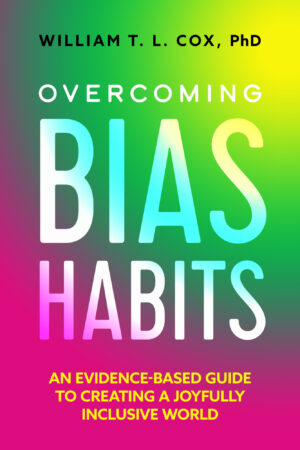
To help everyone to take up this work and make real change, I distilled over twenty years of research and practice into a book, Overcoming Bias Habits: An Evidence-Based Guide to Creating a Joyfully Inclusive World, a concrete guide that anyone can use to continue doing the work, even when our organizations fail us. We can create meaningful change without them.
About the Author

is an award-winning scientist-practitioner with more than twenty years' experience testing bias-reduction methods. He is an affiliate of UW-Madison, founder and CEO of the nonprofit Inequity Agents of Change, cohost of the Diverse Joy podcast, and author of Overcoming Bias Habits: An Evidence-Based Guide to Creating a Joyfully Inclusive World.