“A Reed’s Width of Water”: Urbanization and Migration between Japan and Korea
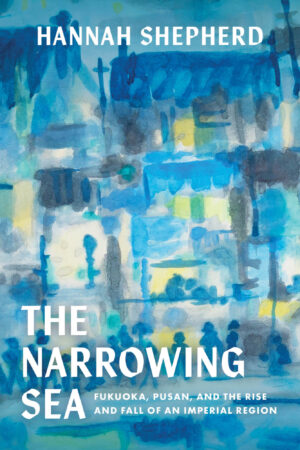
by Hannah Shepherd, author of The Narrowing Sea: Fukuoka, Pusan, and the Rise and Fall of an Imperial Region
Back in 2024, as I was revising my book manuscript, my colleague sent along an article he thought would interest me. The Japanese newspaper the Asahi Shinbun announced the “shocking prediction” by economists that “in 100 years, only Tokyo and Fukuoka will still be prosperous cities.” To me, it didn’t seem that shocking: the lively and well-connected port city of Fukuoka, on the southwestern island of Kyushu, has been a bright spot for many years in the face of Japan’s decreasing provincial urban populations. In their 2024 paper, the economists predicted that, a century from now, Japan’s population would have shrunk to 30 million - around that of the Edo period (1601-1868) - and its urban “center of gravity” would have shifted west: towards Fukuoka, and towards the Asian continent. Although the pessimism may be new, as my book shows, visions of Japan’s urban growth reorienting towards Asia are not.
The Narrowing Sea: Fukuoka, Pusan, and the Rise and Fall of an Imperial Region looks at the history of urban growth between Japan and Korea, from 1876, when Korea’s ports were opened to trade with Japan, through the end of Japan’s empire in 1945, up to 1953, when the Korean War ended in a ceasefire. It offers a new lens through which to view both Japan’s imperial expansion into Asia, especially Korea, and the nature of this empire’s urban growth, which saw regions knitted together via migration, infrastructural expansion, and war.
The project began first as a desire to understand what I saw as a missing piece in the representation of Fukuoka’s modern history in its heritage institutions, which otherwise emphasized the triangular relationship between Fukuoka, Japan, and continental Asia as crucial for the city and region’s historical development. What impact did Japan’s late 19th and early 20th century expansion into Asia, especially the colonization of Korea, have on this city at the western edge of the Japanese archipelago, closer to Seoul than Tokyo?
The scope of my research expanded as I followed the historical sources: I kept finding references to another port city: Pusan, across the maritime border of the Tsushima Strait, on the southeastern coast of Korea. I soon realized that writing a modern history of Fukuoka would be an impossible task without widening my lens. Just as maps of the expanding Japanese empire shifted westward, and moved Fukuoka from periphery to center, this widening of my focus across the straits made possible an account of Japanese empire that spanned the border between Japan and its closest colony, Korea, and began and ended beyond the dates of formal colonial control.
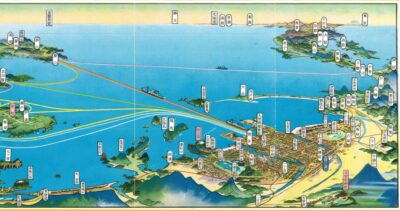
Ironically, this widening of my framework brought to light impulses and visions that attempted the opposite - captured in the book’s title. The Narrowing Sea refers to the dynamics and processes of urbanization as they spread beyond the limits of a single city. In the case of Fukuoka and Pusan these included material changes and connections – new, faster networks of travel and communication, land reclamation along the facing coastlines, exploitation of fisheries that fed growing urban populations. But they also included rhetorical representations of diminishing distance that narrowed the seas, brought the opposite shore closer, and constantly reminded people that the two cities were separated “only by a reed’s width of water”. This rhetoric is conveyed clearly in a 1936 bird’s eye view image from a regional shipping company’s brochure. Painted by artist Yoshida Hatsusaburō, the viewer’s gaze is directed outward towards empire, just as Fukuoka is depicted facing west too. The foreshortened perspective narrows the body of water separating Fukuoka from Pusan and the Asian continent to a thin stretch of calm water, which ships traverse seamlessly.
But alongside these top-down visions and infrastructural links were the many movements of ordinary people which form the other half of the story in The Narrowing Sea – the lived reality of the settlers, immigrants, refugees, forced laborers, stowaways and trafficked people, across the straits and into the growing urban areas on both sides of the imperial border. I chose one such representation of the reality of their lives, and the impact of their movements on the two cities for the book’s cover. P’anjach’on by Yang Dalsuk (1908-1984) is an image of Pusan’s shanty towns. The piece was painted in 1950, after the outbreak of the Korean War and the influx of refugees into the city. Pusan was the furthest south one could flee without stowing away on a trafficker’s boat to cross the Cold War border and reach the shores of southwestern Japan. Yang’s own life had spanned this border– he had studied at art school in Japan before returning to Pusan in 1937.
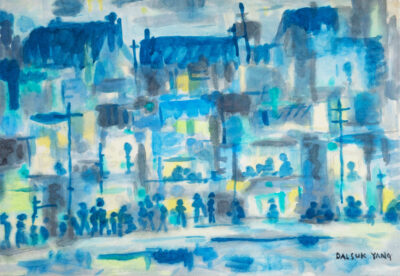
Unlike other dehumanizing descriptions by foreign journalists at the time, Yang’s watercolor work uses the warm glow of lights to illuminate the silhouettes of the shantytown inhabitants, going about their life against the backdrop of ramshackle houses rising up the slopes of the city’s hillsides, reflected in the waters of Pusan harbor. The unplanned movements of people shaped the nature of urban growth across this region as much if not more than the visions of planners and local boosters, and vestiges of them are still visible in the urban landscape today.
I hope this book has something to offer several different readerships. Firstly, for students and historians of Japan and its empire, especially those interested in urban and migration history, my book shows how Japan’s, as well as Korea’s urban growth was shaped by imperial expansion and war. For students and historians of imperialism more broadly, I offer the scale of the imperial region as a way to disaggregate studies of empire and connect to longer temporalities both before and after empire. I see lots of fruitful connections to be made between the case of Pusan and Fukuoka and cities across the Mediterranean, with Liverpool and Ireland, Miami and Havana, and so on. Finally for students of contemporary urbanization, I argue that the new scales allowed by imperial expansion are a way to connect the industrialization and urbanization of the 19th century with what urban theorists refer to as the “planetary urbanization” of today. As for any predictions of Japan’s urban future, although it may well shift west again, perhaps it’s best to remember how much of the urban growth that shaped this region in the past was unplanned and unforeseen.