University of California Press

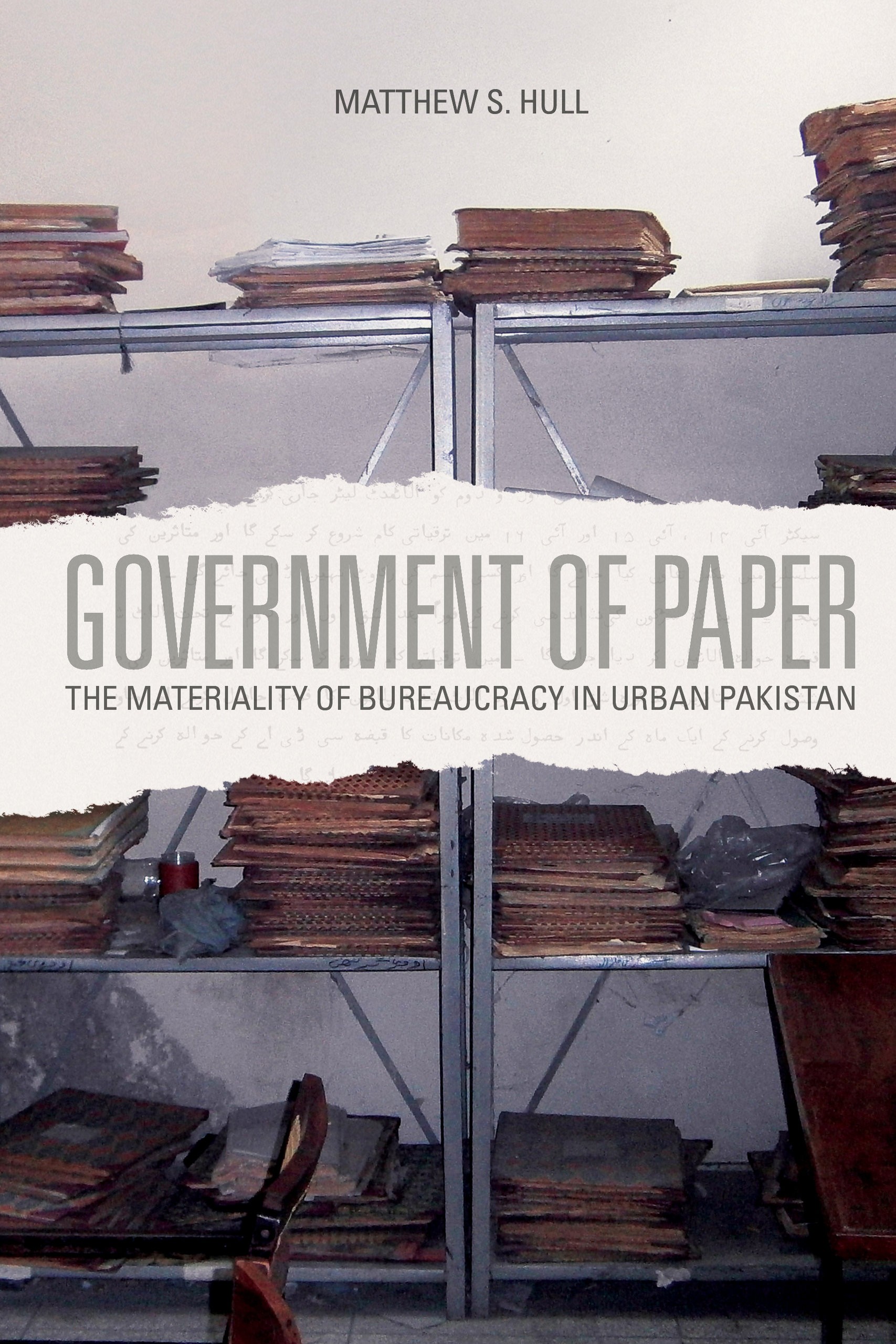
Government of Paper

The Materiality of Bureaucracy in Urban Pakistan

by Matthew S. Hull (Author)
Price: $29.95 / £25.00
Publication Date: Jun 2012
Edition: 1st Edition
Title Details:
Rights: World
Pages: 320
ISBN: 9780520272156
Trim Size: 6 x 9
Illustrations: 24 b/w photographs, 6 line illustrations, 1 map, 1 table

About the Book

In the electronic age, documents appear to have escaped their paper confinement. But we are still surrounded by flows of paper with enormous consequences. In the planned city of Islamabad, order and disorder are produced through the ceaseless inscription and circulation of millions of paper artifacts among bureaucrats, politicians, property owners, villagers, imams (prayer leaders), businessmen, and builders. What are the implications of such a thorough paper mediation of relationships among people, things, places, and purposes? Government of Paper explores this question in the routine yet unpredictable realm of the Pakistani urban bureaucracy, showing how the material forms of postcolonial bureaucratic documentation produce a distinctive political economy of paper that shapes how the city is constructed, regulated, and inhabited. Files, maps, petitions, and visiting cards constitute the enduring material infrastructure of more ephemeral classifications, laws, and institutional organizations. Matthew S. Hull develops a fresh approach to state governance as a material practice, explaining why writing practices designed during the colonial era to isolate the government from society have become a means of participation in it.

About the Author

Matthew S. Hull is Associate Professor in the Department of Anthropology at the University of Michigan. His research focuses on the nexus of representation, technology, and institutions. 

From Our Blog

Award Winning UC Press Authors at AAA

This post is published in conjunction with the American Anthropological Association conference in Vancouver, Canada. Check for other posts from the conference. #AAACASCAThe American Anthropological Association and Canadian Anthropological Association 2019 meeting is about to be underway. As is c
Read More

Table of Contents

LIST OF ILLUSTRATIONS
PREFACE
ACKNOWLEDGMENTS
INTRODUCTION

Writing of the Bureaucracy
Signs of Paper
Associations of Paper
Background of the Study

1. THE MASTER PLAN AND OTHER DOCUMENTS
Splendid Isolation
The Dynapolis and the Colonial City
Communities of All Classes and Categories
From Separation to Participation

2. PARCHIS, PETITIONS AND OFFICES
At Home in the Office
Parchis, Connections, and Recognition
Petitions: Citizens, Bureaucrats, and Supplicants
Parchis, Petitions, and Influence

3. FILES AND THE POLITICAL ECONOMY OF PAPER
The Materiality Cases
Individual Writers and Corporate Authority
Tactics of Irresponsibility and the Byproduct of the Collective
Particular Projects and Collective Agency
A Contest of Graphic Genres

4. THE EXPROPRIATION OF LAND AND THE MISAPPROPRIATION OF LISTS
Problematics of Reference and Materiality
Early Planning and Failed Opposition
Shifting Houses and Dummy Houses
Demolition Certificates
Package Deals and Individual Signatures
Loose Lists
Mediating like a State

5. MAPS, MOSQUES, AND MASLAKS
A Mosque for Every Community
A Mosque for Every Maslak
Claims on the Map
Temporality of Maps and Islamic Adverse Possession
Squatting according to Plan

CONCLUSION: PARTICIPATORY BUREAUCRACY
NOTES
REFERENCES
INDEX

Reviews

"Government of Paper . . . provides a rich apparatus for observing and analyzing the people and activities of bureaucracy in detail. Hull combines linguistic and sociocultural anthropology, in order to closely read details such as arrangements of persons during audiences in offices, the use of specific verb forms by persons according to goal and rank, and so forth. Scholars who work in many settings will profit from careful study of his evidence and interpretation."
Anthropological Quarterly
"Matthew Hull's much anticipated book on the semiotic technology undergirding Pakistan's bureaucratic state does not disappoint. This is a comprehensive ethnographic portrait of the working of the documentary practices that are central to modern governance, based on many years of close observation in Islamabad's Capital Development Authority (CDA) and keen attention to the material and linguistic details of highly complex processes. . . . An important addition to the recent boom in ethnographies of bureaucracy, and his analytic care and precision make it a text that all students of government will have to contend with." 
Political and Legal Anthropology Review
"Hull’s book is a landmark ethnography of Pakistani society and should serve as a touchstone for future social research on Pakistan and South Asia. It is a welcome addition to a growing body of fieldwork-based scholarship that works against the grain of reductionist and essentialist representations of Pakistan as a problem to be fixed and, instead, treats its subject, the Pakistani government and people, with attention, care, and respect."
South Asia Multidisciplinary Academic Journal
"An elegantly composed and rigorously argued ethnography."
HAU: Journal of Ethnographic Theory
"Provides a fascinating insight into recordkeeping practices of the CDA and is a powerful statement about understanding the context in which records are created and used."
Archives and Manuscripts
“A must read.”
Dawn.com
“Drawing inspiration from actor-network theory, science studies, and semiotics, this brilliant book makes us completely rethink the workings of bureaucracy as analyzed by Max Weber and James Scott. Matthew Hull demonstrates convincingly how the materiality of signs truly matters for understanding the projects of ‘the state.’” - Katherine Verdery, author of What was Socialism, and What Comes Next?

“We are used to studies of roads and rails as central material infrastructure for the making of modern states. But what of records, the reams and reams of paper that inscribe the state-in-making? This brilliant book inquires into the materiality of information in colonial and postcolonial Pakistan. This is a work of signal importance for our understanding of the everyday graphic artifacts of authority.” - Bill Maurer, author of Mutual Life, Limited: Islamic Banking, Alternative Currencies, Lateral Reason

"This is an excellent and truly exceptional ethnography. Hull presents a theoretically sophisticated and empirically rich reading that will be an invaluable resource to scholars in the field of Anthropology and South Asian studies. The author’s focus on bureaucracy, “corruption," writing systems and urban studies (Islamabad) in a post-colonial context makes for a unique ethnographic engagement with contemporary Pakistan. In addition, Hull’s study is a refreshing voice that breaks the mold of current representation of Pakistan through the security studies paradigm." - Kamran Asdar Ali, Director, South Asia Institute, University of Texas


Awards

  • J. I. Staley Prize 2019, School for Advanced Research