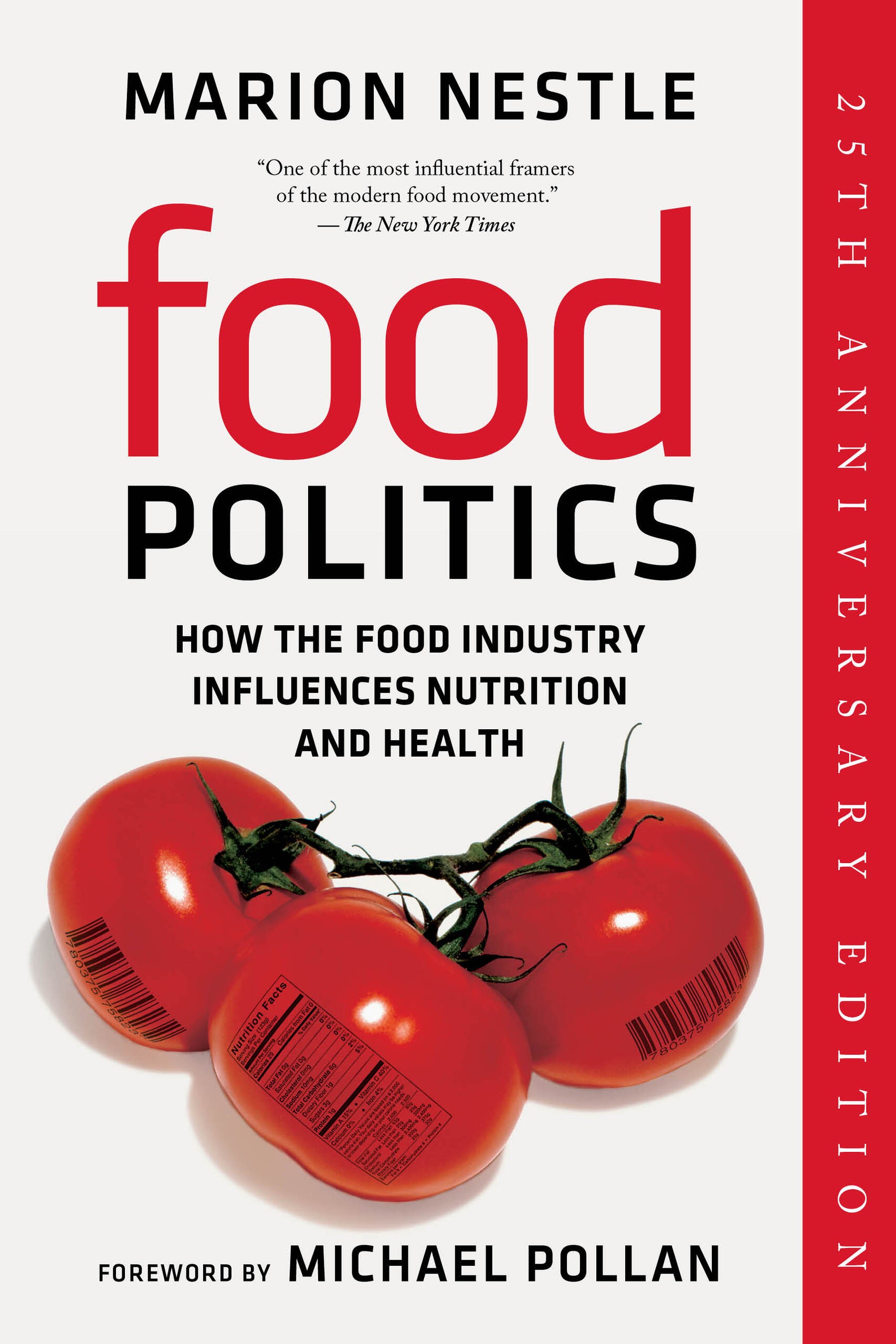
Food Politics
About the Author
Table of Contents
CONTENTS
Foreword by Michael Pollan
Preface to the Twenty-Fifth Anniversary Edition
Preface to the First Edition
Introduction: The Food Industry and “Eat More”
PART ONE
UNDERMINING DIETARY ADVICE
1. From “Eat More” to “Eat Less,” 1900–1990
2. Politics versus Science: Opposing the Food Pyramid, 1991–1992
3. “Deconstructing” Dietary Advice
PART TWO
WORKING THE SYSTEM
4. Influencing Government: Food Lobbies and Lobbyists
5. Co-opting Nutrition Professionals
6. Winning Friends, Disarming Critics
7. Playing Hardball: Legal and Not
PART THREE
EXPLOITING KIDS, CORRUPTING SCHOOLS
8. Starting Early: Underage Consumers
9. Pushing Soft Drinks: “Pouring Rights”
PART FOUR
DEREGULATING DIETARY SUPPLEMENTS
10. Science versus Supplements: “A Gulf of Mutual Incomprehension”
11. Making Health Claims Legal: The Supplement Industry’s War with the FDA
12. Deregulation and Its Consequences
PART FIVE
INVENTING TECHNO-FOODS
13. Go Forth and Fortify
14. Beyond Fortification: Making Foods Functional
15. Selling the Ultimate Techno-Food: Olestra
Conclusion: The Politics of Food Choice
Afterword: Food Politics: Twenty-Five Years Later and Onward
Appendix: Issues in Nutrition and Nutrition Research
Notes
List of Tables
List of Figures
Index
Reviews
— New York Times"Combining the scientific background of a researcher and the skills of a teacher, [Nestle] has made a complex subject easy to understand."
— Toronto Globe & Mail“The ironically named Nestle does for the entire food industry what Eric Schlosser did for fast food in Fast Food Nation—a scathing and sometimes shocking expose of an industry we have taken for granted. This award-winning book looks at how the sheer volume of food available in North America has created questionable marketing practices, to say the least.”
— American Prospect“A solid, important treatise. Taking the health effects as given, it details how food companies undermine public health and infiltrate institutions that are sworn to protect it. If, after Marxism’s demise, you need evidence of the pervasive complicity of government in the amassing of wealth by a few to the detriment of the many, look no further.”
— Women's Review of Books“Nestle’s meticulous, nuanced account traces the connections between North America’s immense agricultural surpluses, industrial foods like infant formula and Hamburger Helper, the supersizing of fast foods, and declines in public health.”
— Bloomsbury Review“In a country that is being targeted by a food industry that will make and market any product that sells, even to children, regardless of its nutritional value or its effect on health, Food Politics is required reading.”
— Sun-Sentinel“Nestle is simply one of the nation’s smartest and most influential authorities on nutrition and food policy.”
— Seattle Weekly“Nestle covers more ground, wields greater authority, and has concrete, tough-minded recommendations for change.”
— American Journal of Clinical Nutrition"Food Politics is a book that deserves to change national and international attitudes, as Carson's Silent Spring did in the 1960s."
— Library Journal"Nestle berates the food companies for going to great lengths to protect what she calls "techno-foods" by confusing the public regarding distinctions among foods, supplements, and drugs, thus making it difficult for federal regulators to guard the public. She urges readers to inform themselves, choose foods wisely, demand ethical behavior and scientific honesty, and promote better cooperation among industry and government. This provocative work will cause quite a stir in food industry circles. Highly recommended."
— Health Education & Behavior"In her exquisitely researched book, Nestle details how the food industry’s tendrils have reached into every aspect of nutritionists’ work and are suffocating its public health goals. Food Politics provides rich case studies of how the industry infiltrates nutrition departments at universities and federal agencies and intermingles unabashedly with the U.S. Department of Agriculture (USDA)."
— Food Anthropology"In the tradition of Upton Sinclair, Eric Schlosser and Michael Pollan, Nestle exposes the dark side of food. A life-giving substance, food can kill us, and Nestle never loses sight of the seriousness of this issue throughout the text."
— Technology and Culture“Food Politics is a well-researched, thoughtful, and angry book. Nestle is most eloquent in her analyses of the relationship between government and industry. . . . An invaluable addition to the literature.”
— San Francisco Chronicle“Nestle's first book, ‘Food Politics’ (The University of California Press, 2002, $39.95 hardcover, $19.95 paper), put her on the map by documenting precisely how the food industry influences what we eat and government food policy.
After it came out, she was invited by the World Health Organization to a meeting with food company executives in Geneva.
They said, ‘You don't have to do anything except sit there. Your presence in the room will tell them we mean business,' ‘ she says.
Her new book, ‘What to Eat’ (due out May 2, North Point Press, $30) starts with a question that never used to be so hard to answer: What are we supposed to be eating?”
— Beaumont Enterprise“Put her on the map by documenting precisely how the food industry influences what we eat and the government food policy.”
— New England Journal Of Medicine“Hard-hitting, revealing. . . . Challenges us to consider the political environment in which the science of food and nutrition exists.”
— Science Magazine“Essential reading for anyone seriously interested in addressing the nutritional dilemma facing the United States."
— Julia Child"A courageous and masterful exposé."
— The Economist"Provocative and highly readable."
— The Nation"An excellent introduction to how decisions are made in Washington—and their effects on consumers."
— Los Angeles Times“Thought-provoking. . . . Voting with our forks for a healthier society, Nestle shows us, is wihtin out power.”
— New York Times“Examines... the industry's manipulation of America's eating habits while enumerating many conflicts of interest among nutritional author-ities.... A telling book.... It's hard to argue with Dr. Nestle's point that food is above all political.”
— San Francisco Chronicle“In her widely acclaimed book, Nestle explains why the wealthiest nation in the world is eating itself to death. Based on meticulous research, Nestle's book exposes how the naked self-interest of the American corporate food industry compromises nutrition policy, as well as our government's regulation of food safety.”
"This remarkable book is essential reading for anyone who wishes to understand how it has come to be that the richest nation in the world is eating itself to death. . . . Straight reporting about the shaping of food policy, as this volume makes clear, is certain to offend some very powerful players."—Joan Dye Gussow, author of This Organic Life
"Food politics underlie all politics in the United States. There is no industry more important to Americans, more fundamentally linked to our well-being and the future well-being of our children. Nestle reveals how corporate control of the nation's food system limits our choices and threatens our health. If you eat, you should read this book."—Eric Schlosser, author of Fast Food Nation
"'Blockbuster' is one of the best ways that I could describe this book. . . . A major contribution to understanding the interaction of politics and science, especially the science of nutrition, it is of extreme value to virtually all policy makers and to everyone concerned with the American diet."—Sheldon Margen, editor of the Berkeley Wellness Letter
"A devastating analysis of how the naked self-interest of America's largest industry influences and compromises nutrition policy and government regulation of food safety. . . . A clear translation of often obscure studies and cases, the writing is accessible and lively."—Warren Belasco, author of Appetite for Change
Awards
- Award for Excellence in Professional / Scholarly Publishing 2003, Association of University Presses (AUP)
- Edinburgh Medal 2023, Edinburgh Science Foundation
- International Association of Culinary Professionals Trailblazer Award 2018, International Association of Culinary Professional
- IACP Cookbook Award Finalist, International Association of Culinary Professionals
- James Beard Award for Literary Writing About Food, Wine & Spirits 2023, James Beard Foundation
- Harry Chapin Media Award 2003, World Hunger Year